The Intolerant Left? Labour’s Anti-Semitism Problem

On March 26th, hundreds of people, including Labour MPs, protested against anti-semitism within the Labour Party and the handling of anti-semitism by leader Jeremy Corbyn. However, this protest is just the most recent in a history of allegations of anti-semitism and an avoidance of addressing this issue within the Labour Party.

Historically the Labour Party was seen as the political party most supported by British Jews, however in from the 1980s onwards this idea changed as the Labour Party’s views were seen as becoming anti-semitic. Dave Rich, who studies anti-semitism in the Labour Party, suggests that anti-semitic ideas grew from the change in attitude to Israel and Zionism which began in the 1980s. The pro-Palestine cause gained strength and support from the youth members of the party, and was then embraced as a stance of the Labour Party. However, it is not until the past five years that anti-semitic views have been brought to the foreground and publicly challenged by party members.
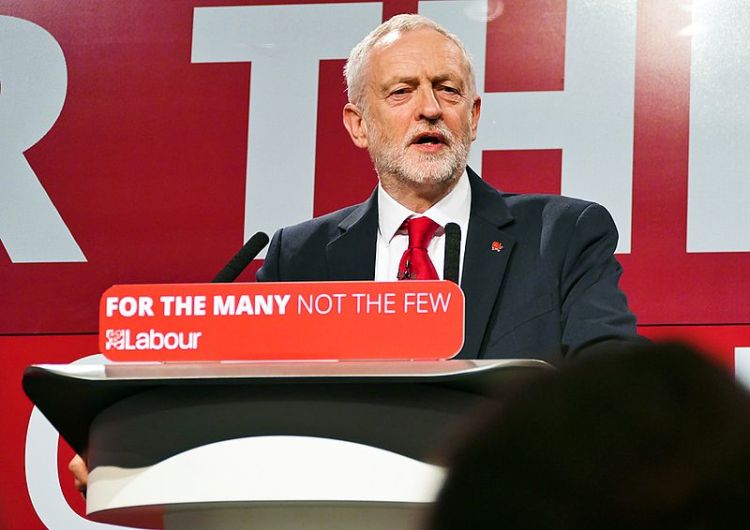
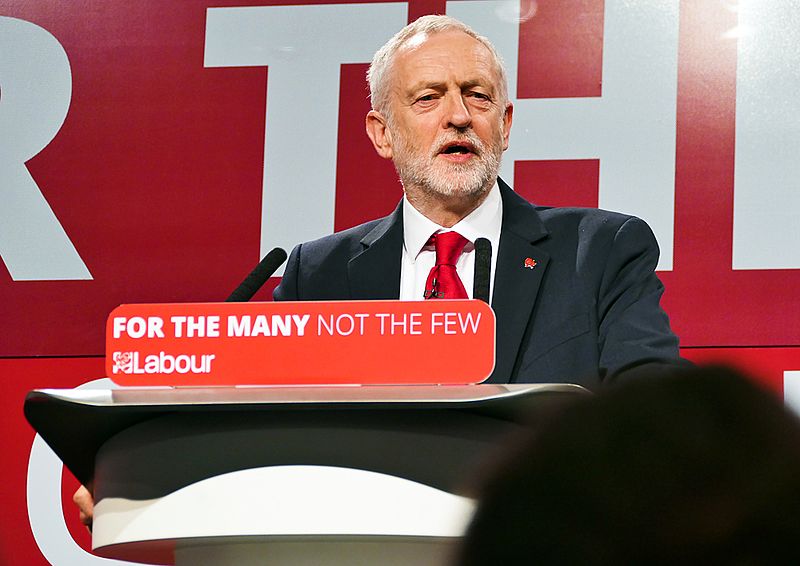
Jeremy Corbyn at the Labour Party General Election Launch 2017. Source: Wikimedia Commons, Sophie Brown.

In 2016, two prominent Labour party members were suspended over claims of anti-semitism. In April, Naz Shah MP was suspended over Facebook posts from 2014, and the former Mayor of London, Ken Livingstone, was suspended in the same month for a radio interview in which he said Adolf Hitler “was supporting Zionism before he went mad and ended up killing 6 million Jews”. Whilst Shah was reinstated as an MP later in the year, Livingstone’s suspension is indefinite and it seems unlikely that he will be reinstated. In both instances, anti-semitism was claimed over statements referring to Israel and Zionism, issues which are often brought up in the Labour Party. Naz Shah is not the only member of the Labour Party whose suspension was lifted; at least 10 local councillors or candidates for a local council seat have had their anti-semitism linked suspension lifted. In England, the local government elections will be held on May 3rd, and it is likely that formally suspended members of the Labour Party will be elected for local council seats.

In response to pressure from within the party, Corbyn called for the Chakrabarti Inquiry, which has investigated the allegations of anti-semitism within the Labour Party. The investigation resulted in a number of recommendations for the party and ultimately came to the conclusion that although the party was not “overrun by anti-semitism”, there was an “occasionally toxic atmosphere” and “clear evidence of ignorant attitudes”. However, there have been doubts about the authenticity of this inquiry as Shami Chakrabarti, the barrister who carried out the inquiry, became a Labour Party member in May 2016, and was the only Labour appointment to the House of Lords in July 2016. Despite the Chakrabarti Inquiry, there has continued to be anti-semitism allegations throughout the party, and the response from Labour is yet to improve. Furthermore, many of the accused members have stated that they believe the accusations of anti-semitism to be an attempt to dissuade or distract from the issues raised by the Labour Party regarding Israel and Palestine. Others have said that they consider the allegations to be an attack on Corbyn and his known socialist beliefs.

One of the most divisive issues with this issue has been the lack of action by Corbyn and the Labour Party. This can be seen in the suspension, and subsequent lifting of suspension, for many of the party members accused of holding anti-semitic beliefs. Despite Corbyn repeated stating that there is no place for anti-semitism or racism within the Labour Party, many Jewish campaigners see this as merely a statement, with no identifiable actions to stop it. Momentum, the grassroots organisation set up in 2015 to support Corbyn, released a statement on social media about their thoughts and solutions to the anti-semitism problem. They state that anti-semitism accusations should not be considered as ‘right-wing smears’, and that these views are part of an ‘unconscious bias which manifests itself in varied, nuanced and subtle ways and is more widespread in the Labour Party’. This statement is the most comprehensive given by an organisation associated with the Labour Party – neither Corbyn nor the party itself have given a statement which contains a clear thought-out solution to the anti-semitic views found within the party.

The anti-semitism allegations are frequently linked to views about Israel which brings to attention the issues between being anti-Israel or anti-Zionism, and how these beliefs are connected to anti-semitism. However, the line between anti-semitism and anti-Zionism is clearly defined and those in the Labour Party should be especially aware of this. It is becoming increasingly obvious that anti-semitic views are becoming part of political parties across Europe. In the past year, nationalist parties such as National Front in France, Golden Dawn in Greece, and many more have gained further support – increasing the publicity of their far-right beliefs. Anti-semitism should always be challenged, and especially so in politics.

These cases focus on evidence from past Facebook posts and activity – which raises the validity and ethic of using past statements as evidence of present wrongdoing. Many of the accused in the Labour Party have claimed that since the anti-semitic posts were written or shared that their views have changed. However, these statements of changed views can also easily be understood as an easy way to deny allegations of anti-semitism. It is also important to consider the separation between private and public political views, and to what extent private views can be taken as representative of that individual as a representative of a political party.

It is hard to know how recognised the issue of anti-semitic beliefs s within the Labour Party are, but it is clear that there is an issue within the party of how to deal with these allegations and the situation. The Momentum statement has set out foundation guidelines for how the Labour Party must move forward and quash anti-semitism within the party. The most significant being the implication of a programme of political education and awareness training for all members of the party. Undoubtedly, this issue can only be tackled from inside the party, and Corbyn must take a hard line with those found expressing anti-semitic views.
Review: “Hope to Nope: Graphics and Politics 2008-18” at the Design Museum, London

What can we learn about graphics, politics and human rights?

Political graphics have long been attached to British and overseas politics, from early twentieth-century suffragette banners to the placards featured in last month’s Campaign Against Anti-Semitism protests at the Labour Party HQ in London. However, whilst they have traditionally been associated with states, corporations and official campaigns, recent years have witnessed the increased ability of the individual to produce and spread such material, notably through social media platforms such as Facebook, Twitter and Instagram. With their prominence amplified by the politically turbulent nature of the past decade, which has seen sub-state terrorism in the West, the rise of populism and worldwide protest movements, political graphics now feature centrally in our lives. In present-day political campaigning and activism, for example, they seem to overshadow knock-on-door techniques and the use of the podium. It is in such a context that an understanding of this phenomenon is particularly important.

Flanked by Shepard Fairey’s “Hope” poster for Barack Obama’s 2008 US presidential campaign and the corresponding Donald Trump “Nope” meme spinoff, the past decade’s political graphics form the subject of the Design Museum’s most recent exhibition “Hope to Nope: Graphics and Politics 2008-18”. The exhibition contains an extensive array of designs, featured on, for example, posters, banknotes, flags, hats and beermats, as well as in the form of memes and videos. Split into three sections (“Power”, “Protest”, and “Personality”), the museum’s basement gallery has been transformed into an urban setting, within which the varying roles of graphics in politics are explored. When considered in relation to human rights, these can be positive. Yet, in some cases they can also be damaging or obstructive.

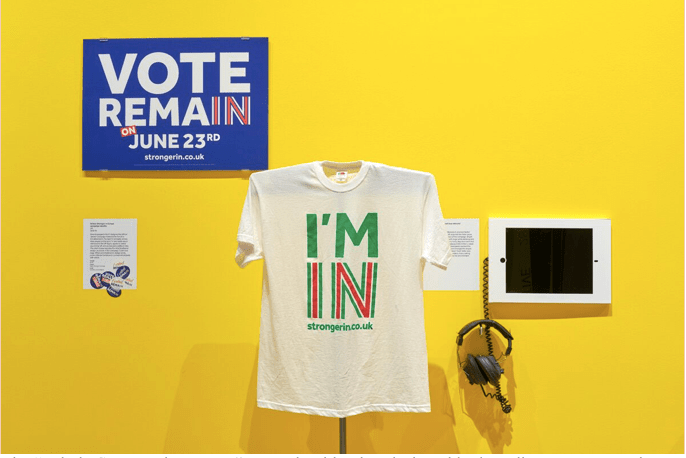
The “Britain Stronger in Europe” campaign identity, designed by branding experts North. Credit: Benjamin Westoby.

Political graphics can serve as powerful tools to assert or subvert power, a theme which is explored in the first room within the exhibition. One such featured example is the 2015 short, animated video “The European Refugee Crisis and Syria Explained”, produced by German YouTube channel and design studio Kurzgesagt – In a Nutshell. Alongside an explanation of the Syria-related causes of the European refugee crisis, the video’s creators promote states’ acceptance of refugees through challenging conservative concerns about Islam, high birth-rates, crime and the collapse of social systems. It is of no surprise that by April 2018, this video had been viewed an impressive 12.1 million times on YouTube. Indeed, the animation is bright and striking, whilst the accompanying verbal narrative is well-structured and clear.

This part of the exhibition also addresses the impact of social media platforms, from which political graphics, such as memes and gifs, can be projected to billions of people around the world. In some ways, these can be understood as democratic instruments: they facilitate access to content for greater numbers of people. As part of the 2017 #MeToo movement, for example, experiences of sexual harassment were shared by 4.7 million people in 12 million Facebook posts on a single day. Nevertheless, social media platforms can also be representative of agents of misinformation. In 2017, it was disclosed that, during the US presidential election of the previous year, an estimated 126 million American people had come into contact with 80,000 posts allegedly produced by 120 fake Russian-backed pages. The exhibition’s curators have reportedly expressed a desire to add additional images of a Russian troll farm, which allegedly produces memes on a mass scale, to this part of the showing.

The subsequent section of the exhibition explores the way in which political graphics are used in public protests to incite change from below, often in relation to basic human rights. Six screens composing the striking “Hope to Nope” film installation stand in one corner of this area. Designed and produced by London-based designer Paul Plowman, this bold piece focuses on five recent public protests: The Women’s March (worldwide), the Grenfell Tower protests (the United Kingdom), the Catalan independence protests (Spain), the Gezi Park protests (Turkey) and the Jacob Zuma protests (South Africa). Featuring social media hashtags and messages, footage and images, it grants the viewer insight into the diverse ways people protest and the variety of emotions on show as such activity takes place.

The “Hope to Nope” film installation, designed and produced by Paul Plowman. Credit: Edward Beales.

From the examples on display in this room, it is clear that many political graphics used in public protests are consciously crafted with social media in mind. For example, English is often included in designs in non-English speaking countries, in what is likely an effort to broaden global support for advocated causes. Another interesting phenomenon is the use of political graphics in more passive forms of public protest, such as the Occupy George movement. In this case, red infographics have been marked on to bank notes, which have then been returned to circulation. The infographics raise various issues, such as rising income inequality, as part of a wider effort to highlight the dominance over world wealth by the richest “1%”.

In the last room of the exhibition, the ways in which political graphics can positively and negatively shape public perceptions of prominent politicians are examined. Jeremy Corbyn, who faced much criticism from the British media after being elected as UK Labour party leader, saw his image somewhat revitalised both in the run up to and after the 2017 general election. Indeed, Corbyn-themed merchandise (including the Nike swoosh Corbyn T-shirt, the Jeremoji range of emojis, The Corbyn Comic Book and the CorbynRun computer game, proved to be youth and social media-friendly. The ensuing wave of support for Corbyn should be attributed in part to such clever designs.

The Nike swoosh Corbyn T-shirt, designed by Bristol Streetwear. Credit: Benjamin Westoby.

Nonetheless, political graphics can also help to shape the culture of “fake news” surrounding certain leaders. In 2017, The Washington Post disclosed that a TIME magazine cover, on show in a number of Donald Trump’s golf clubs and featuring the man himself, had been forged. In spite of Trump’s assertions that he is in a “running war” with the media, this scheme seems to represent an acknowledgement of the power of political graphics in the media, as well as an effort to promote Trump as a more prominent figure than he already is. It is a prime example of the way in which political graphics can manipulate leaders’ images to build or change their identities.

Magazine cover caricatures of Donald Trump. Credit: Benjamin Westoby.

In an interview with The London Evening Standard, Design Museum curator Margaret Cubbage states that although the exhibition’s title “could be interpreted as negative”, she thinks that “‘hope’ is obviously optimistic and ‘nope’ is actually more active and is a word that is used to resist or take change.” In light of this, she expresses a personal desire for people to feel “[e]mpowered and aware” upon leaving this exhibition. Furthermore, besides the persisting idea that the Internet is facilitating the ability of ordinary people to create and engage with visual images, the special attention drawn here to the democratic, but also divisive and destabilising, powers of political graphics should be emphasised.

“Hope to Nope: Graphics and Politics 2008-18” is on display at London’s Design Museum between 28 March and 12 August 2018.

Life in Limbo: Yazidi Tales of Refugee Life in Northern Iraq

Khalaf Dakheel is a 17-year old Yazidi refugee and journalist living in a camp in Iraqi Kurdistan. A writer for the National Discourse with his work having featured in the Jerusalem Post, he often reports on conditions within the camp and life for its Yazidi residents. I spoke to him about his work and hopes for the future.

UK coverage of what has happened to the Yazidis is limited. What can you tell us about your community?

The Yazidis are one of the most ancient religious groups in the world. Yazidi people have always been peaceful and non-aggressive. We believe in God (Xude), Tawsi Melek (the Peacock angel), and humanity. The holiest place for the Yazidis is Lalish, in Iraqi Kurdistan. Every year, Yazidis go to Lalish and pray.

It has been estimated that 23 million Yazidis have been killed over the past seven hundred years, and the Yazidi population continues to decrease. Just two hundred years ago there were two million Yazidis, but it is now estimated to be less than one million worldwide.

More recently, in 2014, the Yazidis were attacked by ISIS. Yazidi homes, families, and 250 villages were permanently destroyed. Five thousand Yazidi men were murdered, and at least seven thousand Yazidi girls and women were kidnapped and sold into sexual slavery.

Previous to these attacks by ISIS, in August 2007, four trucks filled with explosives were driven into two Yazidi towns. Five hundred Yazidis lost their lives in the attack, another two hundred were gravely injured and 200 children became orphans.

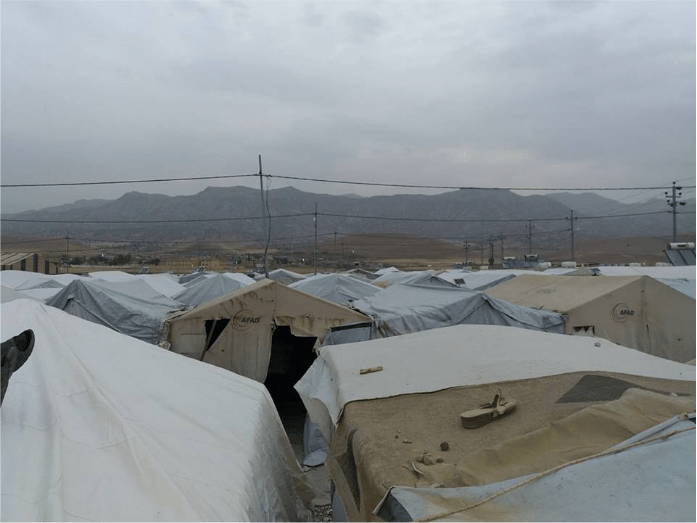
Bersive Camp, Iraqi Kurdistan. Credit: Khalaf Dakheel.

How did you get into journalism, living in a refugee camp?

After all these massacres have happened to the Yazidis, after thousands of Yazidi women and girls have been taken as sex slaves, after thousands of innocent Yazidi men have been killed and after living in IDPs and refugees camps for more than 3 years, most of the world still hasn’t heard about what has happened and what is still happening. I decided to be a journalist to tell the world how the Yazidis have been suffering and how we have been living in terrible conditions, and to also show the world what happened to our innocent girls abducted by ISIS.

I was contacted online by a writer for the National Discourse after seeing him write about the Yazidis. They were looking for another writer, so I accepted and have written two articles so far. They pay me $20 for each article so I can support my family, but it is difficult for me as I have never taken an English or Journalism course before. I think I will be forced to stop my work if I cannot go to school.

What is daily life in the camp like?

Life has been very difficult for the Yazidis in refugees camps. People have been forced to give up their jobs, and we are tired of living in the camps. We have electricity for about 7 hours everyday, The rest of the time people need to use candles and build little fires, but it’s very dangerous. The tents are very flammable and rotted from the sun, so every few days a fire starts somewhere in the camp and innocent people are injured. When it rains, many of the tents are flooded.

The tents were not designed to be long-term homes. They do not have bathrooms or kitchens inside. They get really cold in the winter and get really hot in the summer. After a while, we started to make kitchens besides the tents because there was no place else to cook. The kitchens are made with nylon and catch on fire easily.

When we first arrived in the camp, there were two kindergartens for children but, after a year, they were closed. There is no place for children to play so they cry often.

The remains of a tent destroyed by fires in Bersive Camp. Credit: Khalaf Dakheel.

What do you hope to gain through sharing life in a refugee camp with the world?

I hope Western countries can do something to help such a poor and innocent community that has faced 74 genocides. I also hope Westerners help us, whether through aiding us in coming to Europe, America, Britain etc. or rebuilding Shingal so we can return. I also hope they can liberate and help those of our girls who have been sold, raped and tortured for almost 4 years to return to their families.

How has the genocide changed your aspirations for the future?

It changed us so much: most of us have been forced to give up our jobs as we always think of our people who are still missing. I cannot go to school as there isn’t one, and the education system is bad. If the situation doesn’t improve, I cannot see a future for myself. I want to be confident in English. I write English well but because I have never taken any courses, I cannot speak it very well. I just learned by myself and from talking with native speakers. I wish to be a journalist and a writer. My biggest dream is to finish my schooling in Britain, since I have not been to school for three years.

Thank you to Khalaf his time. More information on how to help the Yazidis can be found at Yazda.org.

Review: Symposium X Children in Conflict

St Andrews UNICEF On Campus held its fourth annual Symposium on Monday 9 April in conjunction with the On The Rocks Festival. The nearly sold out event was held in the Byre’s top floor loft, extending an intimate feel to the event. The evening kicked off at 5:00 pm with a drinks reception, followed by opening remarks by Symposium Convenor Tanera Scott.

Ms. Scott reflected on the year long preparation for Symposium 2018. She stated, “It was an extensive yet rewarding experience.” Furthermore, Ms. Scott touched on the aim of Symposium 2018, noting that “the goal is to raise both funds and awareness for students in need.” The 2018 theme of Children in Conflict engaged both the on campus community and the wider audience comprised of St Andrews locals, university staff, and parents. Ms. Scott concluded by stating, “children do not start wars but are the most vulnerable to them”.

Following Ms. Scott’s opening comments, moderator Michael Tyra, an International Relations graduate student, took over. He introduced the evenings four speakers: Laurie Druelle, Dr. Jaremey McMullin, Mark Ellison, and Daniel Cosgrove. Mr. Tyra noted that the discussion would be particularly interesting given the practitioner’s perspective brought into the evening by the night’s keynotes. Furthermore, he stated, “tonight there will be frank discussions about the international community’s strengths on this theme.” Before introducing the first speaker, Mr. Tyra noted, “there will hopefully be a dialogue with the entire room.” This set the tone for an immersive and insightful event.

Source: UNICEF St Andrews.

Symposium 2018’s first speaker was Ms. Druelle, a research and partnerships manager at HALO Trust. Headquartered just two hours south of Glasgow, they have operations in 19 countries and four territories. Their staff of over 8,000 is mainly comprised of locals with the goal of empowering communities. HALO Trust operates in post-conflict settings to remove landmines; Ms. Druelle believes this work is critical, as she stated, “children are the first impacted by war, even decades after conflict.” Children in these post-conflict settings not only have to live with the daily fear of stepping on landmines but also the psychological trauma of their parents.

Ms. Druelle highlighted several interesting cases of HALO Trust’s work, including Gangawama School in Northern Zimbabwe. Before HALO Trust cleared the land mines from this area students had to circumnavigate the minefield, making their daily school commute two hours each way. However, after the field was cleared, the students commute decreased to just 45 minutes each way.

Ms. Druelle shared another impactful example from Kapisa Province in Afghanistan. Unlike the children in Zimbabwe, young girls in this village had no option but to cross an active minefield everyday to collect water. Ms. Druelle explained that these girls were not only afraid of dying but also of becoming handicapped. Rural Afghanistan and other post-conflict settings do not have adequate resources for the disabled community.

The night’s second speaker was University of St Andrews International Relations lecturer Dr. Jaremey McMullin. Dr. McMullin’s research is centered on Sub-Saharan Africa and encompasses all ex-combattants, not just children. Dr. McMullin spent the month of January researching the commercial motorcyclist industry in Liberia. The industry was established by ex-combattants, although now is not solely dominated by them. Dr. McMullin raised interesting questions such as the tradeoffs between the reintegration of child ex-combattants and their protection. As far as the motorcyclists, he highlighted a common problem in reintegration programs. Many of the children recruited into conflicts are adults by the time that conflict draws to an end. This results not only in an education lapse but also makes it harder for these individuals to access resources and programs, so much so that many of the motorcyclists that Dr. McMullin interviewed in January received their extensive injuries not from the war but from their work in the dangerous motorcycling industry.

Dr. McMullin also discussed at length the problems with child rights architecture. While it does entail child ex-combattants to reintegration programs it lacks a concrete structure, guidance, and goals. This makes it nearly impossible for children to access these international resources. Dr. McMullin stated, “previous legal protections impede more than assist child centered assistance.” Dr. McMullin raised interesting points of view, and argued that children should have a say in the conditions of reintegration.

After a brief intermission, the night’s third speaker, photojournalist Mark Ellison took the podium. Mr. Ellison uses a variety of mediums besides photos to convey the reality of children living in conflict and post-conflict zones, including 360 degree video and interactive graphic novels. Mr. Ellison talked extensively about the Central African Republic (CAR), which he labelled as one of the worst countries to be a child in. CAR’s many problems, including a lengthy civil war, stem from misrule, developmental delays, and lack of access to health services.

Source: Flickr.

Mr. Ellison pointed out some staggering figures to make his point, 2.3 million people in CAR have been directly affected by the conflict and half of those individuals are children. Four years into the conflict a quarter of schools are still closed, only a third of students are enrolled, and many children still live in IDP camps–what Mr. Ellison labels “islands in an ocean of hate”.

Mr. Ellison called CAR “a house without windows” meaning that without media coverage the Western world is oblivious to the situation occurring within the nation. Mr. Ellison also noted that besides the derailed education system, health care would not exist if not for Doctors Without Borders, and malaria, malnutrition, and influenza are rampant. There is also an increasingly alarming number of street kids in the capital city, Mr. Ellison calls the conflict in CAR an “orphan factory”.

Mr. Ellison relayed that he uses graphic novels, photos, and interactive videos because it engages the wider public and prevents reader fatigue. He argues that any tool that results in education is worthwhile.

The evening’s final speaker was UNICEF UK officer Mr. Cosgrove, who works across Scotland with funding partners and donors. He opened his speech with a quote from Home by Warsan Shire:“You have to understand that no one puts their child in a boat unless the water is safer than the land.” Mr. Cosgrove followed that up by stating, “as conflict rumbles on people make longer journeys, spending more time away from healthcare, education, and permanent infrastructure”. Mr. Cosgrove cited statistics that took the entire audience aback:there are currently 22.5 million refugees globally, and half of those refugees come from Syria, Afghanistan, and South Sudan. Even more difficult for the audience to absorb was the fact that children comprise 11 million of the world’s refugees.

Mr. Cosgrove also highlighted the cluster approach, whereby each main area of humanitarianism is represented by leading NGOs. UNICEF oversees nutrition, WASH, and education. This involves tackling malnutrition, ensuring access to clean water, preventing the spread of cholera, and establishing adaptive education programs. UNICEF also tries to ensure child protection through the creation of child friendly spaces within IDP camps and providing individual and group counseling as well as psychotherapy to children in camps.

Lastly, Mr. Cosgrove discussed the emphasis that UNICEF places on innovation. UNICEF tries to adapt the ideas of young people on how to improve the current system. One example of this was the barter and time bank instituted by young people at an IDP camp. A carpenter could spend time helping to build a home and bank that time to use on other services, like a haircut. Mr. Cosgrove ended his remarks by stating, “children who flee conflict do not necessarily flee to safety, we can make effects of conflict softer.”

Following a short intermission, the panel discussion part of the evening commenced. Moderator Mr. Tyra asked a series of interesting questions such as: “Are the international communities current responses on track to keep up the with growing need, or are we falling short?” Mr. Cosgrove argued that funding is becoming harder to come by as a result of Western-states’ turn to the right and isolationism. He argued the solution was to be better with the resources we do have. Mr. Ellison echoed Mr. Cosgrove stating the biggest obstacle to overcome is funding. Meanwhile, Ms. Druelle believed that the international community could improve its responses by remaining in post-conflict areas longer. Finally, Dr. McMullin contended that there is a failure of learning at the institutional level and that NGOs and states need to work to combat wider problems within the international order.

There was a number of follow up questions and insightful responses from the speakers before the floor was opened up to questions from the audience. The ability to ask questions kept the event immersive and the audience engaged. Symposium 2018 was an interesting and thought-provoking event. For those who did not make it this year, look out for their fifth anniversary event in 2019.

Approaching Day Zero of Cape Town’s Water Crisis in the Aftermath of Apartheid

The South African Apartheid, which systematically separated the black and white populations–was officially dismantled in 1991. Before the Apartheid, native South Africans underwent hundreds of years of subjugation under white imperialist countries, namely the Dutch and the British. Stemming from centuries-long white suppression, the end of the Apartheid did not succeed in accomplishing total equality; in fact, wealth inequality is still very intact along racial divides within South Africa. Out of the 154 countries accounted for in 2017, South Africa had the highest Gini coefficient; the Gini coefficient measures inequality, and the higher it is, the more extensive the inequality appears to be.

Within Cape Town, South Africa’s most populated city, the African National Congress–the governing political party–was responsible for building residences for the impoverished. However, these residences were built on government land in townships in accordance with apartheid established racial isolation, relatively distant from job opportunities within the heart of Cape Town. As of October 2017, the South African economy is in recession, with a 28% unemployment rate and less than half of the working age black population is employed. Many people of color within Cape Town are also concerned that private interests within the city have redirected state resources on their own behalf by power of affluence.

The Theewaterskloof Dam, photographed via Sentinel-2B satellite well into the drought on February 10, 2018. As of March 12th, the dam is operating at 10.9% capacity. Source: Flickr.

This concern is even more prevalent now, as Cape Town is quite literally running out of water. The city is currently experiencing a record drought, and its reservoirs–Cape Town’s main water source–are running dry. It could become the first major city in modern history to be exhausted of water as a public resource. As of March 5, Cape Town is set to be without running water by July 15th, 2018, a.k.a. “Day Zero.” After July 15th, the people of Cape Town will have to queue for water at one of 200 designated pick-up points. 25 litres of water will be allotted for 20,000 eligible residents each day. As of the 2011 census, there are 3,740,026 residents in Cape Town. Each household is currently allowed to use 350 litres of running water each day, and if that capacity is exceeded, then a fine will be issued and a water restriction device will be installed to cut off water after 350 litres have been dispensed.

Wealthy residents of Cape Town are clearly advantaged in this troubling time. They are fully capable of paying fines for over-use of water, as well as utilising water delivery services and well-digging companies. Cape Town’s city councillor, JP Smith, has made claims that the residents of affluent Cape Town have shown blatant impudence regarding water conservation rules. While every person in the city is currently allotted 50 litres of water a day, more affluent residents are able to install wellpoints and purchase machines that pulls water vapor from the air, using the water to fill their swimming pools. Meanwhile, in some of the smaller, more impoverished settlements on the outskirts of Cape Town, locals can only get water from communal taps.

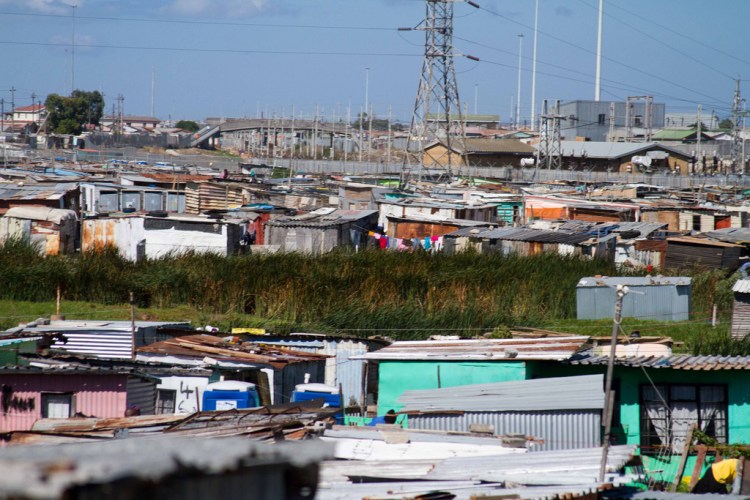
Although there is an offensive disparity in general attitudes toward water, metropolitan Cape Town is not entirely indifferent to the water shortage. The administrations of hotels, gyms, and office buildings have become more and more effective in implementing smaller scale water conservancy. These conservancy tactics range from removing bath plugs from hotel rooms so guests must shower instead to gyms utilizing a buzzer system which sounds in the showers of those who have been using running water for more than two minutes. Some of the city’s cafes have begun selling beverages in paper cups so they do not waste water while washing dishes. It is certainly an improvement that upscale establishments and more wealthy inhabitants of Cape Town are being cognizant of their water usage. However, the poverty-stricken people–primarily of colour–who are forced to live in the townships on the periphery of Cape Town have been applying similar water conservation practices before the drought began. Water saving habits are the norm in these townships, according to Makoma Lekalakala, who directs Earthlife Africa. She told The Guardian, “Using washing water to flush the toilet is what people in townships do all the time. So is washing with buckets and scuttles. I had my first shower when I was in my 20s.” The drought has thus far been a mechanism of exposing to the wealthy how their less fortunate neighbours have been living.

The township Khayelitsha of Cape Town. Source: Wikimedia Commons.

The inconvenience that the water shortage has become for the wealthy is life threatening for the poor. Already, the cost of food has spiked due to insufficient water for irrigation; at the very least, Cape Town’s poor population will become severely malnourished, but starvation is also a possibility. The dangers associated with being compelled to drink water that may not be clean include deadly diseases like cholera, and the risk of parasite infestation.

As climate change generates odder weather patterns and recurrent natural disasters, Cape Town will not be the only city whose inhabitants are in danger. Before the drought, the city was hailed for its proactive water conservation methods. In fact, it won the C40 Cities Award in 2015 for Adaptation Implementation for its Water Conservation and Demand Management Programme. Still, the same Cape Town is facing apocalyptic conditions which are further exposing the evident racial and economic inequality. Indeed, environmental consciousness on a grand scale to limit climate change is ideal, but enabling economic mobility for those who are oppressed is correspondingly important. Social and civic structures which are unable to end long-term droughts are fully capable of ending racial oppression and marginalisation.

Ethical Issues in the International Arms Trade: Is it possible to moralise sales of weapons?

On February 5th, 2016, the former Secretary-General of the United Nations (UN), Ban Ki-Moon, issued a statement about the Yemeni civil war, urging the need for a resolution: “Yemen is in flames, and coalition airstrikes, in particular, continue to strike schools, hospitals, mosques and civilian infrastructure. […] We need states that are party to [the] arms trade treaty to set an example in fulfilling one of the treaty’s main purposes – controlling arms flows to actors that may use them in ways that breach international humanitarian law.”

Two years later, as the conflict still unfolds, the UN labelled the Yemeni crisis as “the world’s largest humanitarian crisis with more than 22 million in need, fueled by ongoing conflict, a breakdown in public services and a collapsing economy.” The enduring fighting has been driven by significant flows of weapons supplied to the primary belligerents – the Hadi government backed by the Saudi-led coalition on one side, and the Houthi armed groups on the other one.

Yemeni women loyal to the Huthis hold up rifles. Source: Mohammed Huwais, AFP/Getty Images.

The circulation of these flows of weapons is made possible by the international arms trade, which is mostly controlled by the exports of the permanent members of the UN Security Council: China, France, Russia, the UK and the US, as well as Germany and Israel. While exports are restricted to a few states, importers of weapons are spread out across the globe.

The arms trade is regulated by the Arms Trade Treaty (ATT), which since it became effective in December 2014, obliges its state parties to assess the existence of a risk that a future arms export to another state will be used for or contribute to serious human rights violations. As stated in Articles 6 and 7 of the Treaty, if the risk is present, the export shall be prohibited.

According to the Control Arms Coalition campaign, France, Germany, Italy, Montenegro, the Netherlands, Spain, Sweden, Switzerland, Turkey, the UK, and the US have sold arms to Saudi Arabia to an amount totaling to nearly $25bn in 2015. The types of arms currently imported by Saudi Arabia and its allies range from battle tanks, combat aircraft, missiles, large-caliber artillery systems to light weapons and ammunition, many of which have been used to commit serious human rights abuses and likely war crimes during aerial and ground attacks in Yemen.

Saudi soldiers stand guard as a Saudi air force cargo plane lands in Yemen. Source: Abdullah Al-Qadry, AFP/Getty Images.

Following the increasing international pressure, three governments decided to halt weapons exports to countries involved in the war in Yemen since January 2018: Norway, followed by the Walloon regional authority in Belgium, and more recently, Germany.

However, many state parties to the treaty such as France or the United Kingdom still export weapons to Saudi Arabia and the UAE despite mounting evidence of serious breaches of human rights violations and humanitarian law, posing serious doubts about these exporter states’ fulfillment of their ATT legal obligations and reveals how economic interests still prevail over the blood of innocent people.

The past months have been blighted by protests in the UK and the US, indicating how many people disagree with their respective governments’ decision of continuing the arms sales in the context of the Yemeni crisis. In September 2017, during a protest at Britain’s biggest arms fair in London, the biennial Defence and Security Equipment International (DSEI), Andrew Smith, of Campaign Against the Arms Trade declared: “Right now UK fighter jets and bombs are playing a central role in the destruction of Yemen; what will be the next atrocity they are used in? War, repression, and injustice are fueled by events like DSEI. It’s time to shut it down for good.”

How much evidence is needed to stop arms exports in the direction of Saudi Arabia and the UAE? How can it be ensured that weapons in the arms trade will not be used in significant conflicts or that their buyers will not violate human rights? Moreover, is it possible to create a truly ethical and responsible arms market?

Although a distinction can be made between arms sold to the states before the conflict, and arms sold during the conflict, in the latter case exporter countries bear moral responsibility for the use of these weapons, even though their liability is not direct. Providing arms to areas that are destabilised by conflicts makes the conflict deadlier and can extend its length. The presence of tensions between countries or within a country makes arms purchases prone to enhance existing tensions and the risk of an actual conflict. Additionally, the sales and persistence of exports to Saudi Arabia and its allies can express a message of international acceptance and approval of their actions. Therefore, Saudi Arabia, the UAE and their allies are not the only ones responsible for the war crimes perpetrated in Yemen, as states that provide them with weapons, ammunition, training and assistance are also complicit in these crimes.

Considering that a certain level of opacity covers the arms trade, all the specific information that can be used to prove that certain arms deliveries and licenses are illegal under the ATT is difficult to obtain. For that reason, the creation of an institutional commission of inquiry is necessary to assemble all the necessary information related to the use of arms and to find out if indeed, countries like France or the UK have authorised the export of military equipment that was used to commit war crimes despite their obligation to the ATT. Control must be continuous, which is a complex and challenging task, requiring military and strategic expertise and transparency from importing countries.

Although some countries have decided to stop exporting arms to Saudi Arabia, others will continue to sell them because they consider it necessary to defend their allies. Nevertheless, exporter countries must try to force their partners to use the weapons they sell in an appropriate manner that will not violate international law.

The ATT is based on the notion of risk, and today, given the Yemeni context, the risk is present. As soon as suspicions arise that weapons are used to commit war crimes, further exports must be halted, despite the need to help the Saudi and Emirati partners, despite the necessity to sell all remaining material, and despite the financial needs. For an ethical arms market, risk and international law must prevail above economic interests. Business as usual must now come to an end.

Migrant Workers in the Gulf: Kafala and the Need for Reform

In the last forty years, few regions on Earth have experienced as dramatic, or indeed meteoric, of an economic rise as the Persian Gulf states. The regimes of Bahrain, Kuwait, Oman, Qatar, Saudi Arabia, and the United Arab Emirates, who today make up the so-called “Gulf Cooperation Council” have seen near unprecedented explosions of prosperity and development since the 1970s, which has transformed cities like Dubai and Kuwait City from quiet trading ports into glistening metropolises. Foreign tourists and expatriates alike have flocked to the Gulf states, seemingly intoxicated by the visions of perfect azure seas reflecting off of the sleek glass megaliths of countless Arab skylines. The states who today make up the GCC, to their credit, put on a good show for the West. Presenting themselves as progressive, enlightened principalities, bastions of stability and prosperity in a region torn apart by sectarian violence and extremism of all forms. This has attracted a swath of Western investment, and good strategic relationships with powerful democracies like the United States.

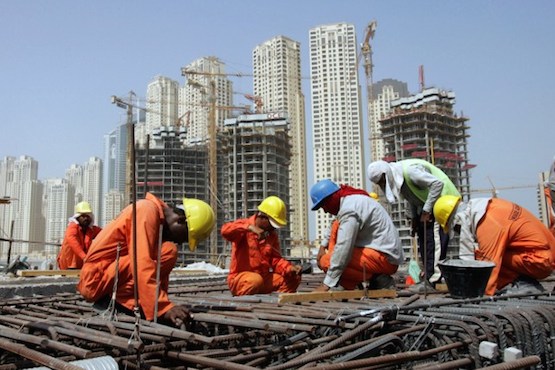
Asian Migrant workers at a construction site in Dubai. Source: Karim Sahib/Agence France-Presse.

But where did all of this newfound prosperity come from? The simple answer is also the most convenient for the GCC: the massive Arab oil boom of the 1970s-1980s. And indeed, the Belfer Center at Harvard’s Kennedy School reports that these boom years brought a “burst of income, spending, and growth.” High prices and rising demand for crude oil over the past several decades have turned into a seemingly bottomless piggy bank for Gulf state economies, providing them with a consistent cushion of resources and investments upon which to build an ever expanding list of mirage-like citadels in the deserts of the Arabian peninsula. However, just because they have the money for such extensive development, does not explain the speed and efficiency of their construction. Therein lies the introduction to what the Gulf regimes and societies refer to as the “Kafala system”. Therein lies the dark side.

During the initial oil boom in the Gulf, the governments of the GCC had a serious problem. As mentioned above, recent years had brought them near-limitless supplies of state revenue and foreign investment. However, the small populations of these states, combined with the newfound white-collar status of native society, caused a gross labor shortage in the region that hamstrung development. The solution, simple, but effective in nature, has fueled the exponential growth of the Gulf cities ever since. GCC regimes implemented huge incentives for foreign-born, blue collar workers to come to the Gulf states with migratory labor status. The reception was immediate, and enormous. Today, although the migrant population makes up only 10% of the world’s labor force, an overwhelming number reside and work in the Gulf states. As seen in the chart below by the Centre for the Study of Labour and Mobility, the majority of the GCC states have among the highest proportions of migrant workers in the world. The most extreme example, Qatar, has a population that is 87% migrants, an unprecedented figure.

Graph on proportions of Migrants to Native Populations in GCC countries. Source: CSLM “Kafala or ‘Sponsorship System’” Presentation.

The problem, however, lies not in the number of migrants in these countries, but how the native regimes regulate and police these massive populations. Officially speaking, the system of ‘Kafala’ is a simple work sponsorship program, regulating foreign workers residing in the Gulf states. It stipulates that the company sponsoring a migrant worker must pay for their travel to the Gulf (however, as reported by Human Rights Watch in 2015, this rule is often ignored), and assume full economic and legal responsibility for the worker. However, Kafala also stipulates that the sponsor company takes full control over the worker’s visa status. This means that the sponsor company has complete authority over the worker’s mobility. Not only that, but the worker cannot transfer employment, leave employment with the sponsor, or even leave the country, without the company’s express consent. Workers must obey the tenets of this agreement, even in cases of accused abuse or substandard pay. There are few embassies in these countries, and migrant workers frequently have their passports revoked by sponsors upon their arrival, providing no outlet for seeking assistance from the outside world. Should they bring a case of abuse or lack of payment to the domestic authorities, migrants are prevented from working at all while the case is being tried (denying them the means to their only livelihood), and are frequently denied judicial aid (making trying their case in court nothing short of impossible). Not only that, but if a worker breaches any rules of the Kafala system on their end, the sponsor company can force them to repay the sponsor’s originally paid recruitment fee, which according to the CSLM, can be upwards of three times higher than a migrant worker’s yearly salary. The worker would also be subject to deportation, or in some cases, even imprisonment.

This gross imbalance of employer-employee rights has created an atmosphere of widespread abuse of power, with a deluge of reports of workers not being paid (or if they are paid, paid far below the contractual wage), preventing workers from contacting or sending money to their families, physical abuse, the mass rape of female workers, and the normalization of corporal punishment on the part of managers and supervisors. The migrants who are unfortunate enough to seek economic opportunities in the Gulf states are, in effect, turned into hostages and serfs to the domestic population. It is this nearly costless, essentially captive labor force that has allowed the Gulf regimes to implement their explosive urban development projects, off the backs of what Migrant-Rights.org describes as “one step above modern day slave labor.” Human Rights Watch has reported that despite intense media scrutiny over the past few years, there has been little progress made in actually fighting “the appalling living and working conditions of low-wage migrant workers in the GCC’s construction sector.” However, there are glimmers of hope for workers in the region. Late last year for example, Qatar bent to international pressure and implemented a judicially led “Labour Dispute Resolution Committee” to scrutinize complaints made by workers against Qatari companies and employers, as well as drastically streamline the judicial appeals process for such complaints. Many experts believe that this liberalization is highly tied to the concerns of the Qatari government over international scrutiny arising from their construction projects ahead of the 2022 Football World Cup (which Qatar is hosting). The government may fear that a lack of reform will drive away potential tourist revenue from the event. If international organizations and democratic regimes alike wish to continue to press for human rights among migrant workers, both in the Gulf and as a precedent for world-wide reform, they have a mandate to keep up the pressure on the region. For our part as global consumers as well, western tourists must do their part, and think carefully about what kind of regimes and policies they are supporting through money spent on holidays in these countries, no matter how modern and beautiful they may seem from the outside.

Bibliography:

1. https://www.amnesty.org/en/countries/middle-east-and-north-africa/qatar/report-qatar/

2. https://www.belfercenter.org/publication/incredible-development-gulf-states

3.https://ceslam.org/mediastorage/files/Kafala%C3%A2%E2%82%AC%E2%84%A2%20or%20%C3%A2%E2%82%AC%CB%9CSponsorship%20System%C3%A2%E2%82%A C%E2%84%A2.pdf

4. https://www.hrw.org/news/2015/12/22/gulf-countries-bid-protect-migrant-workers

5. https://www.migrant-rights.org/campaign/end-the-kafala-system/

How Uzbekistan Used Western Fears of Islamism and Terrorism to its Advantage

With thousands of political prisoners, endemic torture in the prison system, and extremely restricted freedom of speech, Uzbekistan is hardly a model for human rights. Yet, President Karimov, who ruled the country from 1989 until his death in 2016, successfully played on Western fears of Islamism and terrorism and used them to his advantage. He employed the threat of Islamism to not only justify the lack of democratisation and liberalisation, but also to legitimise repression against any potential opposition to domestic and international audiences.

However, this tactic has not always been successful. The international community did not take the threat of Islamism to the region seriously before the attacks of 9/11. Despite the Karimov regime’s efforts, Western countries often suspected that the President was exaggerating the danger that was emanating from Islamist groups in Central Asia and it was questioned whether Tashkent was using the threat of Islamic extremism as a pretext for the absence of political reform. In fact, Karimov greatly overemphasised the Islamist threat in order to make drastic measures, such as keeping thousands of political prisoners and reportedly making use of torture appear necessary and to present himself and the regime as the guarantor of order and security. He would tend to put all dissenters in the same group, often disparaging any opposition as ‘radical’ or ‘Islamist’. The definition of terrorism in the anti-terror legislation was very vague, seeing terrorism even in ideological goals, without the exertion of violence, which makes it all the easier for the regime to legally arrest any opposition or dissenters. Not surprisingly, all this was often heavily criticised by the West.

President Islam Karimov meets with President George W. Bush at the White House on March 12, 2002. Source: Washington Post – Kenneth Lambert/AP.

Yet, that changed with the attacks on the World Trade Centre on September 11th, 2001. Suddenly, the West closed its eyes to the authoritarian practices of President Islam Karimov. Western objections over Uzbekistan’s failure to democratise and its frequent human rights abuses were effectively muted. While the US had for some time been pursuing a dual objective of encouraging democracy and liberalisation as well as security and stability in post-colonial countries, American priorities had clearly shifted. Ensuring security and stability of the region in the fight against terror suddenly became much more important than democratisation and human rights.

Karimov’s claims about the threat that Islamism posed to the security of the region thus appeared vindicated. Uzbekistan was positioned to benefit greatly from the resulting partnership, both financially and diplomatically. For the war against the Taliban in Afghanistan, Uzbekistan was an important point of access and the US required overflight and basing rights from the Uzbek government in addition to intelligence and law enforcement cooperation. In return, Uzbekistan was rewarded for its loyalty. The West supported Uzbekistan’s domestic fight against terrorism and wanted to preserve the country as a stable neighbour of Afghanistan. The US-Uzbek Declaration of Strategic Partnership was signed in March 2002. Western assistance to the Karimov regime was at its highest in 2002, at which time the police and intelligence services alone were given USD 79 million in aid from the Americans. From 2001 to 2002, US assistance to Uzbekistan had increased from USD 85 million to USD 300 million. As a result of the perks the US-Uzbek relationship brought to the country, the Karimov regime was also strengthened domestically.

Moreover, the regime greatly profited from the newly intensified relationship with the US because it enabled them to put off liberalisation and democratisation in the country and even increase repression of opponents. As Central Asia was now integral to the American security agenda, there was an almost inevitable shift away from ideological concerns with human rights and political openness. Democratic reforms in Uzbekistan were no longer a priority to the United States and so, while there was some hope in the beginning that the close relationship between the two countries would force Tashkent to work towards increased democratisation, it became clear that, in fact, the opposite was the case. With its accession to US demands, the Uzbek leadership effectively bought American silence and acquiescence on its human rights abuses. However, the US administration was aware that it was seen as hypocritical for sacrificing its concerns about Uzbek state repression for cooperation in the fight against terror and did not want to be seen as completely having given up the promotion of democracy.

America’s dual agenda becomes clear in this context as the US State Department retained Uzbekistan on their list of countries of concern on their violations of basic freedoms while the Pentagon was more concerned with the immediate goal of securing a military ally in the fight against radical Islam and terrorism. Nevertheless, the Karimov regime was emboldened by the downplaying of US concerns and now had a convenient justification for state violence and repression, which was valid in an international environment. Tellingly, Uzbekistan’s score on the Political Terror Scale increased from 2, the score which it had had almost since independence, to 4, a score which it kept for about 3 years (The Political Terror Scale), which indicates that the decrease in international pressure to democratise after 9/11 could have had a direct impact on the extent of repression of the regime.

It has become clear that while there was some cooperation with the West on security issues before 9/11, the American War on Terror brought many advantages for the Uzbek leadership including financial and military support, acceptance of the authoritarian practices and lack of democratisation of the Karimov regime, and increased regional power by strengthening Uzbekistan’s position against Russia.

Nevertheless, despite the fact that the US tended to prioritise security over concerns about human rights after 9/11, the West was not going to turn a blind eye towards all extents of state violence. Western acquiescence was only going to last up until a certain point and this point was reached when the brutal May 2005 government crackdown on protesters in Fergana Valley happened. An unfair trial against probably innocent people led to local protests and eventually, the storming of the prison where they were held. As a result security forces killed hundreds, perhaps even thousands of protesters. The US-Uzbek partnership came under severe strain after this incident, there was heavy US criticism and the EU imposed sanctions. President Karimov responded with ordering the closure of US military bases in the country. This shows that the benefits the regime was enjoying due to the US War on Terror were not permanent due to Uzbekistan being unwilling to take human rights concerns seriously.

Bibliography:

  • Akbarzadeh, Shahram. Uzbekistan and the United States: authoritarianism, Islamism and Washington’s security agenda. Zed Books, 2005

  • Boyle, Michael J. “The War on Terror in American Grand Strategy.” International Affairs (Royal Institute of International Affairs 1944-) Vol.84, No.2, 2008, pp.191-209

  • Carothers, Thomas “Promoting Democracy and Fighting Terror” Foreign Affairs. Vol. 82, No.1, 2003, pp.84-97

  • Dunn, David Hastings. “Bush, 11 September and the Conflicting Strategies of the ‘War on Terrorism’.” Irish Studies in International Affairs Vol.16, 2005, pp.11-133

  • Edel, Miriam and Josua, Maria. “How Authoritarian Rulers Seek to Legitimise Repression: Framing Mass Killings in Egypt and Uzbekistan.” GIGA Working Papers, 2017

  • Forest, James J.F. Countering terrorism and insurgency in the 21st century: international perspectives Volume 2.Praeger Security International, 2007

  • Friedman, Uri. “Trump and the Cycle of Demcoracy Promotion” The Atlantic, 02.04.2017, accessed 25.11.2017 https://www.theatlantic.com/international/archive/2017/04/trump-sisi-egypt/521682/

  • Gib­ney, Mark, Linda Cor­nett, Reed Wood, Peter Hasch­ke, and Daniel Arnon. 2016. The Polit­ic­al Ter­ror Scale 1976-2015. Date Re­trieved, from the Polit­ic­al Ter­ror Scale website: ht­tp://www.polit­ic­al­ter­rorscale.org.http://www.politicalterrorscale.org/Data/Datatable.html accessed 25.11.2017

  • Kagan, Robert “The September 12 Paradigm: America, the World, and George W. Bush” Foreign Affairs. Vol. 87, No. 5, 2008, pp.25-39

  • Kaye, Dalia Dassa et al. More Freedom, Less Terror ? – Liberalisation and Political Violence in the Arab World. RAND Corporation, 2008

  • Khalid, Abdeeb. Islam after Communism: Religion and Politics in Central Asia. University of Califronai Press, 2014

  • Weitz, Richard. “Storm Clouds over Central Asia: Revival of the Islamic Movement of Uzbekistan (IMU)?” Studies in Conflict & Terrorism. Vol. 27, No.6, 2004, pp.505-530

  • Whitaker, Beth Elise “Exporting the Patriot Act? Democracy and the ‘war on terror’ in the Third World.” Third World Quarterly. Vol. 28, No. 5, 2007, pp.1017-1032

Fast Fashion and its Fatal Consequences in Bangladesh

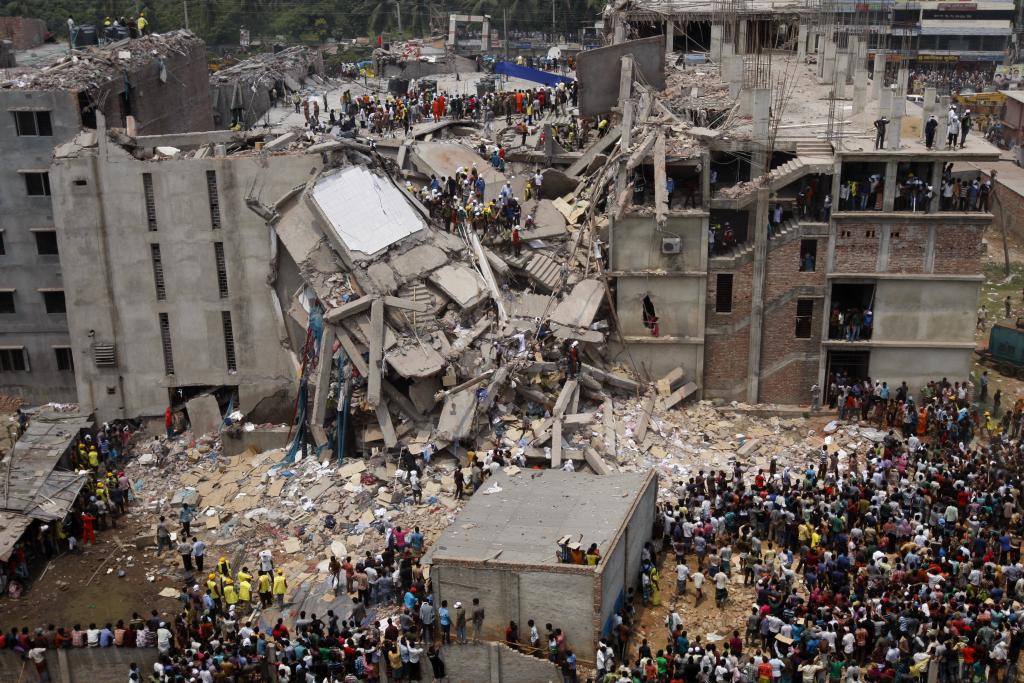
This coming April will mark 5 years since the garment industry’s deadliest disaster: the collapse of the eight-story Rana Plaza factory building in Bangladesh. The tragedy, a consequence of cheap construction and heavy equipment, was entirely avoidable, yet took the lives of over 1,100 people and injured thousands more. It regrettably took a catastrophe of this magnitude to grab the attention and condemnation of the international community – in its wake, calls for stronger labor rights and transparent supply chains were profuse. Nonetheless, the global fashion industry has sustained an annual growth rate of 4.78% since 2011, with the industry valued at an astounding 1.4 trillion USD in 2017, and is only expected to grow (Foundation for Economic Education). The Rana Plaza tragedy tangibly revealed the fatal flaws in the garment industry and its profound human rights implications, but what has been done about it?

Dhaka Savar Building Collapse. Source: Flickr.

As of 2014, between 60 and 75 million people are employed worldwide (largely in Asia) by the garment and footwear industry. However, this has not always been the case. As recent as 2000, only 20 million people were employed in the garment sector (cleanclothes.org). The exponential growth and transformation of the fashion industry is truly an unprecedented twenty-first century phenomenon. The traditional fashion industry has been overtaken by the new ‘fast fashion’ industry, pioneered by companies such as Zara, H&M, and Forever 21. Emerging in the 1990s, fast fashion was made possible when international trade norms began to lift regulations and allow companies to relocate manufacturing to developing countries where labour costs were much lower. With the help of low production costs and a streamlined supply chain, the fast fashion industry utilizes a business model that relies on “stocking inexpensive fashion forward items in limited quantities that would encourage frequent store visits and purchases” (Ian Malcolm Taplin). In result, fast fashion is as addicting to the consumer as it is cheap and accessible.

Fast fashion’s success lies in inexpensive, overseas labor. As competition drives prices down and demand up, factories and their workers are under increasing pressure to keep pace. In Bangladesh alone, the second highest garment producing country behind China, there are 4,825 garment factories that account for 80% of the nation’s export revenue (War on Want). Despite the new wealth being generated, factory workers have yet to reap its benefits and in remain grossly underpaid and mistreated. Perhaps the most fundamental and undeniable right that is consistently denied to garment factory works is the right to earn a living wage.

According to the United Nations Universal Declaration of Human Rights (UDHR), a worker’s ability to meet basic needs with a living wage is a fundamental human right. Garment factory workers in Bangladesh are lucky to make anything above the minimum wage set at 32 cents an hour. In a month’s time, this only amounts to about 3,000 taka. As the living wage in Bangladesh is an estimated 5,000 taka a month, garment workers simply do not make enough money to support themselves, much less their families (War on Want). Furthermore, workers are often forced to work overtime without compensation and against their will. Factory owners posit that all overtime work, as it is usually exceeds the legal limit, is voluntary, but in reality they threaten dismissal or salary cuts if their workers do not stay. A recent report found that in one Bangladesh factory, managers physically beat their workers who were incapable of meeting ridiculous production goals (Rachel Tang). Adding insult to injury, freedom of association and labour unions are heavily restricted and repressed by both state regulators and factory owners. Before the Rana Plaza collapse, the Bangladeshi government only recognized a handful of unions and would quell collective action through violence and unjustified detention. Factory owners, on the other hand, utilize short-term contracts and threat of dismissal to discourage unions from the inside. The combination of inhumane wages and hours with the inability to form productive unions to fight such inhumanity has created top-down system where workers consistently lose.

An overall disregard for health and safety is another human rights concern that has already taken or devastated the lives of too many. Building safety in particular is poorly regulated due to corruption between factory owners and government officials who turn a blind eye. The collapse of the Rana Plaza is clear testament to the inadequacy of safety regulations, and it was certainly not an isolated incident. It is estimated that over 700 workers died between 2007 and 2013 in factory fires in Bangladesh and China (Rachel Tang). The Rana Plaza disaster served as a wake up call in many ways and revealed the need for not only greater transparency in the industry, but also vast improvements on health, safety, and labor regulations.

Some progress has been achieved through the Bangladeshi government who worked to improve safety measures and workers rights immediately after the tragedy. Agreements such as the Accord on Fire and Building Safety in Bangladesh and the Alliance for Bangladesh Worker Safety were additionally reached between trade unions and global retail brands. Additionally, 17 large brands such as Patagonia and Nike have agreed to The Apparel and Footwear Supply Chain Transparency Pledge while others such as Walt Disney Co. are now publishing names and addresses of supplier factories. These measures are certainly a step in the right direction, but their effectiveness is yet to be truly realized. While 17 companies did agree to the Transparency Pledge by the end of 2017, 55 companies also contacted by coalitions did not (NPR). Bangladeshi factory workers themselves have not been idle, with tens of thousands of workers participating in a walk-off protest of low wages at the end of 2016, effectively shutting down 50 factories in Dhaka for a week.

On the surface, the affordable, trendy clothing is alluring. That allure tends to disintegrate when one learns the social and environmental consequences of fast fashion. More often than not, consumers would chose to buy their clothes from an ethical and transparent supply chain if given the option. That option needs to become more available, and the vocal and informed consumer can play a large role in making that happen. Companies, consumers, governments, and workers all have roles to play in the fight against fast fashion’s evils.

Cape Town Water Crisis

Water scarcity is one of the most imminent challenges the world currently faces. As a result of lack of access to or a physical shortage of water, 700 million people face a water scarcity crisis. Even more startling is the 1.6 billion people who face economic water shortage because their state cannot afford water infrastructure. Moreover, water consumption throughout the last century has increased at twice the rate per population growth. This further exacerbates the already limited resources, creating a situation in which 1.8 billion individuals are expected to face absolute water scarcity by 2025. By 2030, The United Nations Commission to Combat Desertification (UNCCD) estimates that between 24 and 700 million people will be displaced as a result of water scarcity.

Global attention has turned to Cape Town in South Africa, where water is expected to completely run out by July 9, 2018. However, Cape Town is not the only city with a fast approaching water crisis. In 2015, the water reservoir in Sao Paulo, Brazil, fell below 4% capacity and the city had only 20 days of drinking water left. Sao Paolo’s water shortage was exacerbated by deforestation, pollution, a zika outbreak, and the vast economic disparities of its citizens. The city implemented 12 hour water cut offs to help preserve their dwindling water supply. While not as dramatized, Beijing is also facing one of the most severe water shortage crisis of any city. The World Bank classifies water scarcity as when an individual has access to less than 1,000 cubic meters of water per year. In Beijing, the average water consumption among its 20 million inhabitants is only 145 cubic meters. There are a variety of factors that work together to put Beijing at risk for water scarcity, including: their disproportionately large population in comparison to their direct access to fresh water and severe pollution, which has contaminated some of the only viable water sources. A study by Columbia University analyzed Chinese water reservoirs levels from 2000-2009 and determined that the water supply decreased by 13% in that period. In order to combat the problem, China has funded education initiatives focused on water conservation and built a slew of water diversion projects. However, these pressing water shortages are not just relegated to the global south. International megapoles like London, Tokyo, Moscow, and Miami are among the most vulnerable to an imminent water scarcity crisis.

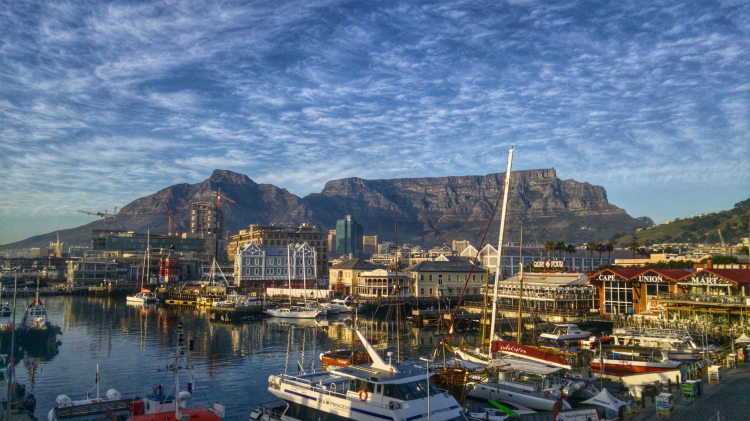
The city of Cape Town is the economic and tourist hub of South Africa. Source: Pexels.

As in most cases, Cape Town’s water crisis cannot be solely analyzed as a scientific conundrum. While Cape Town has experienced an abnormally small amount of rainfall the last three years, the pressing crisis is the result of long term mismanagement. Other factors which contributed to the current system are the remnants of apartheid rule and the laissez-faire elitist attitude of the Democratic Alliance (DA). In addition, the DA’s complicated relationship with The National South African Ruling Conference and African National Congress Party (ANC) and South Africa’s widespread economic disparity were factors. All of these elements were further exacerbated by Cape Town’s inability to recognize or at least admit to the coming water scarcity crisis until last year.

Cape Town’s, and in fact the worlds focus, has been on “day-zero”. “Day-Zero” has now been estimated as July 9 2018, pushed back from April. It represents the date that Cape Town will completely run out of water. When this occurs Cape Town will become the first major city of the modern era to be totally without water. Extensive measures are currently being undertaken to hold off “day-zero”, which is feared will result in “anarchy.” The current plan of South African officials is to try and get through the next months using as little water as possible. It is hoped that by the end of winter, enough water will have fallen to keep the city out of jeopardy of a “day-zero” situation.

The measures that have been enacted penetrate nearly every aspect of daily life, when drastically curbing water usage societal challenges emerge. Currently, Cape Town residents are only permitted 50 litres of water a day. In comparison, Americans use an average of 400 litres (88 gallons) of water and British people use an estimated 150 litres a day. Cape Town’s citizens are being advised to avoid flushing the toilet, use buckets to collect spare water from their showers, and use hand sanitizer instead of soap and water to wash hands. The Western Cape government (of which Cape Town is a part) will fine excessive water users, and has forbidden municipal water from being used in pools, irrigation, and the washing of cars.

The water crisis is not just a concern for Cape Town urbanites but also the farmers who live north of the city. These farmers independently manage their water reservoir capacities and unlike the DA city planning efforts, they began conserving water before the situation reached crisis level. These farmers believe climate change is real and that effective water management will be a cornerstone of its prevention. In many ways, South African farmers have accepted defeat, they released 10 million litres of water from their dams into the city of Cape Town, this generous donation allowed “zero-day” to be pushed back to April (it has since been moved to July 9). However, this decision, as well as the wider water restrictions, heavily impacts South African farmers, despite their relative water abundance when compared to metropole Cape Town. Crops will die and food prices will skyrocket, as irrigation is heavily taxed and water becomes a luxury commodity.

The water shortage in Cape Town has become a humanitarian crisis, as socio-economic status, magnified by the nations apartheid past, creates a stark divide in citizen responses. Cape Town’s wealthy, and usually white citizens, hire private companies to dig boreholes and wells in their backyard. They invest in desalination machines which create clean drinking water and water safe enough to fill their pools. They even invest in washing machines which operate on less water per cycle. These luxuries each cost thousands of pounds, the elite of Cape Town are investing millions to safeguard themselves from the effects of the drought. They can afford to buy water bottles in bulk even with their inflated prices and foreign shipping fees. On the other hand, Cape Town’s poorest, and often black citizens, live in shanty-like towns on the cities periphery. Their geographical locations in itself, hours commute from the city-center, is the long-standing effect of apartheid era relocation policies. Here, South Africans face the tough reality of being reliant on government measures to remedy the crisis. When the water eventually does run out, their only option will be to buy expensive bottled water and to eat less.

The water crisis is a microcosm through which to view the wider socio-economic inequalities that plague South Africa: 10% of the population owns 90-95% of all assets, in nations with developed economies this number is usually between 50-75%. Even more staggering is that the poorest 50% of the population has no measurable assets whatsoever. Cape Town’s imminent water crisis is rooted in the nations apartheid past and severely exacerbated by socio-economic inequalities which are tied not only into race, but also political party allegiances and government mismanagement.