Migration as a Human Right? Debunking Myths Surrounding the UN Migration Pact

Two years after the adoption of the New York Declaration for Refugees and Migrants in the wake of the refugee and migrant crisis in Europe, the United Nations (UN) has completed its preparations to further international cooperation and coordination concerning migration. This comes with the United Nations General Assembly’s embrace of the Global Compact for Safe, Orderly and Regular Migration (GCM)on 19 December 2018, two days after the same body approved the associated Global Compact on Refugees. The former is a 34-page pact which puts forward 23 objectives for safe, orderly and regular migration as negotiated by member states of the UN. Representing ‘a collective commitment to improving cooperation on international migration’, it has proven to be by far the more controversial of the two compacts.

Indeed, only 152 out of 193 UN member states endorsed the GCM. Five states (the Czech Republic, Hungary, Israel, Poland and the United States) voted against it, whilst 12 abstained and 24 did not vote. This outcome came after 33 states chose not to attend the Intergovernmental Conference to Adopt the Global Compact for Safe, Orderly and Regular Migration in Marrakesh, Morocco, on 11 and 12 December 2018.

The first rejection of the GCM came from the United States (US) back in December 2017. The former US Ambassador to the UN, Nikki Haley, justified this choice on the grounds that ‘decisions on immigration policies must always be made by Americans and Americans alone’, classing the GCM as ‘not compatible with US sovereignty’. The move was mirrored several months later by Hungary, whose Minister of Foreign Affairs and Trade, Péter Szijjártó, considers the GCM to be ‘in conflict with common sense and also with the intent to restore European security.’ Other states have since followed suit, with Australia, Austria, Chile and Italy amongst those abstaining from last December’s vote. Intense political debates have taken place even in states which voted in favour of the GCM, including Belgium, Croatia, Germany, the Netherlands and Slovenia. Whilst the United Kingdom (UK) likewise supported the GCM, an online petition asking the UK not to sign it is still active and has now gained over 130,000 signatures.

The situation in Belgium should perhaps be deemed the most alarming, given that the country has been gripped by violent protests and an unfolding political crisis in connection with the GCM. Here, former White House adviser, Steve Bannon, and the President of France’s Rassemblement National (RN or National Rally), Marine Le Pen, attended an event led by the RN’s Flemish counterpart Vlaams Belang (Flemish Interest) in Brussels on 8 December. At this time, Le Pen ominously declared that a state which ‘signs the pact obviously signs a pact with the devil.’ Less than two weeks later, the Prime Minister of Belgium, Charles Michel, resigned after his coalition partner, Nieuw-Vlaamse Alliantie (New Flemish Alliance), quit following Michel’s signing of the GCM.
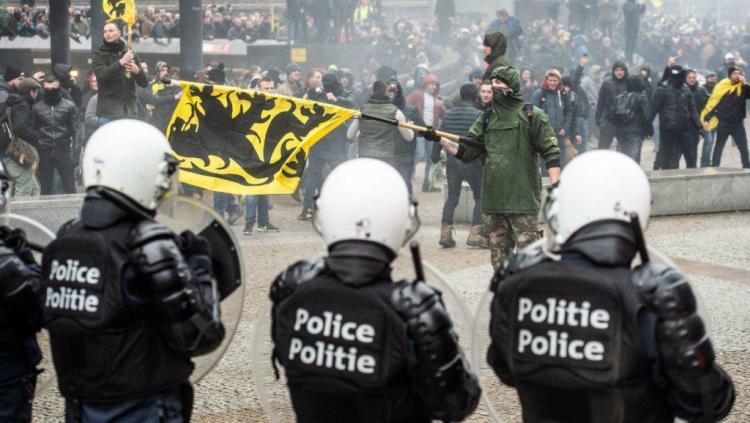
Demonstrators clash with Belgian riot police in Brussels on 16 December 2018. Source: Jonas Roosens/Belga / AFP.

The President of the European Commission, Jean-Claude Juncker, envisioned that ‘those countries that decided they are leaving the UN migration compact, had they read it, they would not have done it’. Whilst this might be true, it seems that state defections can be explained with reference to another type of ignorance. The Chancellor of Germany, Angela Merkel, noted that fears about illegal migration are being ‘exploited by opponents of the Compact to spread false rumours.’ Indeed, examples of disinformation, in this case often advocated by representatives of nationalist and anti-immigration parties, can be identified and refuted.

Claim 1: The GCM will make migration a human right. The Vice-Chancellor of Austria and Chairman of the Freiheitliche Partei Österreichs (Freedom Party of Austria), Heinz-Christian Strache, implied this to be the case through stating in relation to the GCM that ‘migration … should not become a human right.’ The claim has been put forward even more explicitly by the former leader of the UK Independence Party, Nigel Farage, who proclaimed on Fox News that ‘what the UN wants to do is to make migration a human right.’ However, this is not true. The GCM at no point voices that a ‘human right to migrate’ does or should exist. This is supported by British Minister of State at the Department for International Development, Lord Bates, who asserts that the GCM ‘does not create any new “rights” for migrants.’ Rather, he explains, it ‘emphasises that migrants are entitled to the same universal human rights as any human being.’ It is therefore incorrect to view the GCM as a declaration of, or in support of, a human right to migrate.

Claim 2: The GCM will make criticism of migration illegal. According to Dutch MEP Marcel de Graaff, ‘criticism of migration will become a criminal offence.’ Likewise, this is also untrue. The document involves a commitment ‘to eliminate all forms of discrimination … against all migrants.’ In other words, this is about ending prejudice against migrants as people, rather than criticism of migration as a policy. De Graaff also claimed that ‘media outlets … that give room to criticism of migration can be shut down.’ Again, the exact wording of the GCM is crucial. States should ‘promote independent, objective and quality reporting of media outlets … including by sensitising and educating media professionals on migration-related issues and terminology, investing in ethical reporting standards and advertising, and stopping allocation of public funding or material support to media outlets that systematically promote … discrimination towards migrants, in full respect for the freedom of the media.’ In any case, these claims run counter to the GCM’s more general commitment ‘to protect freedom of expression in accordance with international law’. Relevant here is also an insight put forward by Associate Professor of International Human Rights and Refugee Law at the University of Oxford, Cathryn Costello, who argues that any state which ‘decided to meet the commitment to tackle discrimination and xenophobia by censorship would in likelihood be breaching its international human rights obligations, in particular the right to freedom of expression.’ Overall, de Graaff’s interpretation is far removed from the GCM’s actual text.

Claim 3: The GCM will encourage migration. Szijjártó announced that the GCM ‘poses a threat to the world from the aspect that it could inspire millions [of migrants]’. In addition, Poland’s Minister of the Interior, Joachim Budziński, has linked the GCM to a specific type of migration, viewing it as a possible ‘incentive to undertake illegal migration’. Nevertheless, this is not necessarily the case. Amongst other commitments, the GCM is dedicated to the collection of improved data on international migration, the reduction of factors that encourage migrants to leave their countries of origin and the prevention of smuggling and people trafficking. Although it is difficult to predict the exact impacts of the GCM on migration flows, Szijjártó and Budziński’s bold statements are clearly facile.

Claim 4: The GCM threatens sovereignty. In relation to the GCM, Australia’s former Minister for Immigration and Border Protection, Peter Dutton, said that ‘it’s not in our national interest to sign our border protection policy over to the UN … We’re not going to surrender our sovereignty’. On the same note, Strache declared that ‘Austria’s sovereignty is of the highest priority, it is inviolable for us and we will protect it.’ Running counter to these comments, the GCM is nonetheless, as stated in its text, ‘non-legally binding’. This has also been confirmed by the European Commission, which insists that the GCM will ‘have no legal effect on national legal systems’. States will thus remain in charge of their immigration laws, with their sovereignty left intact. Besides, as observed by the Secretary-General of the United Nations, António Guterres, ‘[h]uman rights strengthen states and societies and reinforce sovereignty.’ On that account, states are helping to legitimise themselves as independent sources of authority by supporting human rights through the GCM. Therefore, the GCM does not pose a threat to state sovereignty.

It is widely understood that transnational issues, such as migration, should be managed at least in part through global governance, with the support of the international community. However, it appears that the sensitivity of the present political climate, which has been significantly shaped by the refugee and migrant crisis in Europe, is being overtly capitalised on, even as the number of arrivals falls to ‘pre-crisis’ levels. Indeed, a set of aims, issued with a view to mitigating some of the most detrimental problems faced by migrants and host countries, has ironically been turned on its head through disinformation, repeatedly spread by members of nationalist and anti-immigration parties in Europe. This is helping to drive a regressive and divisive type of politics, whose presence will likely be felt in the upcoming 2019 European Parliament elections.

‘If he beats you, it means he loves you’: Domestic Assault Law and Russian Culture

Source: Sergey Fadeichev/ TASS

Sign translation: (right) All women need are their fundamental human rights! (middle) To the victims of violence – protection and support!

In a country where one woman dies every 40 minutes as a result of domestic violence, there is an almost ubiquitous acceptance of abuse in Russian culture and increasingly in the law. Two years in review, the 2017 bill to decriminalise some forms of domestic violence is having a drastic impact on the number of reported cases of assault and, in the opinions of some human rights activists, contributing to a sense of increasingly normalized violence in Russia.

Since February 2017, the law has stated that one-off assault, against a partner, family member, or a child, that does not result in serious medical harm requiring hospital treatment is not a criminal offence. Under this amendment, assault that fits this criteria is considered ‘administrative rather than criminal‘, and punishable with a 30,000 ruble fine (£400), detention in custody for up to 15 days, or 120 hours of community service. Prior to these changes, the sentence was a maximum of two years in prison. This amendment was considered to be the closing of a loophole in Russian Law, which meant the penalties for domestic assault were higher than other assault. The driving force behind this change was Yelena Mizulina, an ultra-conservative MP who argued that the previous law was ridiculous and meant perpetrators could be branded criminal ‘for a slap’.

Russia sees unprecedented levels of domestic assault, with 36,000 women being assaulted by a partner daily and 14,000 being killed every year. This culture of abuse not only affects assault between partners but also that of children, with 26,000 children being beaten by a parent annually.

Two years in review of the changes to domestic assault law, which took place in February 2017, there are increasingly clear signs that this regression is a reflection of Russian cultural and social values, with 59% of the population entirely in favour, and a mere 17% being entirely against. This cultural acceptance is reflected in the media, with the tabloid Komsomolskaya Pravda promoting wife-beating: ‘Recent scientific studies show the wives of angry men have a reason to be proud of their bruises. Biologists say that beaten-up women have a valuable advantage: they more often give birth to boys!’.

Political analyst Maria Lipman argues that Russia’s apathy to domestic assault stems from the origin of its gender equality transformation during the Soviet period, which rather than being fought for was ‘…granted or even imposed on Russian women‘. This has meant Russian women did not have to fight for their rights in the same way as other countries, and as a result gender dynamics are very different.

The change not only reflects gender relations in Russia, but also Russian ‘family values’. Alyona Popova, a political activist and women’s rights campaigner believes ‘Traditional, or rather archaic values have become popular again‘, a statement that reflects the standpoints of numerous religious and conservative groups. The Russian Orthodox Church issued a statement saying that ‘if reasonable and carried out with love, corporal punishment is an essential right given to parents by God’. Pervasive through all groups that support the bill is a belief that unlike in Western Europe, the government has no right to interfere in family matters, with Putin stating in December that while ‘there’s too little distance between a spanking and a beating’, he believes, ‘unceremonious interference with the family is impermissible’.

Two years to the month after the bill passed, its impacts are clearly shown in both statistics and lived experience for many Russians. The State statistics showed that in 2016 there were 65,543 cases of domestic violence reported, and that in 2017, after the bill, the number of reported cases fell to 36,037- an decrease of almost half. Of course this could be read as a fall in the number of instances of abuse, however the national helpline at the Anna Centre, an NGO that supports victims of domestic abuse, registered an increase of 35% over the same time period. One activist argues that the statistics don’t show a decline in abuse, but that ‘…women are even less inclined to ask for help than they were before’. According to another campaign, over 16 million Russian women a year experience domestic violence and only a shockingly small 10% ever report it to the police.

These statistics are hardly surprising given the experiences women have had of reporting abuse after the bill. Victims of domestic violence who share a bank account with the perpetrator have reported being forced by officials to pay the fine on their behalf. Pisklakova-Parker of the Anna Centre believes that, ‘The amendments have sent a message to women that it is useless to search for help, and to the perpetrators that this is all right to do.’ The bill has meant that for many of the women reporting domestic violence not only does the perpetrator face no real punishment but also that they themselves do, which would explain the radical reduction in reports of abuse.

It is clear that Russia does not only have a legal or political problem with identifying and tackling an abuse epidemic, but also a cultural one. While the work of human rights campaigners and NGOs shows a strong resistance to an increasingly violent and apathetic society, to make any significant difference to current domestic abuse statistics Russia would have to see a complete cultural shift, which does not yet seem to be on the horizon.

#EditorMargaretCrawford #domesticviolence #womensrights #childrensrights #Russia

'If he beats you, it means he loves you': Domestic Assault Law and Russian Culture

Women marching for their rights in Russia

Source: Sergey Fadeichev/ TASS

Sign translation: (right) All women need are their fundamental human rights! (middle) To the victims of violence – protection and support!

In a country where one woman dies every 40 minutes as a result of domestic violence, there is an almost ubiquitous acceptance of abuse in Russian culture and increasingly in the law. Two years in review, the 2017 bill to decriminalise some forms of domestic violence is having a drastic impact on the number of reported cases of assault and, in the opinions of some human rights activists, contributing to a sense of increasingly normalized violence in Russia.

Since February 2017, the law has stated that one-off assault, against a partner, family member, or a child, that does not result in serious medical harm requiring hospital treatment is not a criminal offence. Under this amendment, assault that fits this criteria is considered ‘administrative rather than criminal, and punishable with a 30,000 ruble fine (£400), detention in custody for up to 15 days, or 120 hours of community service. Prior to these changes, the sentence was a maximum of two years in prison. This amendment was considered to be the closing of a loophole in Russian Law, which meant the penalties for domestic assault were higher than other assault. The driving force behind this change was Yelena Mizulina, an ultra-conservative MP who argued that the previous law was ridiculous and meant perpetrators could be branded criminal ‘for a slap’.

Russia sees unprecedented levels of domestic assault, with 36,000 women being assaulted by a partner daily and 14,000 being killed every year. This culture of abuse not only affects assault between partners but also that of children, with 26,000 children being beaten by a parent annually.

Two years in review of the changes to domestic assault law, which took place in February 2017, there are increasingly clear signs that this regression is a reflection of Russian cultural and social values, with 59% of the population entirely in favour, and a mere 17% being entirely against. This cultural acceptance is reflected in the media, with the tabloid Komsomolskaya Pravda promoting wife-beating: ‘Recent scientific studies show the wives of angry men have a reason to be proud of their bruises. Biologists say that beaten-up women have a valuable advantage: they more often give birth to boys!’.

Political analyst Maria Lipman argues that Russia’s apathy to domestic assault stems from the origin of its gender equality transformation during the Soviet period, which rather than being fought for was ‘…granted or even imposed on Russian women. This has meant Russian women did not have to fight for their rights in the same way as other countries, and as a result gender dynamics are very different.

The change not only reflects gender relations in Russia, but also Russian ‘family values’. Alyona Popova, a political activist and women’s rights campaigner believes ‘Traditional, or rather archaic values have become popular again‘, a statement that reflects the standpoints of numerous religious and conservative groups. The Russian Orthodox Church issued a statement saying that ‘if reasonable and carried out with love, corporal punishment is an essential right given to parents by God’. Pervasive through all groups that support the bill is a belief that unlike in Western Europe, the government has no right to interfere in family matters, with Putin stating in December that while ‘there’s too little distance between a spanking and a beating’, he believes, ‘unceremonious interference with the family is impermissible’.

Two years to the month after the bill passed, its impacts are clearly shown in both statistics and lived experience for many Russians. The State statistics showed that in 2016 there were 65,543 cases of domestic violence reported, and that in 2017, after the bill, the number of reported cases fell to 36,037- an decrease of almost half. Of course this could be read as a fall in the number of instances of abuse, however the national helpline at the Anna Centre, an NGO that supports victims of domestic abuse, registered an increase of 35% over the same time period. One activist argues that the statistics don’t show a decline in abuse, but that ‘…women are even less inclined to ask for help than they were before’. According to another campaign, over 16 million Russian women a year experience domestic violence and only a shockingly small 10% ever report it to the police.

These statistics are hardly surprising given the experiences women have had of reporting abuse after the bill. Victims of domestic violence who share a bank account with the perpetrator have reported being forced by officials to pay the fine on their behalf. Pisklakova-Parker of the Anna Centre believes that, ‘The amendments have sent a message to women that it is useless to search for help, and to the perpetrators that this is all right to do.’ The bill has meant that for many of the women reporting domestic violence not only does the perpetrator face no real punishment but also that they themselves do, which would explain the radical reduction in reports of abuse.

It is clear that Russia does not only have a legal or political problem with identifying and tackling an abuse epidemic, but also a cultural one. While the work of human rights campaigners and NGOs shows a strong resistance to an increasingly violent and apathetic society, to make any significant difference to current domestic abuse statistics Russia would have to see a complete cultural shift, which does not yet seem to be on the horizon.

Who are the North Sentinelese?

In November 2018, the eyes of the world turned with fascination to a small island in the Bay of Bengal after an American missionary named John Allen Chau met his death there at the hands of the native people. This article will explore the history of North Sentinel Island and its mysterious inhabitants, examining the deep roots of the Sentinelese people’s desire to be left alone, and why it is so important that this desire be respected.

The North Sentinelese have been referred to as ‘the last uncontacted people on earth‘ and, for as long as 60,000 years, have lived a hunter-gatherer lifestyle largely undisturbed by events in the rest of the world. This isolation is not the result of the island being unknown to outsiders: a description of North Sentinel Island and its inhabitants can be found in the writings of Marco Polo, though there is some dispute over whether Polo himself explored the island. Several attempts were made in the 18th and 19th centuries to make contact with the North Sentinelese, but in each attempt the natives either hid from or attacked the unwelcome arrivals.

This fear and hostility towards outsiders is likely the result of bitter experience: historically, the Andaman Islands, of which North Sentinel Island is a part, were frequently victims of Malaysian, Burmese, and Chinese slaving expeditions. It is not known whether the North Sentinelese are an oral culture or whether they have a written language, but either way it seems likely that stories of strangers coming to their home and kidnapping friends and family members would be passed from generation to generation, with the fear and hostility being inherited alongside the stories.

In 1880, an armed British expedition led by the British naval officer Maurice Vidal Portman landed on the island in what is believed by some to be the first attempt to fully explore North Sentinel Island by outsiders. For several days all he found were abandoned villages – the North Sentinelese had clearly adopted a strategy of non-confrontation – but eventually came upon a party of six natives: an elderly man and woman, and four children. Portman kidnapped all six, hoping to ‘study’ them. The North Sentinelese, obviously not accustomed to the germs and microbes that the British expedition unknowingly carried on them, soon fell ill, and the two adults died shortly thereafter. Portman returned the four children to North Sentinel Island with gifts in the desperate hope that it would lessen their disdain for outsiders.

It will probably never be known what those children told the other islanders of their kidnappers, but it has by no means made the Sentinelese any friendlier to outsiders than they were before Portman arrived. The children too fell ill on Portman’s ship, and likely carried germs back to the island with them. It is entirely possible that the children died because of Portman’s attempts to ‘study’ them, and may in turn have infected those who met them upon their return. The possible ripple effects of contact with outsiders is a likely root for the continued hostility North Sentinelese show towards those who attempt to visit their island. However, even without speculating about the wider impact of Portman’s exploration, we can safely assume that his kidnapping of natives did not lend itself to creating a positive impression of outsiders, and the North Sentinelese have almost exclusively attempted to hide from or repel outsiders ever since.

From 1967 onwards, a series of expeditions by a team led by the anthropologist T. N. Pandit attempted to peacefully contact the North Sentinelese, but no direct contact was achieved and the Sentinelese made it clear they did not wish to meet these visitors. By the time a National Geographic film crew arrived in 1974, the islanders had become overtly hostile again, violently repelling the new arrivals. The expeditions of Pandit and the National Geographic crew were among the last non-governmental expeditions to North Sentinel Island. In the 1990s, the Indian government – under whose jurisdiction the island falls – banned non-natives from travelling to the island and making contact with the natives, in large part because they feared unintentional infection could wipe out the indigenous islanders. Indeed, concerns now abound as to whether John Allen Chau’s ill-fated expedition has caused disease to spread across the island.

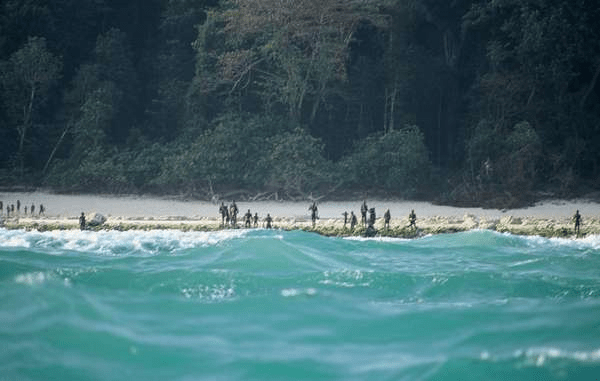
A photo taken at a distance of the Northern Sentinelese on the shore of their island.

The North Sentinelese have fiercely resisted intrusion for generations. Source: Christian Caron, Survival International

Owing to their intense isolation, very little is known about the North Sentinelese people and how they live. Some have estimated that somewhere between 50 and 400 natives remain alive on the island today; others have placed the number as low as 15. Any estimate however, is really just a ‘wild guess‘ since the isolation of the islanders precludes any detailed demographic study. The Sentinelese retain a hunter-gatherer lifestyle, using the bows and arrows with which they repel outsiders to catch indigenous wildlife, and other methods to fish along the coast in their boats. Their language, Sentinelese, is a language isolate, spoken exclusively by natives to the island. Very little is known about it, so it remains an unclassified language. The only thing that is known with certainty is that it is radically different even from languages native to nearby islands, indicating that the North Sentinelese have likely refused outside contact for millennia.

For generations beyond counting, the North Sentinelese have fled from and repelled contact from outsiders, maintaining a fierce independence that likely has its roots in memories of fellow natives dying at the hands of intruders. Unless this desire for isolation is respected, these people face utter catastrophe. All visitors, including John Allen Chau, pose an existential threat to this highly vulnerable community, owing to the Sentinelese people’s inability to cope with foreign germs. Outsiders also pose a threat to the cultural heritage of the North Sentinelese, as can be seen from the negative effects of integration of the neighbouring Jarawa. The United Nations has pointed out that the protection of cultural heritage and the protection of human rights go hand in hand. This is especially clear in the case of the North Sentinelese, where threats to their culture and their lives are one in the same. Given these facts, the best thing that the rest of the world can do for the North Sentinelese people is precisely what they want: leave them alone.

Can we still trust charities?

As human beings, we place high social value on what qualifies us to be good people, some of the most prominent criteria being generosity and kindness. In especially privileged regions of the world, people are eager to engage with charities as a way to achieve these characteristics, but do the organisations we support really fulfil these goals? With the rise of social media and digital marketing, charities have gained a more accessible platform to reach a bigger audience to spread their message and to ask for donations, whether it is via advertisements or pop-ups on internet platforms. Though this should theoretically increase the base of donation and support for these charities, studies have shown that the public’s trust in these organisations has dropped 6% since 2017, with 33% of those surveyed linking the cause to this media coverage.

The visibility of disheartening and immoral scandals found in the work of high-profile charities has increased due to the media acting as a platform that allows for transparency in the work of these organisations. As stated in the England and Wales Charity Commission Report of July 2018, charities are the fifth most trusted public figure, putting them 0.2 points below the trust the public would give an average stranger on the street. The report cites that negative news stories about the work of charities and their excessive advertising campaigns have created a wave of doubt about whether a sizeable portion the money donated does in fact reach the beneficiaries promised to those giving. Trust in overseas aid has also declined from 40% to 36%, majorly due to the explicit ethical violations uncovered about charity workers in less economically developed countries. The most recent and shocking example of this revelation was uncovered by an investigation pursued by The Times, in January 2018, into the misconduct of staff helpers at Oxfam in Haiti following the 2010 earthquake. Oxfam GB has since been banned from supplying developmental aid to Haiti, and thousands of regular subscription donations have been halted, following the forcible dismissal of nine people after it was revealed that they had sexually exploited children and women in exchange for food and resources.

A man walking past an Oxfam sign a camp set up by the charity in Haiti.

Oxfam Camp Corail, Haiti (2010). Source: Daily Sabah

The distrust in charitable organisations not only stems from the gross misconduct uncovered, but also that they have been able to hide these issues for so long. The aforementioned abuse allegations of the Oxfam workers had been ongoing since 2010, however it only came to light eight years later after intensive media investigation. The Head of Safeguarding at Oxfam, Helen Davies, claims that despite having brought up concerns in 2015 about the treatment of women in resource camps in Haiti, no-one took action on her words, alluding to the internal mismanagement of these violations. It is only now that this has gone public that repercussions have been faced, shown by Penny Lawrence’s (former Deputy Chief Executive of Oxfam GB) resignation following the scandal as she has now taken ‘full responsibility’ for ‘harm and distress’ caused. This has not been the only case of large organisation cover-ups, as a similar situation entailed in the Barnardo’s scandal of 2017. Many groups have come forward about the disregard for many abuse cases of patients in Barnardo’s care homes, dating from the 1960s-1980s, as the charity’s solicitor admitted in the Supreme Court hearing that Barnardo’s were aware of the allegations, but did not feel the need to keep the records which could have been used as evidence in criminal cases. This systematic neglect by charities to manage their workers and the accountability they hold, has been reflected in poor publicity for large organisations, as 74% of people now feel uncomfortable with publicly fundraising for these charities.

Following the drop in public support, the UK Charity Commission’s chairman, William Shawcross, stated that ‘it is a wake-up call for everyone who supports charity in this country‘, putting the fault on ‘poor fundraising, inappropriate data sharing and commercial relationships‘. MPs and public officials have, although overdue, cracked down on dishonest and unethical charity work, warning charity bosses that they are on their last chance to ‘get their house in order’. Not only will abuse allegations be taken more seriously, but accountability to data control and confidentiality will be checked upon more frequently, as a government commissioned review by Sir Stuart Etherington put forward proposals for a new supervisor to be convened for the industry. Failure to comply to enhanced management checks will mean that large partly government-funded companies will face statutory regulation, confining their global outreach and fundraising methods.

While there will always be dispute that regulations and policies have not gone far enough to diminish these scandals, it is realistically left to the charity itself to ensure that its functioning is upheld to the ethical code it has promised, and that transparency to its donors is maintained regularly. As Bond, the international development network, summarises: ‘NGOs must protect people from abuse, hold abusers to account and encourage those affected to come forward to report incidents.‘ We can only hope in the future that charities will align with these principles, and slowly but surely, our trust in them will be restored.

Another Round of Temporary Peace: How the Trauma for Israelis and Gazans Has Been Extended

A recent reigniting of violence between Israel and Gaza has once again brought to light the toll constant conflict has on the lives of citizens on both sides of the border. After decades of conflict and bloodshed, the emotional, psychological, and physical impact on citizens of the region has taken a horrifying toll. For many Israelis and Gazans, it seems hard to believe that such long term trauma has not been a stronger catalyst for peace.

The Israel-Palestine conflict dates back to the early 1900s when thousands of Zionist European Jews migrated to the territory of Israel-Palestine (then under Ottoman rule) – a movement that aligned with the development of a distinct Palestinian national identity amongst the Arab citizens of the land. Since then, a dispute over the ownership of the land between Israeli Jews and Palestinian Arabs has fuelled the conflict, with seemingly no end in sight.

The Gaza strip is one of two Palestinian territories, and is the one most often involved in active combat with Israel. The territory, established originally by the United Nations General Assembly in 1947, borders Israel to the north and west, Egypt’s Sinai Peninsula to the south, and the Mediterranean Sea to the east. It is a rectangular area of land spanning 25 miles long and about 4-5 miles wide, and has an uncomfortable population density of 812 people per square kilometer. Since 2007, the strip has been administered by Hamas, an ‘islamist political organization and militant group‘ listed officially as a terrorist organization by Israel, the United States, the EU, and several other nations.

Relations between the Israelis and Palestinians have fluctuated frequently between violence and fragile peace for decades, cycling between wars, ceasefires, intifadas, military interventions, civilian outbursts, and the American-moderated peace process. The most recent flare up of the conflict occurred on Monday, 12 November, 2018, in response to an Israeli operation aimed at taking out a senior Hamas commander carried out the day before. The operation consisted of air strikes to draw attention away from Israeli special forces, who then infiltrated the city of Khan Younis in a civilian vehicle and successfully killed Nour Baraka, a commander of Hamas’ armed brigades. The operation reportedly killed seven Gazans. One Israeli soldier was killed in an exchange of fire, and the 40 missiles fired into the surrounding area killed at least four civilians.

Hamas announced its intended retaliation shortly after the operation. The Israeli air force immediately cleared out Gazan citizens from air strike target areas, and by the next morning, Hamas had fired 300 rockets towards Israel, forcing citizens to seek refuge in bomb shelters. Within 24 hours after the initial strike, the total number of rockets fired into Israel reached 460.

But the trauma was not one-sided. Israeli forces returned the fighting with attacks on terrorist squads and dozens of air raids.

By the end of the second day of fighting, an Egyptian-brokered ceasefire agreement was reached. Yet this end to the sudden and swift exchange seemed to dissatisfy most citizens.

Residents of Sderot, a southern Israeli town located less than a mile from the Gazan border, protested their government’s ceasefire on Tuesday, 13 November. One citizen told Israel’s Channel 2 News: ‘It’s better to suffer in safe rooms, and that once and for all they will put an end to this. I know a month from now it will be the same thing – another few days and again there will be missiles, and nothing will have changed. It’s not reasonable that this is how our lives look.’

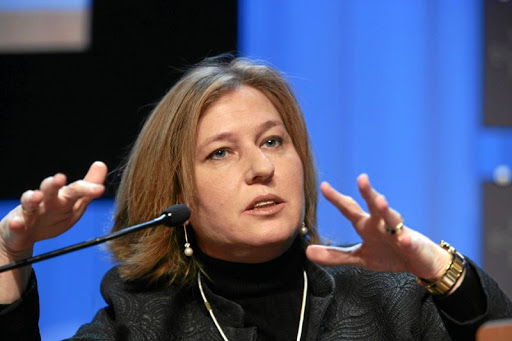
Tzipi Livni, a prominent Israeli politician and Leader of the Opposition, told reporters that ‘True quiet will be achieved only by deterrence against Hamas and by action against Hamas. There is no such thing as an agreement with Hamas.’

Tzipi Livni talking into a microphone

Tzipi Livni, Israel’s Leader of the Opposition. Source: Wikimedia Commons

Many Palestinian citizens reacted in practically the opposite manner to the ceasefire. On Tuesday night hundreds of Gazans met in the streets of Gaza City to celebrate their declared victory over Israel. However, for many others, the durability of the agreement is just as doubtful as it is for the Israelis. Palestinian school teacher Mohammed Baroud told Qatari media network Al-Jazeera that because ‘…Israel has never stuck to any agreement in the past…‘ he is not certain the deal will not hold for long.

But what is perhaps more troubling than the lack of confidence in their respective governments is the scale to which living through constant violence impacts young citizens. Baroud went on to describe his classroom to Al-Jazeera the day after the ceasefire: ‘My students, who are mostly 11-year-olds, were scared. I spent the day comforting them, reassuring them that it will be OK.’

Baroud’s students are not the only ones who have suffered emotional scars. In fact, according to Al Jazeera English, Gazans under the age of 17 (half of Palestine’s population) have lived through three wars. Yet, stories profiling individual families affected by the turmoil unfortunately only surface when conflict attracts prolonged international attention, despite the fact the suffering is constant regardless of the status of Israeli-Gazan relations.

Shimon Ben Shelaimi Zalman, and Israeli, revealed to BBC shortly after the 2014 Israel-Gaza war of the fighting’s affects on his family: ‘My elder daughter, who is married and has a young baby, refuses to visit [me and my wife] because we don’t have a sealed room.’

Civilians on both sides of the border have been suffering from personal loss for years. An Israeli human rights organization called B’Tselem has been tracking the number of Israelis and Palestinians killed monthly as a result of the conflict since September 2000. In 2014, the total number of recorded deaths reached 8,166 – 7,065 Palestinian and 1,101 Israeli.

How long will Israelis and Palestinians continue to face such trauma and heartbreak before their governments’ are finally inclined to instigate real change in the region? The answer, unfortunately, is that it could be a while. The actions taken by both sides in the recent outburst nearly mirrored those of the last war in 2014, which ended with a ceasefire that only brought peace for a mere three and a half years.

The experience of deep traumatic scars secondary to the horror of fighting and killing, and the constant threat of terrorist activity has to mean more to the leaders of these suffering people. Expressed scepticism, fleeting hope, retaliation, the need for sealed rooms and death toll reports cannot continue to be the only outcomes for the Israeli and Palestinian people.

Tales from an LGBT+ Safe Haven in Beirut, Lebanon

Despite discriminatory laws that have criminalised ‘sexual acts contradicting the laws of nature’ (Article 534), there is a relatively thriving LGBT+ community in Lebanon. Among them, you will meet brave people of all ages who are committed to promoting LGBT+ rights and who dedicate much of their time explaining those rights to others within the community itself.

A map of Lebanon with the colours of the LGBT flag

LGBT flag of Lebanon. Source: Wikipedia Commons.

In Arabic, Helem means ‘dream’. Helem is also the name of the primary association fighting for LGBT+ rights in Lebanon. In Beirut, at Helem’s community centre, which is an apartment serving as a refuge for many marginalised people and is also the first of its kind in the Arab World, three women share their thoughts. For the purposes of this article, they will be referred to as Wolf, Eagle and Shark.

The word "helem", written in both Arabic and English, in white letters on a red background.

Helem logo. Source: Official Page for Helem Lebanon, via Facebook.

Wolf is a twenty-one-year-old transgender woman. She has already been stopped on the streets of Beirut and arrested by local police for, as she puts it, wearing earrings. Intending on charging her with prostitution, they dragged her to the police station. This is common for trans women, who are often associated with illegal sex work.

At the station, the policemen slapped Wolf before throwing her in jail. They demanded she hand over her phone and were surprised when she refused, knowing full that well they needed a warrant. The policemen then began to write a false statement maintaining, for instance, that she had told them she was gay. She insisted that they erased the statement and requested a lawyer who never came. She also asked if they had called a judge. They had not.

Ultimately, due to Wolf’s understanding of the legal system and of her own rights, thanks to Helem, the policemen were forced to release her. A woman without Helem’s support and Wolf’s emotional resilience might not have been so lucky.

Initially, Wolf sought Helem for a safe space and was terrified of the police finding her. Today, Wolf is the head of their Transgender Committee. She is currently working on an international trans week campaign entitled ‘It’s Your Time To Hear Us’. Aside from her activism, Wolf enjoys the Beirut nightlife and, more specifically, its queer side. As does Eagle, who is seventeen.

Eagle is a pupil at International College, one of the most prestigious schools in the country. Much like Wolf, Eagle originally thought she was a feminine gay boy. Due to a tense relationship with her parents (her mother is Shia, her father Sunni) and despite their relative open-mindedness, she remained closeted towards them until after she turned fifteen. By that time, she had already joined Grindr and had already been in a relationship. When she did come out, as a gay boy originally, she describes it as though her future fell apart in her parent’s eyes. ‘Go to hell if you want,’ her parents said. ‘But keep it a secret.’

With no intention of doing so, Eagle managed to find a close circle of gay friends who were all engaging with LGBT+ issues through the internet. Now, Eagle identifies as trans and is unapologetic about her side-cut, long hair and femininity (unlike Wolf, who has short hair and wears more neutral clothing), despite the risks.

Her only issue is the idea of sex reassignment surgery (SRS), which is expensive and does not always end well. Eagle is firmly of the belief that gender is a social construct and poses a question that is very much prevalent in current gender debates, most notably in relation to identity politics: ‘Why can’t I be a woman and have a penis?’

For Eagle, the internal pain is worth choosing over any external pain. Her biggest fear is to lose her family. If she transitions, she feels that she most definitely will.

Two years ago, a Lebanese court ruling – the first of its kind – allowed a transgender man to change his official documents and receive the medical treatment he desired. This was considered a giant leap forward for trans rights in the country. Recently, there have also been cases of supreme court rulings acting in favour of people persecuted for being gay, arguing that homosexual relations should not be criminalised, as long as these are acted out behind closed doors and not flaunted in public.

Since then, however, there has been little improvement. 80% of Lebanese people do not believe that homosexuality should be socially accepted, and as stated in Helem’s April 2017 report on human rights violations against LGBT+ people, there has been a rise in arrests under Article 534 since 2012. However, Eagle stresses that in relation to the rights of trans people in other countries of the Arab world, Lebanon is not the worst.

Ultimately, Eagle feels sorry for those with homophobic and transphobic attitudes, simply saying: ‘they are wired like that’. This ambivalence is shared by Shark, who is also twenty-one.

Shark is a lesbian cisgender woman from a village near Byblos in the north with a bold buzzcut and multiple piercings, firmly rejecting any notion of ever wearing a dress. She highlights that ten years ago, teachers were not even allowed to utter the word ‘homosexual’. The situation has slightly improved since that time, she says, mostly on a social and individual level.

Shark’s Maronite father is very religious. Luckily, her stepmother is a feminist woman and an LGBT+ ally. Despite their father’s attitudes, Shark’s little brother, partially thanks to their stepmother’s influence, was already defending gay rights to his hypocritical father at age thirteen. Like him, Shark is assertive and articulate. She laughs as she explains how she used to visit priests to seek advice about being gay. Some were accepting, others were not. She eventually found an online LGBT+ community, which boosted her confidence.

Growing up, the most important thing for Shark turned out to be LGBT+ visibility on TV. A moment of sexual awakening for her was Britney Spears and Madonna kissing on MTV in 2003. Shark was aware of her sexuality at a young age, although she also fully believed that she was the only lesbian in the world. This was until a lesbian couple moved in next door. They were the first people she would come out to. In grade ten, Shark was already preaching about equal rights for everyone regardless of gender, colour, disability and, eventually, sexual identity. It was in her senior year of high school that she finally came out to her peers – ‘Khallas!’ (‘finished’ in colloquial Lebanese Arabic).

Although the experiences of these three women are widely different, they all thrived due to their connections with other people and the knowledge as well as confidence that these connections produced. Their networks were created online and in person, through organisations such as Helem and encountering kindred spirits within local communities despite all odds. Visibility and access to information prove to be vital components to not only help overcome violent homophobia from the outside, but internalised homophobia as well.

I will end this article by greatly encouraging further research about the efforts made by Helem and other Lebanese activists to make Lebanon a more tolerant place.

40 years after legalised abortion, Italian women face restrictions on access to abortion

On 4 October 2018, a motion to declare Verona a ‘pro-life city’ was approved by the city council. Motion 434, which was proposed by Alberto Zelger of the Lega Nord party, calls for public funding for pro-life groups and for campaigns to encourage pregnant women to consider adoption over abortion. The vote was met with protest by the women’s group Non Una Di Meno (Not One Woman Less), who wore costumes from the television adaptation of Margaret Atwood’s The Handmaid’s Tale as they protested the city council decision. In Italy, abortion was legalised in the first 12 weeks of pregnancy (and subsequently only when there is a serious risk to the pregnant woman’s life or a severe foetal abnormality) by the introduction of Law 194 in May 1978. The law was seen as one of the biggest advancements in Italian women’s rights. However, while the procedure remains legal across the country, the entitlement of doctors to refuse to perform abortions has made the procedure increasingly difficult to procure, while doctors who do perform abortions have seen their careers affected by the stigma.

Women wearing the 'Handmaid' costume from Margaret Atwood's "The Handmaid's Tale"

The Handmaid costume, from Margaret Atwood’s dystopian novel The Handmaid’s Tale, has become a symbol of pro-choice protest. Source: TitiNicola.

While four decades have now passed since abortion was legalised in Italy, anti-abortion sentiment remains higher than in other European states. An Ipsos poll found 15% of Italians believed that abortion should never be permitted or should only be permitted if the woman’s life is in danger, compared to just 1% in Sweden, 3% in France, 5% in the UK and 6% in Germany. The Italian minister of families, former vice-mayor of Verona, Lorenzo Fontana, is openly against abortion and told the press after assuming office in June 2018 that he would work to reduce the number of abortions carried out across the country by giving doctors powers to dissuade women from having the procedure. The number of abortions has already been in decline for decades.

Italian doctors maintain the right of “conscientious objection”, meaning that they are not legally obliged to perform procedures relating to abortion. Some of Italy’s objectors are motivated by their Catholic faith, but others are simply concerned that association with the practice would damage their credibility in the Italian medical community. Italy is one of very few countries which records figures of objections among doctors: in the last 20 years, there has been a 12.9% increase in doctors who refuse to perform abortion for moral reasons, according to the Italian Ministry of Health. This has seen the percentage of objecting doctors rise from 62.8% in 1997 to 70.9% in 2016. However, this figure varies regionally, with as many as 84% of doctors in Sicily and Campania objecting, leaving a minority of doctors to provide the service for an entire region. Doctors are entitled to refuse to perform abortions in most member states of the European Union, but the right of objection is not legally upheld in Bulgaria, the Czech Republic, Finland and Sweden.

The generation of women who campaigned for Law 194 are concerned by the decline in legal abortion provision and fear that younger generations do not see the urgency in protecting this right. Currently, women often have to travel to other cities or regions or go abroad to have an abortion as only 60% of hospitals in Italy perform the procedure at all. In 2017, it was reported that a woman in the north-west of Italy was turned away from 23 hospitals before she was able to obtain an abortion through intervention by the trade union the Italian General Confederation of Labour. For those who have illegal procedures, the penalties are high – up to €10,000 as of 2016 – so women may risk death to avoid going to hospital when they experience complications from illegal procedures. Previously there was just a symbolic fine of €51.

Graffiti under a bridge saying "MY BODY / MY CHOICE" in blue letters, preceded by the feminist symbol of a clenched fist within the Venus symbol.

Source: Edson Chilundo.

Women face challenges in obtaining abortions even when they are faced with serious medical complications to pregnancy. In 2016, a woman died in Cannizzaro hospital in Catania, Sicily, after miscarrying. The family of Valentina Milluzzo allege that the doctor treating her refused to perform a potentially life-saving termination after she suffered complications and went into premature labour at 19 weeks of pregnancy as he was a ‘conscientious objector‘. The hospital denies this, and the case has been under investigation since.

The Council of Europe – responsible for ensuring states uphold the European Convention on Human Rights – ruled that Italy’s weak regulation on conscientious objection has negatively impacted women’s ability to access healthcare services that are guaranteed by Italian law. Furthermore, the Council of Europe charged Italy for discrimination against doctors who do perform abortions, arguing that they face ‘direct and indirect labor disadvantages‘. In areas where objection is high, non-objecting doctors are burdened with a high workload, while young doctors are not being taught to perform the procedure, making even greater the lack of doctors available to perform an abortion. Non-objecting doctors have reported hostility from colleagues and being passed on for promotion because of their decision to provide abortions.

In Lazio, the region including Rome, only seven doctors provide abortion services after 90 days of pregnancy. Silvana Agatone, who is one of these seven, argues that the service is a necessity as she believes that the restrictions on abortion provision will result in women compromising their health because they are too afraid to seek an abortion. Agatone is one of the founders and President of LAIGA, the Free Association of Italian Gynaecologists for Law 194, which provides information on where to find non-objecting doctors for women seeking legal abortion.

You can follow the Non Una Di Meno movement on Twitter @nonunadimeno to see how they are working to protect Law 194.

School Segregation in Modern America: New York’s Separate and Unequal Schools

New York Mayer Bill de Blasio high-fiving schoolchildren in the Amber Charter School, Manhattan.

New York Mayor Bill de Blasio visits the Amber Charter School in Manhattan

The United Nations Universal Declaration of Human Rights lists education as a right for all. New York City, a liberal stronghold, presents an outdated public schooling system whose institutionalized, racist factors permit racial and socio-economic separation within schools. Schools draw from areas around them and are funded based upon the taxes they collect, and when examining wealthy and poorer neighborhoods, this tends to heavily contribute to discrepancies in education. These factors end up creating a poverty trap, which therefore leads to a human rights issue regarding education. Segregated schools, regardless of being intentional or not, will always create unequal learning situations. In such a wealthy nation and city, the state of some underfunded public schools in New York can be atrocious. Children deserve a right to education and a right to pursue achievement, and the prevention of this due to inadequate funding directly harms their chances of future accomplishment. In a nation that presents itself as a champion of human rights, the achievement gap regarding education stands to contradict this.

In 1954, the U.S. Supreme Court ruled in Brown v. Board of Education that separating schools by race was unconstitutional. And yet, while ‘separate, but equal’, (Plessy v. Ferguson, 1896) had supposedly lost its place over 50 years ago, the United States remains to this day a country that promotes human rights around the globe while inadequately addressing segregation and racism at home.

While Brown v. Board of Education was about inequities within the public-school system, it laid the groundwork for national desegregation laws, and its importance is shown in the subsequent promotion of progressive values within the United States. School segregation, however, was never truly eradicated and in some of America’s most diverse and progressive cities it remains, de facto if not de jure, as strong as ever.

According to a study by ProPublica, in 1988, 2,762 schools had a student body of which white students comprised 1% or less. By 2011, this was the case in 6,727 schools. At the same time, an increasing number of schools are also now seeing a reducing number of students of color, proving that schools are still strongly separated along racial lines – and in some surprising places. The typical partisanship present in the United State would lead one to expect that this would be the case in ‘the South,’ a region that demonstrated much more violent and overt examples of segregation in the 20th century. However, this is not the case. According to the UCLA Civil Rights Project, the South is in fact the least segregated region of the United States, and New York City has the most segregated school system in the country. Just 4 percent of white students across the city attend schools where black children are the largest group, data shows.

The root of the problem lies in the fact that New York never made sufficient integration efforts. The Civil Rights Act of 1964 was drafted by American lawmakers from the North targeting outright displays of segregation that had been occurring in the south. Even in 1964, prominent civil rights activists such as Malcolm X had begun drawing criticism to this hypocrisy of the North, observing that, ‘you don’t have to go as far down as Mississippi to see segregated school systems, we have it right here in New York City’. White liberals, who had been pointing fingers at the explicit acts of racism down in the south, had been ignorant to their own injustices. So, while the Act tackled segregation in the public forums, such as the disallowing of children of color into white-only schools, it did little to prevent less visible aggressions in housing and employment which, unchecked, resulted in the establishment of racially and economically imbalanced neighborhoods. While schools cannot turn away students on the basis of race, they are allowed to draw from their local population, even if there is a ‘natural racial imbalance’. The result was the establishment of tightly segregated neighborhoods and schools.

In New York City, America’s largest school system, Black and Latino students are almost six times as likely to end up in high poverty, beginning with an education in under-performing schools – schools with less experienced teachers, fewer resources, and without the fundraising and advocacy power of wealthy white parents. Access to classroom computers, enrichment and college-prep courses cause discrepancies in learning and advancement when compared to students who attend public schools in the top rankings, such as Eleanor Roosevelt High School or Stuyvesant High School. These two schools, like many other wealthy public schools in New York, have access to much more funding; funding that goes towards their education. Unsurprisingly, these two schools both have a black student population below 7%, and a Hispanic student population below 10%.

This is all the more troubling when it is considered that integration has in fact been proven to raise results in schools. When New York City engaged in ‘bussing’ programs, in which children were transported across school district lines to promote diversity, school performance improved for all students. Despite this, during the 1990s, desegregation efforts became easier to fight in court, and bussing began to be phased out. The prevailing narrative was that desegregation placed too high a cost on students for a cause no longer entirely necessary, whether that was bussing student’s long distances, or white parents and students believing that they had been negatively affected by affirmative action policies.

School districts in the South have made more of an effort to reintegrate schools by complicating the way in which districts are constructed and students are admitted, resulting in more diversity in schools. Northern cities, long thought to be more progressive than the South, have done little to amend their broken system. In New York City, a stew of issues have worsened the situation; gerrymandering, housing and employment inequalities and more. New York City incorporates multiple policies that draw from institutionalized racism, perhaps the most popular being the drawing of school district lines. School districts in New York are drawn in ways that incorporate the wealthier neighborhoods into their own districts, and less well-off neighborhoods into others. The consequences of this yield detriments to not only diversity program in New York, but to universal human rights. Denying access for children of color into public schools, whether overt in segregation or a result of institutionalized injustices, restricts a human right to education. The United States has long displayed a dedication to human rights both domestically and abroad, yet still school segregation persists. A dedication to human rights must present an emphasis on education, and school separation, whether intentional or not, directly inhibits this.

Why the United Nations needs more female peacekeepers

Despite having been proven effective in peacekeeping, female peacekeepers remain underrepresented in UN missions

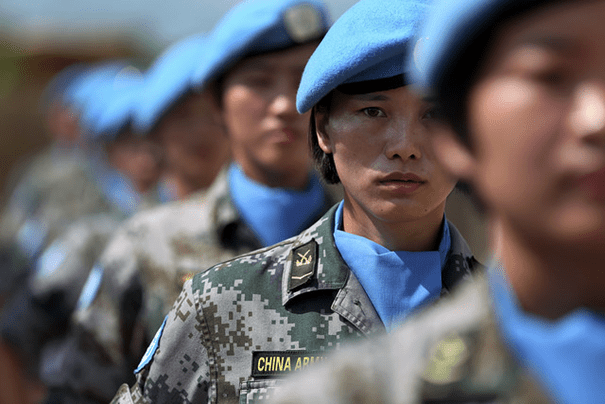
Chinese Peacekeeping Battalion Awarded UN Medal for Service. Source: UNMISS/Eric Kanalstein

On 31 October 2000, the UN Security Council adopted resolution 1325, a landmark resolution on women, peace and security. As defined by the UN, the resolution stresses the importance of women’s equal participation and full involvement in all efforts for the maintenance, and promotion, of both peace and security. However, nearly 18 years after the adoption of resolution 1325, women are still largely underrepresented in UN missions. There has been a slight growth over the past 25 years, from a mere 1% in 1993 to 4% of military peacekeepers and 10% of police personnel in 2017. These percentages are significantly short of the set UN targets of 15% and 20%. Even for specialized positions within the U.N. missions, there are currently only 65 women active in the missions out of a total 1757, which is a mere 3.6%. These numbers are especially low considering that UN missions including a significant number of female peacekeepers have shown to increase effectiveness and stability in providing peace and implementing human rights in the conflicted countries, which raises the question of why there has not been a significant increase in their number.

Why should the UN increase the number of female peacekeepers?

One of the main reasons female peacekeepers can increase the UN mission’s effectiveness is due to them having access to a part of the population most affected, as the culture of most conflicted countries makes it difficult for male peacekeepers to help women and children. In addition to this, female peacekeepers have access to places men do not and can be essential in obtaining intelligence and achieving an overall peaceful cooperation with the local population, as pointed out by the UN Women’s Policy Brief in 2015. As stated in the brief, women’s participation in the security sector has been recognized as a critical component of mission success, both in the UN normative frameworks on peacekeeping and women, peace and security, as well as by commanders on the ground themselves.

Ms Caecilia van Peski, Chief, Peace Programming Section (P5), for the United Nations Development Programme (UNDP) and United Nations Volunteers (UNV), is a strong supporter of the idea of increasing the number of female peacekeepers. Van Peski has declared: ‘Personally, due to my interactions with the army as well, I notice that people often speak positively about there being more female peacekeepers/monitors, since they can talk to the women at the scene where men do not have access, for example in Afghanistan.’ For Van Peski, the aforementioned benefits of having female peacekeepers should not be the main reason for increasing their number in missions; instead, ‘women should start to be seen as the “bringers of peace, security and stability” instead of solely the taker of this, as the weaker sex in need of protection. This thinking often leads to women being put in action in specific “women-like” missions, or female peacekeepers solely being positioned since it looks good and one is required to do so in accordance with resolution 1325.’

UNMIT Military Officer Participates in Peacekeepers Day Observance. Source: Martine Perret

Sexual exploitation and abuse allegations involving UN peacekeepers

Over the last decade, there has been an increase in reports of sexual intimidation and violence from within the UN Peacekeeping department itself as well as reports of peacekeepers being reluctant to protect civilians. In 2014, UN Watch, a non-governmental organisation monitoring the UN and promoting human rights, pointed this out during their oral statement given for the Human Rights Council’s Special Session on South Sudan in December 2016. They expressed their grave concerns regarding reports various incidents, such as the rape of dozens of ethnic Nuer woman and girls by South Sudanese government soldiers right outside a UN camp where they had come to seek protection and a woman being dragged away by two armed soldiers while UN peacekeepers looked on, which have raised questions about the measures taken by UN forces to adequately protect the civilians in these countries. According to Farhan Haq, UN deputy spokesperson, the UN received a total of 70 allegations of sexual exploitation and abuse at the beginning of this year, with 18 cases involving peacekeeping operations. Since January 2017, at least 55 UN peacekeepers have been accused of sexual exploitation and abuse on global UN missions. In a male-dominated UN entity, the increase of female peacekeepers could increase trust with the local population but effective measures to prevent the sexual exploitation and abuse by the UN peacekeepers in general will have to be taken to ensure both their safety and the safety of the women in affected areas.

How can the UN motivate their member states to train and employ more female peacekeepers?

It is clear that better incentives need to be put in place in order to increase the number of female peacekeepers in UN missions. There currently is funding in place for peacekeeping missions, but it is linked to time and risk instead of gender incorporation. A similar incentive was adopted in 2015, in the shape of the UN Security Council Resolution 2242, but has not yet been effectively implemented, even if the positive impact by the female peacekeepers would justify the extra financial premiums set by the UN. If financial premiums were set according to the percentage of women, or more specifically high-ranked women, employed by countries providing troops to the UN missions, more countries would be inclined to train and include highly skilled female peacekeepers. In its turn, an increased number of female peacekeepers would not only be a step towards a more successful implementation of UN resolution 1325 regarding gender equality, but will also improve the effectiveness of UN missions on a global scale, and the relationship with the local population, thus allowing them to be more successful in keeping the peace and protecting human rights.