Theresa May: The New Prime Minister and the Future of Human Rights in Britain

Britain’s new Prime Minister has made it clear that Brexit means Brexit, but what does her appointment mean for human rights?

Theresa May has faced a number of challenges in her first months at 10 Downing Street. It now falls on her to negotiate Britain’s exit from the European Union and to deal with the 42% rise in hate crimes surrounding the Brexit decision. Alongside negotiations with the EU, Theresa May must deal with the implications the referendum result will have on immigrants to the United Kingdom and must further David Cameron’s policies in dealing with the global refugee crisis.

Ms May has stated that hers would be a government that tackled injustice. She envisioned a Britain “where everyone plays by the same rules and where every single person… is given the chance to be all they want to be.” But despite expectations that Theresa May would initiate the creation of a more gender-balanced Cabinet, she has increased the number of female MPs by just one and only two black and minority ethnic MPs hold positions (despite these groups representing 51% and 14% of the British public, respectively). This appears to contradict her vision of a fairer Britain, as a more balanced and representative Cabinet could lead to the creation of policies more promotive of equality.

With obvious confusion at the October Conservative Party Conference on policy regarding migrant workers and a clear desire by the new Prime Minister to change, if not abandon, the existing Human Rights Act, what does her term in office hold for the status of human rights in Britain?

Theresa May addresses the seventy-first session of the UN General Assembly, September 2016, by Cia Pak

In her role as Home Secretary Theresa May was responsible for the controversial immigration pilot scheme Operation Vaken, aimed at encouraging illegal immigrants to voluntarily leave the country. The campaign saw vans bearing the slogan ‘Go Home’ sent into communities with high volumes of immigrants. The impact of the campaign was considerably negative and a government evaluation found that just 60 voluntary departures can be attributed to Operation Vaken.

The recent party conference presented a picture of the Conservatives in turmoil. A note distributed after Amber Rudd’s immigration speech suggested that a new legislation would require businesses to submit figures on the number of migrant workers in their employment. This accompanied her announcement of new restrictions on the numbers of international students admitted to the UK.

Steve Hilton, former director of strategy to David Cameron, said the policy would have a “big impact on Britain’s reputation around the world” and may negatively impact on the numbers of skilled professionals joining the British workforce, while Scottish First Minister Nicola Sturgeon amounted the measure to naming and shaming businesses for possessing a global outlook.

The Conservatives have shed little light on this controversial plan, with Education Secretary Justine Greening asserting that data from the scheme would not be made public, while Defence Secretary Michael Fallon denied that such a legislation would be passed at all. What is clear is that this policy could prove divisive in relations with Britain’s European neighbours and global partners.

In tackling the current refugee crisis, Theresa May has focussed efforts on providing aid in countries neighbouring Syria and has been reluctant to assist in EU relocation schemes. While David Cameron committed to bringing 3000 unaccompanied refugee minors into Britain earlier this year, more than 200 religious leaders have signed an open letter to Ms May, calling on her to do more to tackle the refugee crisis, including unblocking legislation which prevents refugees from being reunited with family living in the UK.

Home Secretary Amber Rudd has suggested that the British government is expecting to receive a list of the names of unaccompanied minors from the Calais camp and that action to aid them will begin in “a matter of days – a week at the most.”
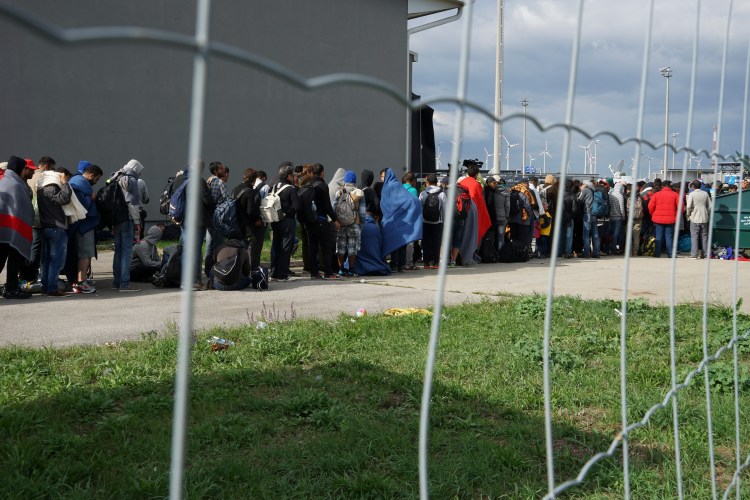
Syrian refugees wait at the border of Hungary and Austria, by Mstyslav Chernov

In her address to the Conservative Party Conference, Theresa May attacked “activist left wing human rights lawyers” who “harangue and harass” British military personnel with accusations of misconduct in war zones. She backs the plan to exempt military forces from adhering to the European Convention on Human Rights (ECHR) in combat. She argued that court cases brought against military personnel for allegations of misconduct in Afghanistan and Iraq has cost the Ministry of Defence in excess of £100 million since 2004 and resulted in considerable grief and inconvenience for the accused. The move would present a more serious danger to the basic human rights which the convention protects.

Theresa May previously advocated for a total withdrawal from the ECHR, arguing that it was this legislation, and not the European Union, which limited traditional British rights. She became one of the convention’s harshest critics during her tenure as Home Secretary when the European Court of Human Rights blocked her attempts to extradite the radical cleric Abu Qatada to Jordan.

Temporary derogations are permitted by the Council of Europe in circumstances of war or immediate public emergency, but certain rights remain inviolable. This privilege was notably used by France in November 2015 to hold terror suspects under house arrest and by Turkey in July 2016 after declaring a national state of emergency.

Many critics of the proposal argue that alone or as part of a wider plan to replace the Human Rights Act, which incorporates the ECHR into British domestic law, it would be a disaster for the preservation of human rights. Martha Spurrier, director of civil rights organisation Liberty, argues that since the accusations against British military personnel relate to rights that remain inviolable during a derogation, the proposal would only harm the innocent in order to save Ministry of Defence funds. She asserted that it will be a priority for Liberty to stop any attempts by the British government to repeal the Human Rights Act, or replace it with a new ‘British Bill of Rights.’ Nicholas Mercer, former lieutenant colonel and senior legal adviser to the military during the Iraq War, argued that the Prime Minister’s claim that charges brought against military personnel are false is ‘nonsense’, pointing to a total of 326 cases and £20m in compensation paid by the Ministry of Defence as evidence of the verity of these allegations.

A troublingly long list of human rights issues plagues the UK government as Theresa May begins her time as Prime Minister. Ultimately it will be up to her to tackle rising xenophobia, make Britain a more effective partner in dealing with the international refugee crisis, and to seek a just conclusion to the debate over the future of the Human Rights Act.

You can find out more about the Human Rights Act and add your voice to defend it here.
Christianity and the Middle East: A History of Cohabitation, a Present of Persecution, a Future of U

For as long as humans have been able to communicate, there has been belief. Whether it is stone age burials with objects to help someone in the next life or the recent beliefs of modern day Humanism, our capacity to discuss ideas and beliefs has been ever-present. The United Nations (UN) recognizes the vast amount of beliefs in the world and the freedom to practice it in the UN Charter of Human Rights, Article 18:

“Everyone has the right to freedom of thought, conscience and religion; this right includes freedom to change his religion or belief, and freedom, either alone or in community with others and in public or private, to manifest his religion or belief in teaching, practice, worship and observance.”

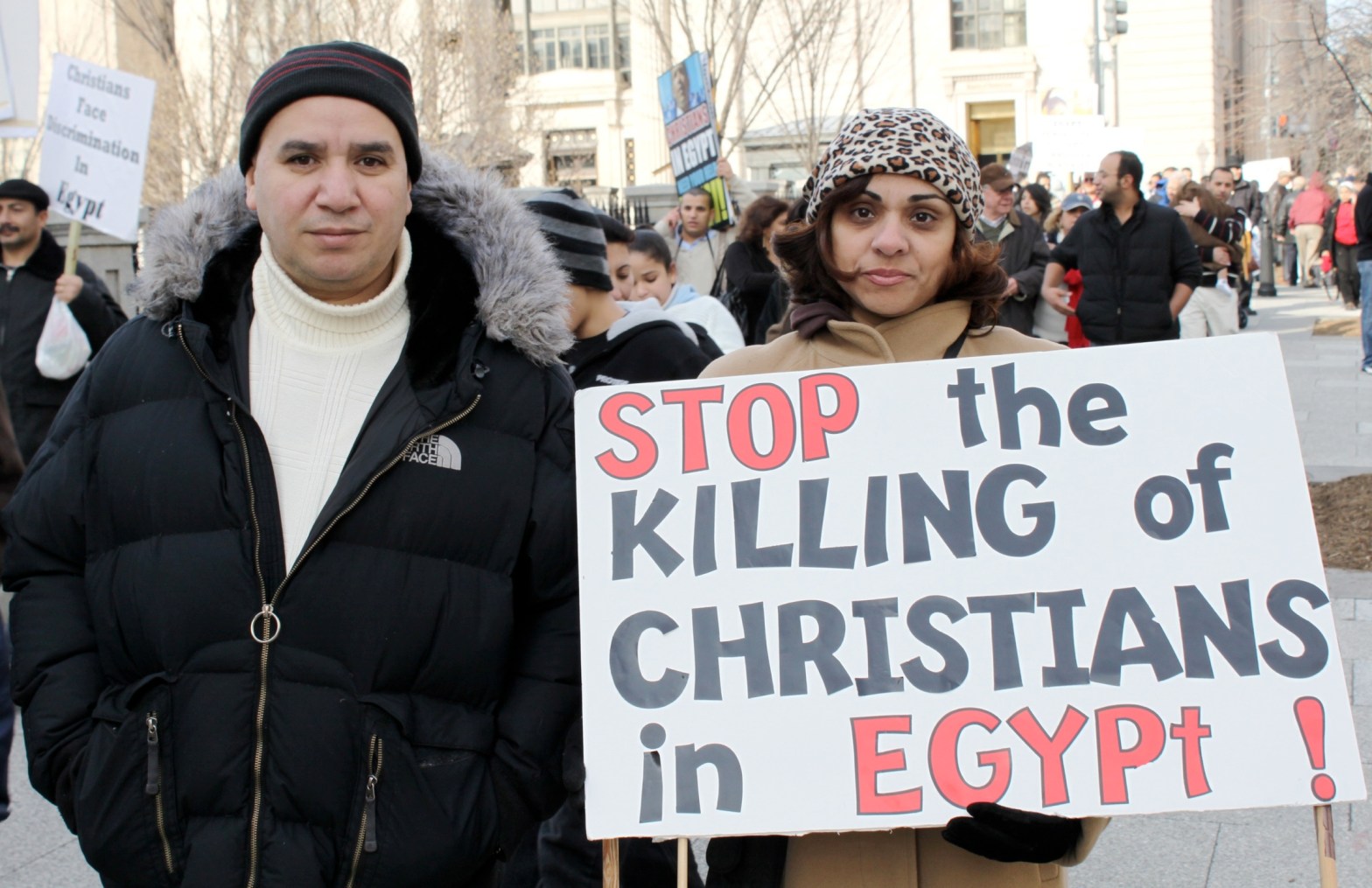
Coptic Christians protesting their treatment in Egypt, by Talk Radio News Service

In the West, Christianity has been dominant. Indeed, it is difficult to understand the Western ethos without some understanding of Christianity. In the Middle East, Christianity has a rich and powerful history, with many churches in the region claiming their traditions as far back as to the disciples of Christ themselves. Historically, while there were conflicts between Christian principalities and Islamic Kingdoms, freedom of belief was largely accepted and we can see in history how in the Middle East, Christians, Muslims, and Jews often lived peacefully together. With the fall of the Ottoman Empire in 1918 and the ensuing unrest of the brief period of colonialism, the Middle East has descended into one of the most unstable regions of the world, with devastating consequences for Christians and other minorities. In 2003, before the Iraq War, there was an estimated population of 1.5 million Iraqi Christians; that number has dropped to as low 200,000 in some estimates. It is a scene being replicated across the Middle East. In Syria, where Christians make up 10% of the population, 1 million have left the country since the Civil War began in 2011. In Egypt, where 10-12% of the country’s population are Coptic Christians, Christian Solidarity Worldwide (CSW) reports that since the removal of President Morsi in 2013, attacks on Christians and Churches have increased considerably with many churches being bombed by extremists. Open Doors, a Christian NGO which works to support persecuted Christians across the world, annually publishes a list of 50 countries where Christians are most likely to suffer persecution. Open Doors defines persecution as:

“A complex, multifaceted phenomenon that involves many aspects such as various forms of cultural marginalisation, government discrimination, hindrances on conversion, interferences on participation in public affairs and restrictions on church life. World Watch Research distinguishes two main expressions of persecution: ‘squeeze’ (the suffocating pressure Christians experience in all areas of life) and ‘smash’ (plain violence).”

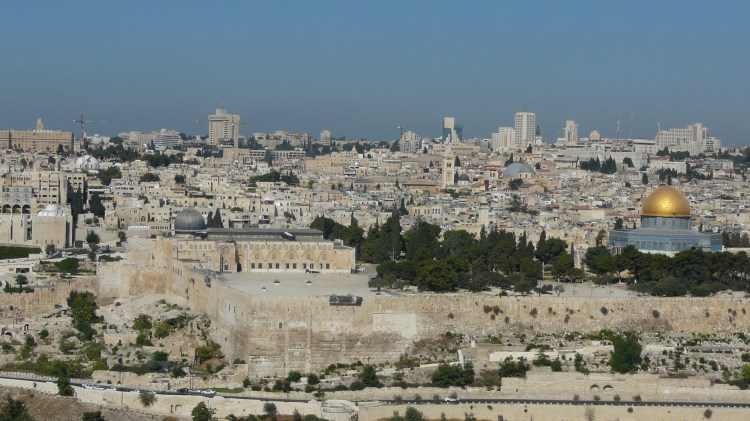
The city of Jerusalem, considered holy by all three major Abrahamic religions

Most states in the Middle East are included in the top 50 most difficult places for Christians to live. Why is this the case? Why is the Middle East so difficult for Christians to live in? Open Doors claims that “The state is still a major source of persecution; but increasingly extremism is a cross-border phenomenon.” Meanwhile, the collapse of state control in Iraq and Syria has resulted in huge numbers of migrants, Muslim and Christian alike, being forced to leave their homes. Yet even in the migrant camps Christians are persecuted:

“Most of Syria’s refugees have ended up in refugee camps in Turkey, Lebanon or Jordan. But many Christians fear to go into the camps where, in the words of one, ‘we are still a vulnerable minority in a very dangerous place.’ ‘You flee to survive and keep your children safe, but that is just as hard in the camps,’ said a father in a refugee camp in Lebanon. ‘It can be tough to find enough to eat and also to stop undesirables preying particularly on our young daughters.'”

While states such as Iran and Saudi Arabia are relatively stable compared to their neighbours, their insistence on Sharia Law makes it especially difficult for Christians to live there. In both countries, apostasy (leaving Islam) is punishable by death. Voice of the Martyrs, another Christian Non-Governmental Organisation (NGO), says that there are 90 Christians in prison or awaiting trial in Iran. Are these people murderers? Rapists? Terrorists or Western sympathizers? No, they are simply Iranian citizens who are of a different religion to Islam. What about Iran’s direct territorial and Sunni rival, Saudi Arabia? Surely they would want to have an excellent image to the world of tolerance and compassion, especially since Saudi Arabia is on the human rights council. Sadly, this is not the case. Wahhabism, a particularly extreme interpretation of Islam, dominates the country’s political and legal institutions. This makes it difficult for minorities such as Christians to openly practice their beliefs, while Churches are banned from operating, and blasphemy and advocating atheism are acts of terrorism.

Christians in the Middle East face discrimination and persecution daily. Whether it is by the state or by extremists, it can be difficult for Christians in the Middle East to lead a normal life. Despite a history of cohabitation with their neighbours, the present reality is persecution while the future is uncertain. If you want to find out more information on persecution of Middle Eastern Christians or wish to donate to NGO’s which seek to help persecuted Christians, the following NGO’s provide resources and information: Voice of the Martyrs, Christian Solidarity Worldwide, Open Doors, and Steadfast Global.

#Christianity #religion #religiousfreedom #discrimination

Christianity and the Middle East: A History of Cohabitation, a Present of Persecution, a Future of Uncertainty

For as long as humans have been able to communicate, there has been belief. Whether it is stone age burials with objects to help someone in the next life or the recent beliefs of modern day Humanism, our capacity to discuss ideas and beliefs has been ever-present. The United Nations (UN) recognizes the vast amount of beliefs in the world and the freedom to practice it in the UN Charter of Human Rights, Article 18:

“Everyone has the right to freedom of thought, conscience and religion; this right includes freedom to change his religion or belief, and freedom, either alone or in community with others and in public or private, to manifest his religion or belief in teaching, practice, worship and observance.”

Coptic Christians protesting their treatment in Egypt, by Talk Radio News Service

In the West, Christianity has been dominant. Indeed, it is difficult to understand the Western ethos without some understanding of Christianity. In the Middle East, Christianity has a rich and powerful history, with many churches in the region claiming their traditions as far back as to the disciples of Christ themselves. Historically, while there were conflicts between Christian principalities and Islamic Kingdoms, freedom of belief was largely accepted and we can see in history how in the Middle East, Christians, Muslims, and Jews often lived peacefully together. With the fall of the Ottoman Empire in 1918 and the ensuing unrest of the brief period of colonialism, the Middle East has descended into one of the most unstable regions of the world, with devastating consequences for Christians and other minorities. In 2003, before the Iraq War, there was an estimated population of 1.5 million Iraqi Christians; that number has dropped to as low 200,000 in some estimates. It is a scene being replicated across the Middle East. In Syria, where Christians make up 10% of the population, 1 million have left the country since the Civil War began in 2011. In Egypt, where 10-12% of the country’s population are Coptic Christians, Christian Solidarity Worldwide (CSW) reports that since the removal of President Morsi in 2013, attacks on Christians and Churches have increased considerably with many churches being bombed by extremists. Open Doors, a Christian NGO which works to support persecuted Christians across the world, annually publishes a list of 50 countries where Christians are most likely to suffer persecution. Open Doors defines persecution as:

“A complex, multifaceted phenomenon that involves many aspects such as various forms of cultural marginalisation, government discrimination, hindrances on conversion, interferences on participation in public affairs and restrictions on church life. World Watch Research distinguishes two main expressions of persecution: ‘squeeze’ (the suffocating pressure Christians experience in all areas of life) and ‘smash’ (plain violence).”

The city of Jerusalem, considered holy by all three major Abrahamic religions

Most states in the Middle East are included in the top 50 most difficult places for Christians to live. Why is this the case? Why is the Middle East so difficult for Christians to live in? Open Doors claims that “The state is still a major source of persecution; but increasingly extremism is a cross-border phenomenon.” Meanwhile, the collapse of state control in Iraq and Syria has resulted in huge numbers of migrants, Muslim and Christian alike, being forced to leave their homes. Yet even in the migrant camps Christians are persecuted:

“Most of Syria’s refugees have ended up in refugee camps in Turkey, Lebanon or Jordan. But many Christians fear to go into the camps where, in the words of one, ‘we are still a vulnerable minority in a very dangerous place.’ ‘You flee to survive and keep your children safe, but that is just as hard in the camps,’ said a father in a refugee camp in Lebanon. ‘It can be tough to find enough to eat and also to stop undesirables preying particularly on our young daughters.'”

While states such as Iran and Saudi Arabia are relatively stable compared to their neighbours, their insistence on Sharia Law makes it especially difficult for Christians to live there. In both countries, apostasy (leaving Islam) is punishable by death. Voice of the Martyrs, another Christian Non-Governmental Organisation (NGO), says that there are 90 Christians in prison or awaiting trial in Iran. Are these people murderers? Rapists? Terrorists or Western sympathizers? No, they are simply Iranian citizens who are of a different religion to Islam. What about Iran’s direct territorial and Sunni rival, Saudi Arabia? Surely they would want to have an excellent image to the world of tolerance and compassion, especially since Saudi Arabia is on the human rights council. Sadly, this is not the case. Wahhabism, a particularly extreme interpretation of Islam, dominates the country’s political and legal institutions. This makes it difficult for minorities such as Christians to openly practice their beliefs, while Churches are banned from operating, and blasphemy and advocating atheism are acts of terrorism.

Christians in the Middle East face discrimination and persecution daily. Whether it is by the state or by extremists, it can be difficult for Christians in the Middle East to lead a normal life. Despite a history of cohabitation with their neighbours, the present reality is persecution while the future is uncertain. If you want to find out more information on persecution of Middle Eastern Christians or wish to donate to NGO’s which seek to help persecuted Christians, the following NGO’s provide resources and information: Voice of the Martyrs, Christian Solidarity Worldwide, Open Doors, and Steadfast Global.

Brexit and Prisoners' Right to Vote

A prisoner looks out of his cell

On the 23rd of June 2016, 52% of British voters elected to leave the European Union in a national referendum. Britain joined this union in 1973 when it was the European Community, under the conservative government of Edward Heath. Different political analysts will cite different reasons as ultimately causing the leave vote, from sovereignty concerns to economic judgements. Furthermore, it is unclear exactly when or how Britain will negotiate the precise terms of its exit. Yet a fact that many appear to agree on is that there is now some uncertainty over exactly what the effects on the enforcement of human rights laws in the UK will be. The fact that the Council of Europe, whose job it is to oversee the manner in which national governments enforce court rulings, is separate to the European Union and its 28 members means that some aspects of current treatment of human rights won’t change. The European Court of Justice, however, directly interprets EU law and secures consistency in the way it is applied across the EU. Now that the UK will soon no longer be classed as a member of the EU, the Court of Justice of the European Union will cease to be the deciding institution when Britain acts outside EU laws. The EU’s Charter of Fundamental Rights would also be influenced, whereby UK laws will realise greater priority under Judge’s court rulings.

The European court of Human Rights, established by the European Convention on Human Rights, has supported the view that a ‘blanket ban’ on all prisoners voting constitutes a breaching of basic rights. Any Human Rights violations are significant, and a violation of a person’s right to vote matters because Government- and the laws it makes- will influence virtually every aspect of a citizen’s life. Article 3 of the First Protocol of the European Convention on Human Rights states that all individuals have the right to a free election. Britain’s ban on certain prisoners voting has already been officially identified as a violation of convicts’ fundamental rights over three times. (Although the British government has continually failed to provide financial compensation to prisoners who have won similar cases.)

Fencing outside a prison.

In 2016 the perception of prisoners’ rights is arguably shifting towards being viewed more as earned privileges, rather than entitlements all humans inherently and indeed intrinsically deserve, regardless of convictions. The views of ex-prime ministers such as David Cameron, who has said he’s made sick by the idea of all prisoners being able to vote, and Margaret Thatcher who was famously in favour of the death penalty for violent criminals, are evidently still shared by millions of Britons today.

Despite the majority of prisoners in the UK having been convicted for non-electoral offences, many voters still appear to hold that being denied the right to vote is an appropriate punishment for offenders. Although, it is important to note that punishment is only one aspect of the job incarceration must perform, in order to improve a society. Prison needs to act as both a deterrence against crime for other citizens, and as a space in which prisoners can be rehabilitated back into society. Given that prisoners are more influenced by parliamentary decisions than people who aren’t under the direct influence of government care, some hold it is more important for this group of people to be politically active, than it is for average citizens.

Several British prisoners, including 1979 convicted killer John Hirst, have pursued their right to vote with the court of European Human Rights. A 2005 ruling entitling British prisoners to vote under the right to free elections, received what might be described as relatively moderate publicity at the time. Today, far few people seem to have been exposed to the violations committed by the British Government. Some people don’t see denying the vote to prisoners as a morally significant rights violation, and only as a decision that disagrees with human rights in the most technical of senses. The controversial cases of Timothy Evans, Derek Bentley, and Ruth Ellis arguably combined to be the straw that broke the camel’s back when it came to ceasing capital punishment, and protecting a prisoner’s right to life in the UK. However, according to recent findings by ‘Britain Thinks’, support for the death penalty has risen. White ‘leave’ voters in the Brexit referendum were significantly more likely to be in favour of traditional values, and the re-instating of capital punishment in the UK than ‘remain’ voters.

With ‘leave’ having won, the consequences of how prisoners and the significance of their rights are viewed (like the right to life and to vote), are potentially uncomfortable. If convicts are seen by voters as not even deserving of the same fundamental right to life as other humans, then it will be unlikely those voters will defend prisoners’ rights to participate in a free election. As it stands, prisoners in the UK can rely on the continued protection of their fundamental right to life, but as Theresa May leads the UK into a new conservative government, prisoners would be understandably less sure about just how secure their entitlement to voting will be.

If reading this article has made you interested in taking action, and you would like to be part of a petition to call on current justice secretary and member of parliament for South West Norfolk Elizabeth Truss to protect the human rights act, including the right of free votes for all, then please follow this link to add your name.

http://savetheact.uk/#signup-form

The United States’ Failure to Ratify the UN Convention on the Rights of the Child

The United Nations Convention on the Rights of the Child (CRC) is the most widely accepted human rights treaty in the world. It describes the civil, political, economic, social, health, and cultural rights of children – including freedom of thought and religion, freedom from violence and abuse, the right to privacy, and the unhindered right to information. It outlaws capital punishments for children and asserts that all children have the right to education and adequate health care. There is also an emphasis on equal treatment of all children regardless of gender, race, or cultural background. So far, 196 UN member states have ratified the CRC, committing to grant the children of their nations the rights described in the treaty. The only country that stands in the way of the CRC being the first truly universal human rights treaty is the United States.

A group of children meet with UN Secretary General Javier Perez De Cuellar to mark the adoption of the Convention on the Rights of the Child, 1989, by Milton Grant

The CRC first went into force in 1990, and Madeleine Albright (then US Ambassador to the UN) signed the Convention on behalf of the United States in 1995. To ‘sign’ the CRC indicated that the US would move towards ratification in the near future. However, the political process in the US means any such resolution needs to pass with a 2/3 majority vote in the Senate before it can go into effect. Since 1995, presidents Bush, Clinton, and Obama have all expressed their support of the CRC, but it has never been presented to the Senate for a vote. This is largely due to persistent opposition from both the public and members of the Senate.

Groups like Amnesty USA have argued that political opposition to the CRC is fuelled by and built on misconceptions of how it would be implemented. The key argument against ratification is the CRC’s supposed infringement upon American sovereignty,, and the belief that it would have the power to override the United States Constitution. This is not the case. Neither the CRC or the Committee have any authority over domestic legislation. The CRC is a commitment by states to submit regular reports on the status of children’s rights to an independent Committee of elected officials every five years. The Committee reviews the report and issues recommendations for states to improve their compliance with the CRC.

The Convention is based on self-compliance alone. While the recommendations made on the back of regular reporting encourages ratified states to set up national legislation that will ensure their compliance with the CRC, they cannot force a state to do so. The CRC does not include any rules or punishments for non-compliance.

The bulk of public groups opposing the CRC in the US are right-wing family-focused organisations. Powerful fundamental Christian groups such as the Home School Legal Defence Association and Parental Rights are two among many right-wing groups committed to spreading information about the ‘dangers’ of the CRC, especially governmental and international interference in the private matters of how children are raised. They argue that the implementation of the CRC will allow children to choose their own religion, access reproductive health services without their parent’s consent, and be encouraged to view pornography. The emphasis of the CRC on provision of services that are ‘in the best interests of the child’ is portrayed as undermining parental authority and encouraging children to sue their parents.

While the US has not ratified the CRC, it has ratified the two Optional Protocols that outline the involvement of children in armed conflict and prohibit child prostitution and child pornography, respectively. They were signed by President Clinton in 1999. Ironically, a UNICEF press release following the ceremony has the organisation hopeful that “the US will move to bring about the earliest possible ratification of the CRC.” The Optional Protocols were considered less controversial and passed through the Senate without much opposition, largely because existing US laws already lived up to the standards they set.

During a debate in the 2008 Primary Election, President Obama stated that US failure to ratify the CRC was ‘embarrassing’ and said he would“review this and other treaties to ensure that the United States resumes its global leadership in human rights.” After taking office the Obama administration reiterated in January 2009 their commitment to the objectives of the CRC. In November of that year a spokesperson for the State Department stated that the administration was “committed to undertaking a thorough and thoughtful review of it.” Since 2009 there have been no further public statements about the CRC from the State Department or from the Obama Administration.

Many have called for President Obama to put forward the CRC to the Senate for a vote. Caryl M. Stern, CEO of the United States Fund for UNICEF, wrote an opinion piece earlier this year saying ratification “will become a powerful symbol for our commitment to children everywhere.” She further makes the point that accepting the CRC would effectively weaken claims of hypocrisy when the US advocates for human rights abroad.

Is US ratification of the CRC likely in the future? The arguments made by opposing groups may sound extreme, but the size of the opposing public is not insignificant, and has put pressure on (mainly Republican) members of the Senate to oppose ratification. The need for at 2/3 of the vote to be affirmative for the ratification has made the CRC difficult to pass, to the point where no president has even attempted to submit the CRC to the Senate for approval. The partisan nature of American politics is a major obstruction to the ratification of the CRC and a democratic majority in the Senate seems to be the first step towards any possibility of ratification in the future. Even if this were to be the case though, the process needs to be initiated by the president. With the election looming, neither candidate has expressed a position on the CRC. Hillary Clinton has a long history of advocating for children’s rights, and promoted the ratification of the CRC in 1989. Although her current presidential campaign includes a focus on children’s rights, she has made no statement about the CRC directly. Donald Trump’s campaign platform does not mention children’s rights. It does not seem likely that US will move toward ratification of the CRC anytime soon.

Read more about the UNICEF USA campaign for ratification of the Convention on the Rights of the Child here. Learn about the report-system, the Committee on the Rights of the Child, and self-compliance with the CRC here. Click here to find out which states have ratified other human rights treaties.

Summer Series: After Ebola: Sustainable Agriculture in Sierra Leone

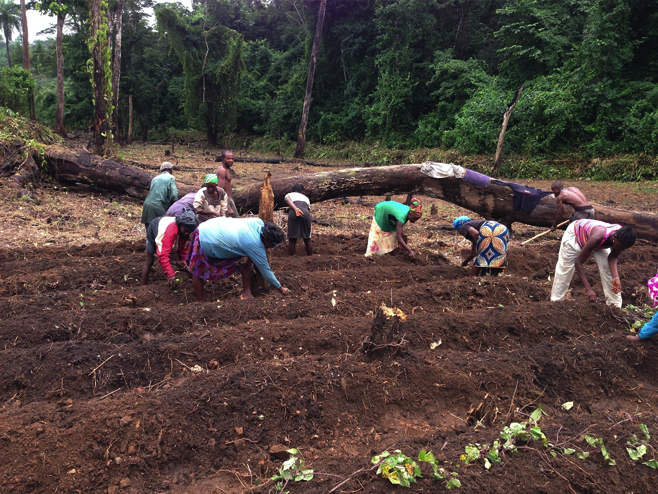
Planting potato vines in raised rows. Using new tools to turn the soil. Planting peppers in a nursery, shaded by palm fronds, before transplanting them. Spreading quality fertilizer.

These are not new or revolutionary techniques. However, they have the ability to make a huge impact on a farmer’s yields. My name is Emma Middleton and my partner, Marlene Paradee, and I went to Sierra Leone for three weeks this August to implement our project, After Ebola: Sustainable Agriculture in Sierra Leone using these techniques and more. Our goal was to set up an agricultural project in the wake of the Ebola crisis, when many farmers were unable to tend to their fields and the economic growth forecast for Sierra Leone was dismal. We worked with five groups, each made up of 20 women and up to 5 men in order to promote women’s empowerment. Four of the groups came from a small village of approximately 525 people called Mano, in Jaiama-Bongore Chiefdom, and the last group came from the neighboring village of Folu. Working in conjunction with a Sierra Leonian NGO called Village Care Initiatives, we were able to transform acres of donated land into functioning farms, with each group working together on their own plot. When we got there, the groups had just started clearing the land. By the time we left, they had planted long rows of potato vines and large swathes of groundnut (also known as peanut) on their land, with plans to transplant the peppers, finish planting the groundnut, and start planting okra in the near future.

Women from the Folu group planting potato vines, by Emma Middleton

We had conceived of this idea way back in the fall of 2014, after attending a talk by Sierra Leonian healthcare worker Ezekiel Conteh. He described not only the devastation caused by the disease itself, but also the economic havoc it had and would wreak. The economic growth forecast in 2014 was at 11.3% until the outbreak hit and it ended at 7.1%. In 2015, the economy contracted by 21%. Although around 70% of Sierra Leonians work in the agricultural sector, the country still spends upwards of $200 million yearly importing rice to supplement what its people make themselves. We saw the agricultural sector’s shortcomings firsthand while in Mano during the ‘hunger season,’ when crops are not yet ready to be harvested and the money made during the last harvest season has nearly run out.

Our project aimed to provide seeds, tools, and guidance to the groups in order to not only get the job done, but also to insure that it would be sustainable in the long term. Village Care Initiatives brought in a Sierra Leonian agricultural expert, Mr. Kamanda, to show the groups exactly how to best plant the seeds, use the tools we had purchased, form raised rows to plant the potato vines, and more. The villagers had been planting crops at the wrong time, reducing yields; selling off too much of their crops, meaning that they would either have to repurchase them during the rainy season or starve; and not saving any seeds for the next planting season, meaning that they had to purchase more each year. Mr. Kamanda learned of this and immediately drafted plans to insure that the villagers, especially those working in our groups, would use more sustainable practices in the future.

The project did come with a price tag, however. Though we received a $10,000 grant through the Clinton Global Initiative University and pledged by the university, in the end it was decided that the school would pay for our flights, visas, and medical expenses, leaving us to fundraise the entire $10,000 projected cost for the project. We had done bake sales throughout 2015, sitting outside the library or Marlene’s house, to raise money. We had run an online fundraiser. However, we soon found ourselves with three weeks to go before our departure date, and only $873.75 raised.

Women from another of the groups planting groundnut in newly turned soil, by Emma Middleton

Together, we did anything we could think of to raise the funds before our departure date. I was put to work painting a deck and set up donation jars at my work and church; a new online fundraiser was set up and both of us sent the link, along with a flyer explaining our project, to anyone we could think of. Amazingly, everyone around us stepped up to the plate. We ended up raising enough to pay for not only the original, budgeted project expenses, but also eight 50kg bags of rice to serve as ‘food for work’ for the community, to pay and thank them for how much work they have and continue to put in to this project. We were absolutely blown away by the number of people who listened to what we had to say and saw the worth in our cause.

The number one thing that development and aid workers should ask when leaving a project site is, in my opinion, what they are leaving behind. We have an agreement with Village Care Initiatives whereby they will check up on the project monthly for the next year in order to be sure of its success and to discuss any problems that may arise. We are also exploring the possibility of coming back to Mano, our new ‘second home,’ as many of the people there called it, in order to expand the project into rice farming in the ample swamps around the village. We have received requests to expand the project from neighboring villages. Most importantly, however, we have left behind a sustainable project, one that is highly likely to continue to benefit not only these women and men, but also their families and their village as a whole, for years to come. The commitment and dedication they showed us in the short time we were working with them was astounding, from eating lunch on the field to be able to finish work faster to working on days they were not assigned to, simply because more work needed to be done. We are constantly amazed at how well this project has been received by the community, and we cannot wait to continue working with them and seeing the fruits of their labor for the months to come.

Sacrificing Human Rights for Regional Stability

The Middle East is the most contentious region in the world in this day and age. Power vacuums, radicalism, and wars have evolved at a dangerous pace since the Arab Spring of 2011. Most people have heard of the events in Libya, Syria, Egypt, and Yemen. However, not many recognize that the Kingdom of Bahrain, a tiny island in the Arabian Gulf has also battled with internal opposition to its monarchy during the Arab Spring and continued to face challenges to its stability ever since. The international community has repeatedly expressed “deep concern” over the mounting human rights violations by authorities and the violent crackdown on opposition. Unfortunately, it would seem that their “concern” has gone to waste. Allegations of torture, oppression of speech, sectarianism, excess violence, unfair trials, and stigmatization fail to be addressed.

Although small and to many insignificant, the island is critical to its allies and neighbors. The geopolitical elements influencing Bahrain are a key reason for the lack of intervention on human rights issues. The Gulf monarchies find it in their best interest to support the Bahraini royal family to ensure their own power grip on their citizens. In fact, during the 2011 uprising in Bahrain, Gulf neighbors sent military reinforcement in the form of tanks and soldiers to put down the uprising.

Especially for Saudi Arabia, Bahrain is a central piece in warding off Iranian influence in the region. Unlike other Gulf states, Bahrain’s population is majority Shia yet ruled by a Sunni monarchy. Iran, which is also a majority Shia country, is very well connected with the Shia population in Bahrain and Iranian officials have often expressed their dismay at the political situation on the island. Their statements have put the Gulf monarchies on the defensive, accusing Iran of interfering with their internal politics and plotting to disturb the region’s stability. Iran’s attention to Bahrain has also caused some distress to Western powers. Bahrain hosts the United States’ fifth naval fleet and is a strong importer of American arms. Bahrain continues to enjoy a strong relationship with its former colonizer, the UK, and a Royal Naval base is currently under construction to support that relationship. The U.S and UK bases are seen as important for the stability and security of the region. Considering that Iran is right across the Arabian Gulf from Bahrain, neither of these powers would appreciate a face off between Iran and the Gulf States, not that it is likely to happen. Although the U.S has expressed frustration over Bahraini’s situation and called for reform and reconciliation with the opposition party, those calls went unanswered.

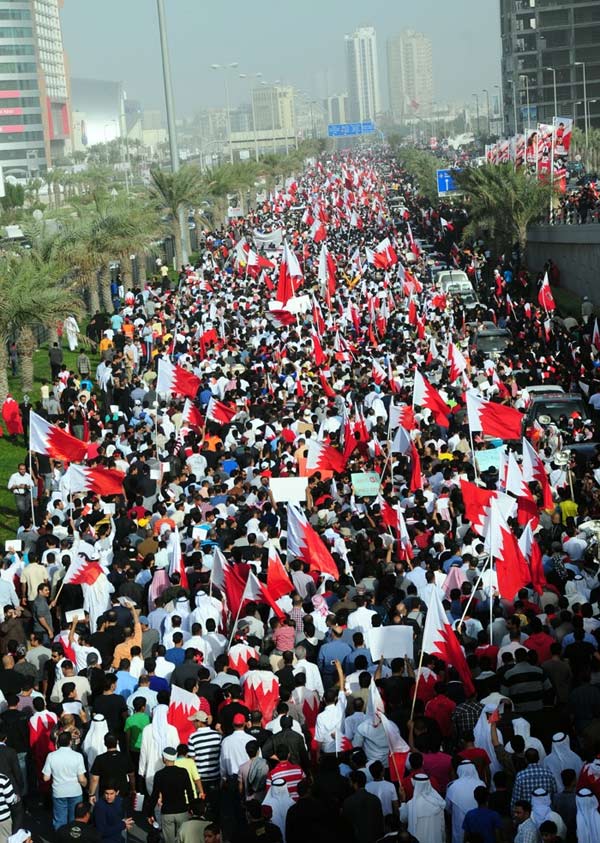
Bahraini protests against the ruling Al Khalifa family

However, international human rights organizations have been more adamant in their mission to expose violations. Human Rights Watch in their 2016 World Report mention some violations pertaining to torture and imprisonment, fair trial, freedom of expression, and use of excessive force. Amnesty international in their 2015/2016 Report pointed out similar violations as well as impunity of authorities. Reports Sans Borders ranks Bahrain at a low 162nd in their Press Freedom Index. Moreover, the United States Embassy in Bahrain published its own Human Rights Report on its website. In a very lengthy report that includes numbers and dates, the embassy admits to acknowledging many of these violations. It would seem very unlikely, to me at least, that all of these organization are fabricating facts and accusing the authorities with illegitimate claims.

In 2015 alone, the opposition party AlWifaq, which has been shut down recently by authorities in attempts to stifle dissent, documented almost 1,765 arbitrary arrests, the highest per capita in the Middle East as reported by Index Censorship. Some prisoners have died under detention. Many are detained without warrants or clear criminal charges. Prisoners as well as protestors provided evidence of physical abuse and torture, much of which can be found with a simple Google search on the topic. Those responsible for torture are often not prosecuted or acquitted without punishment. Even children between the ages of 10-15 were not spared from arrest. Rather than prosecuting them through juvenile trials, they were treated to the same unfair courts other detainees faced.

Moreover, there is no room for activism in Bahrain, whether through social media or organizations. Many activists fled the country in an attempt to escape arrest and those who choose to speak out against authorities do so cautiously. Nabeel Rajab, one of Bahrain’s prominent human rights activists and the president of Bahrain’s Centre for Human Rights has been in and out of prison for Twitter posts that are considered offensive to national institutions. The former president and founder of the organization Abdulhadi al Khawaja was sentenced to life in prison in 2011, has gone through a hunger strike, and sent an open letter to the High Commissioner for Human Rights describing physical and sexual abuse he has received during his time in prison.

The plain scenario of Bahrain is as follows: if you are a citizen, especially Shia and poor, you already have a target on your back and your rights to protest are minimal. You are not allowed to voice criticism against the government, the royal family, or national authorities. You should watch what you say on any form of social media or news outlet lest the secret intelligence get a whiff of it. If you are a civil or political leader, your speeches about demanding more rights and reform will be turned into criminal charges of inciting violence and conspiracy to topple down the government. If you are caught doing any of these, you will most probably face an unfair trial, a biased judicial system, and, if you’re lucky, abuse on top of it all. All of this is clear as day to anyone who bothers to do a little bit of research on Bahrain, yet when you are an ally of the Bahraini government, you are pressured by Saudi Arabia to not interfere and you are scared of Iran’s influence, you are most likely going to overlook their atrocities to keep the greater good of a stable Gulf. My final question is then, until when?

By Anonymous

The Nauru Files and Australia’s Dangerous Refugee Rhetoric

On Tuesday August 9th, the Guardian released 2,000 incident reports from Australia’s immigration detention and offshore asylum processing centre on the Island of Nauru, an island in the Central Pacific so remote, that it’s nearest neighbour is Kiribati over 300 km away. According to the Guardian’s analysis, 51.3% of the reports involve children, despite children only making up around 18% of those detained on Nauru. The reports include a guard threatening to kill a boy, and a guard allegedly slapping a child. A teacher at the camp reported that her young classroom helper asked permission for a four minute shower rather than the usual two. The request was only accepted on condition of sexual favours. A report from July 2014 notes that a 10 year old child undressed and invited a group of adults to insert their fingers in her vagina. In September of that year, a girl sewed her lips together. When a guard saw this, he burst out laughing. In total the Guardian counts 7 reports of sexual assault on children, 59 reports of assault on children, 30 reports of self-harm involving children, and 159 reports of threatened self-harm involving children.

Accommodation in the Nauru detention centre

Yet sadly this should come as no surprise to the world. Two years ago, the Chief Psychiatrist responsible for the care of asylum seekers declared that, “If we take the definition of torture to be the deliberate harming of people in order to coerce them into a desired outcome, I think it does fulfil that definition.” Such criticism seemed to have little effect on the Australian government, which argued that is was doing “everything it humanly can” to provide “appropriate medical care.” This is clearly not true, as made clear by the release of these reports. Australia is committing torture in an attempt to stop people from immigrating and has been doing so for some time. This is a flagrant transgression of the Universal Declaration of Human Rights, which simply states “No one shall be subjected to torture or to cruel, inhuman or degrading treatment or punishment.” The question I wish to ask, is how did Australia, a free and democratic country, reach the point where it was torturing children on a remote Pacific island.

A good starting place to look for answers is the Tampa Affair of 2001. A Norwegian Freighter, the MV Tampa, rescued more than 400 Afghan refugees from their sinking vessel 140km north of Christmas Island. The ship requested permission to land the refugees on Christmas Island. The Australian government responded by refusing permission for the ship to even enter Australian waters and threatened to prosecute the captain as a people smuggler if he did so. The captain attempted to turn towards Indonesia, yet upon noticing that the ship was turning, the refugees became agitated. Fearing that the refugees might either jump ship or riot, the captain returned on his course towards Christmas Island. The Australian government, unimpressed with this turn of events, responded by deploying the Special Air Service Regiment to board the ship and to stop it from docking at Christmas Island. Ultimately, the refugees were then transported by the Australian Navy to two detention camps on the Island of Nauru. This was the beginning of Australia’s ‘Pacific Solution’.

The Pacific Solution was comprised of multiple strands, but the most important one was that all asylum seekers who arrived by boat would have their claims processed not in Australia, but at offshore detention centers on Manau in Papua New Guinea and Nauru. Australian Prime Minister John Howard proclaimed that “we will decide who comes to this country and the circumstances in which they come.” The aim was to deter future asylum seekers from trying to enter the country by boat. In 2002, the year after the policy was implemented, only one boat with a single asylum seeker attempted to reach Australia. According to Howard’s supporters, this was proof that he “stopped the boats,” although critics have argued that this in fact had nothing to do with Howard’s policies. They instead note that the fall of the Taliban regime led to a global decline in Afghan refugees, which had been one of the biggest groups seeking asylum in Australia. Some also point to the rise in temporary visas, meaning that refugees no longer needed to risk their lives in a boat. The detention center was finally closed in 2007 after 6 years by Howard’s successor, Kevin Rudd. Problems with the camp, including a lack of water and overcrowded tents, coupled with the fact that most the people who arrived by boat were discovered to be genuine refugees had persuaded the new Labour government to shut it down. It was however reinstated in 2012, a decision sparked by a rise in the number of boats arriving. It is the horror of this second iteration of the detention centre that the incident reports published by the Guardian cover.

However, none of this quite answers the question in hand. It is simply an explanation of events: it still begs the question of why the Howard government followed by the Labour government in 2012 both responded so aggressively to asylum seekers arriving by boat that they would detain them on Pacific Islands in secretive detention centres. To try and answer this, we must turn the clock even further back to the 1970’s, when the term ‘boat people’, entered the Australian vernacular. The first wave of boats was a symptom of the Vietnam war. Over half the Vietnamese population was displaced in this period, many fleeing to neighbouring countries, but some decided to embark on the voyage to Australia in any boat they could. Whilst the first boat people were initially received with sympathy, this did not last very long. Public debate began to focus on issues of unemployment, and of boat people “jumping the queue.” The language of a “flood”, “invasion” and “yellow peril” quickly followed, until some were even claiming that the people who arrived by boat were “pirates, rich businessmen, drug runners, and communist infiltrators.” This was the start of a growing trend of anti-boat people feeling in Australia, so that by 2001, 77% of Australians wanted to limit the number of boat people arriving.

The implicit racism is hard to ignore, especially with the language of ‘yellow peril.’ Australia has a long history of pursuing a racist immigration policy, all the way back to 1901, with the White Australia policy. There was a mix of economic concerns such as competition between British and Chinese gold miners, and union opposition of plantation owners importing Pacific islanders as cheap labour in the sugar plantations of Queensland, as well as cultural concerns about Chinese men sleeping with white women, “a fate worse than death.” The Australian government decided that it needed to protect the jobs and purity of white Australians and passed the Immigration Restriction Act of 1901. The aim of the act was to halt all non-European immigration to Australia. Non-Europeans were not allowed to immigrate for half a century, until 1958, with the passing of the Migration Act. As more and more non-Europeans migrated, a backlash began, particularly against Asian immigration and the concept of multiculturalism. This culminated politically, with the launch of then opposition leader John Howard’s One Australia Policy. He argued that the rate of Asian immigration needed to be slowed down to protect social cohesion. It was then the same John Howard who as Prime Minister set up the first detention camps on Nauru in 2001.

What we are seeing at the detention and offshore asylum processing centre at Nauru is not an isolated and deeply regrettable incident. It is the culmination of a long process, whereby Asian immigrants were looked down upon, discriminated against, belittled, and ultimately tortured and abused. Given this conclusion, it is hard to avoid thinking about Mr. Donald J. Trump, a man who up to this point has achieved surprising electoral success by calling Mexican immigrants criminals and rapists and promising to ban all Muslims, or to think of the rise of the Front National in France where Marine Le Pen compared Muslims praying on the streets due to insufficient mosque space as being like the Nazi occupation, saying “This is an occupation. Sure, there are no armored vehicles, no soldiers, but it’s still an occupation, and it weighs on the inhabitants.” If the events at Nauru are to serve any purpose, it is to remind the world of the long term dangers of poisonous rhetoric towards immigrants. When an otherwise sane government can preside over a system that repeatedly abuses and tortures children, it should give us all pause for thought.

#refugees #Australia #ThirdGenerationProject #Nauru #abuse #racism #discrimination

The Nauru Files and Australia's Dangerous Refugee Rhetoric

On Tuesday August 9th, the Guardian released 2,000 incident reports from Australia’s immigration detention and offshore asylum processing centre on the Island of Nauru, an island in the Central Pacific so remote, that it’s nearest neighbour is Kiribati over 300 km away. According to the Guardian’s analysis, 51.3% of the reports involve children, despite children only making up around 18% of those detained on Nauru. The reports include a guard threatening to kill a boy, and a guard allegedly slapping a child. A teacher at the camp reported that her young classroom helper asked permission for a four minute shower rather than the usual two. The request was only accepted on condition of sexual favours. A report from July 2014 notes that a 10 year old child undressed and invited a group of adults to insert their fingers in her vagina. In September of that year, a girl sewed her lips together. When a guard saw this, he burst out laughing. In total the Guardian counts 7 reports of sexual assault on children, 59 reports of assault on children, 30 reports of self-harm involving children, and 159 reports of threatened self-harm involving children.

Accommodation in the Nauru detention centre

Yet sadly this should come as no surprise to the world. Two years ago, the Chief Psychiatrist responsible for the care of asylum seekers declared that, “If we take the definition of torture to be the deliberate harming of people in order to coerce them into a desired outcome, I think it does fulfil that definition.” Such criticism seemed to have little effect on the Australian government, which argued that is was doing “everything it humanly can” to provide “appropriate medical care.” This is clearly not true, as made clear by the release of these reports. Australia is committing torture in an attempt to stop people from immigrating and has been doing so for some time. This is a flagrant transgression of the Universal Declaration of Human Rights, which simply states “No one shall be subjected to torture or to cruel, inhuman or degrading treatment or punishment.” The question I wish to ask, is how did Australia, a free and democratic country, reach the point where it was torturing children on a remote Pacific island.

A good starting place to look for answers is the Tampa Affair of 2001. A Norwegian Freighter, the MV Tampa, rescued more than 400 Afghan refugees from their sinking vessel 140km north of Christmas Island. The ship requested permission to land the refugees on Christmas Island. The Australian government responded by refusing permission for the ship to even enter Australian waters and threatened to prosecute the captain as a people smuggler if he did so. The captain attempted to turn towards Indonesia, yet upon noticing that the ship was turning, the refugees became agitated. Fearing that the refugees might either jump ship or riot, the captain returned on his course towards Christmas Island. The Australian government, unimpressed with this turn of events, responded by deploying the Special Air Service Regiment to board the ship and to stop it from docking at Christmas Island. Ultimately, the refugees were then transported by the Australian Navy to two detention camps on the Island of Nauru. This was the beginning of Australia’s ‘Pacific Solution’.

The Pacific Solution was comprised of multiple strands, but the most important one was that all asylum seekers who arrived by boat would have their claims processed not in Australia, but at offshore detention centers on Manau in Papua New Guinea and Nauru. Australian Prime Minister John Howard proclaimed that “we will decide who comes to this country and the circumstances in which they come.” The aim was to deter future asylum seekers from trying to enter the country by boat. In 2002, the year after the policy was implemented, only one boat with a single asylum seeker attempted to reach Australia. According to Howard’s supporters, this was proof that he “stopped the boats,” although critics have argued that this in fact had nothing to do with Howard’s policies. They instead note that the fall of the Taliban regime led to a global decline in Afghan refugees, which had been one of the biggest groups seeking asylum in Australia. Some also point to the rise in temporary visas, meaning that refugees no longer needed to risk their lives in a boat. The detention center was finally closed in 2007 after 6 years by Howard’s successor, Kevin Rudd. Problems with the camp, including a lack of water and overcrowded tents, coupled with the fact that most the people who arrived by boat were discovered to be genuine refugees had persuaded the new Labour government to shut it down. It was however reinstated in 2012, a decision sparked by a rise in the number of boats arriving. It is the horror of this second iteration of the detention centre that the incident reports published by the Guardian cover.

However, none of this quite answers the question in hand. It is simply an explanation of events: it still begs the question of why the Howard government followed by the Labour government in 2012 both responded so aggressively to asylum seekers arriving by boat that they would detain them on Pacific Islands in secretive detention centres. To try and answer this, we must turn the clock even further back to the 1970’s, when the term ‘boat people’, entered the Australian vernacular. The first wave of boats was a symptom of the Vietnam war. Over half the Vietnamese population was displaced in this period, many fleeing to neighbouring countries, but some decided to embark on the voyage to Australia in any boat they could. Whilst the first boat people were initially received with sympathy, this did not last very long. Public debate began to focus on issues of unemployment, and of boat people “jumping the queue.” The language of a “flood”, “invasion” and “yellow peril” quickly followed, until some were even claiming that the people who arrived by boat were “pirates, rich businessmen, drug runners, and communist infiltrators.” This was the start of a growing trend of anti-boat people feeling in Australia, so that by 2001, 77% of Australians wanted to limit the number of boat people arriving.

The implicit racism is hard to ignore, especially with the language of ‘yellow peril.’ Australia has a long history of pursuing a racist immigration policy, all the way back to 1901, with the White Australia policy. There was a mix of economic concerns such as competition between British and Chinese gold miners, and union opposition of plantation owners importing Pacific islanders as cheap labour in the sugar plantations of Queensland, as well as cultural concerns about Chinese men sleeping with white women, “a fate worse than death.” The Australian government decided that it needed to protect the jobs and purity of white Australians and passed the Immigration Restriction Act of 1901. The aim of the act was to halt all non-European immigration to Australia. Non-Europeans were not allowed to immigrate for half a century, until 1958, with the passing of the Migration Act. As more and more non-Europeans migrated, a backlash began, particularly against Asian immigration and the concept of multiculturalism. This culminated politically, with the launch of then opposition leader John Howard’s One Australia Policy. He argued that the rate of Asian immigration needed to be slowed down to protect social cohesion. It was then the same John Howard who as Prime Minister set up the first detention camps on Nauru in 2001.

What we are seeing at the detention and offshore asylum processing centre at Nauru is not an isolated and deeply regrettable incident. It is the culmination of a long process, whereby Asian immigrants were looked down upon, discriminated against, belittled, and ultimately tortured and abused. Given this conclusion, it is hard to avoid thinking about Mr. Donald J. Trump, a man who up to this point has achieved surprising electoral success by calling Mexican immigrants criminals and rapists and promising to ban all Muslims, or to think of the rise of the Front National in France where Marine Le Pen compared Muslims praying on the streets due to insufficient mosque space as being like the Nazi occupation, saying “This is an occupation. Sure, there are no armored vehicles, no soldiers, but it’s still an occupation, and it weighs on the inhabitants.” If the events at Nauru are to serve any purpose, it is to remind the world of the long term dangers of poisonous rhetoric towards immigrants. When an otherwise sane government can preside over a system that repeatedly abuses and tortures children, it should give us all pause for thought.