Hatch4Good: Solving the Challenges We Face, Now and in the Future

Students from different areas of study at the University of Saint Andrews came together on 14-15 October as part of a national effort to instigate social and environmental change through the ‘Hatch4Good’ initiative.

The aim was to inspire and innovate, to reform the old, and invent new means to live and promote sustainable resource use, environmental protection, and social improvement.

Students grouped together to create business models and pitched their ideas to a judging panel comprised of fellow students who initiated the incubator event. The solutions fest was kickstarted at the end of the first day, with some exciting and thought-provoking plans to address a range of issues, from reinvigorating health systems to new systems for environmental change.

The event is witness to the next generation of concepts and designs for a cleaner, fairer, and healthier world, one that respects, protects, and sustains our finite environmental resources, as well as provide people with better life choices and opportunities in the future.

Some students crossed the boundaries of subject matter to address health or physical impediments within a newly imagined school system to help students better deal with dyslexia from an early age. Concepts included a new application to help people better manage debilitating diseases such as dementia, in the form of a backpack designed to record and calculate the weight of their bag and the items within. The app alerts the wearer when something is missing before they leave a shop for example.

The atmosphere was charged. Students were energized. Guest speakers revved up proceedings with activities and exercises designed to spur students’ imagination through helping with their pitching skills. Student participators were engaged and animated throughout these introductory sessions and the following process. They split into groups to start working on their own innovations with some support from the KickStart Incubator (the first student incubator running Hatch4Good at St. Andrews).

Each group was encouraged to apply an interdisciplinary approach to their collaboration efforts. Leadership roles, pitching and marketing people, tech people, creative people and writers were all needed to come up with something that was viable, believable, and possible.

At the end of the event, groups with great concepts had a chance to win funding support to bring their invention to fruition. The event, sponsored by JP Morgan, Amazon, Vodafone and Founders Factory, gives young people the chance to realize their brainchild to solve a problem or address a social challenge for all. This is corporate social responsibility in action for positive and constructive change.

Photography by Alanna Gow.

To see more photos, visit our Facebook page.

Remembering Liu Xiaobo

Last Thursday (October 19th), a service took place at Washington National Cathedral to commemorate the work and life of Nobel Peace Prize Laureate, Liu Xiaobo, and celebrate his wife, Beijing-based poet, artist, and activist, Liu Xia. The event included messages from the Dalai Lama, House Democratic Leader Nancy Pelosi, and Congressman Chris Smith, as well as readings of Liu Xiaobo and Liu Xia’s works by eminent academics.

It served primarily to remember the achievements of Liu Xiaobo who died in custody on 13 July this year, aged 61. He had been imprisoned since 2008 on charges of “suspicion of inciting subversion”. In May, he was diagnosed with late-stage liver cancer and eventually transferred to Shenyang’s First Hospital of China Medical University.

Liu’s entire imprisonment was shrouded in secrecy; he was not allowed to travel abroad to receive medical treatment. This was despite his family’s wishes, and the adjudication of two independent doctors from the United States and Germany that he was “fit for travel”, contrary to the Chinese Government’s previous assertion that his condition prevented him from traveling abroad to receive treatment.

The quality of care that Liu received is unknown, yet Human Rights Watch has reported significant medical neglect in Chinese prisons and detention centres. Berit Reiss-Andersen, the leader of the Norwegian Nobel Committee, said the Chinese government bore “a heavy responsibility for his premature death”. The situation drew comparisons to the last time a Nobel Peace laureate died in state custody. This was in 1938, when Carl von Ossietzky died of tuberculosis under guard in a hospital in Nazi Germany.

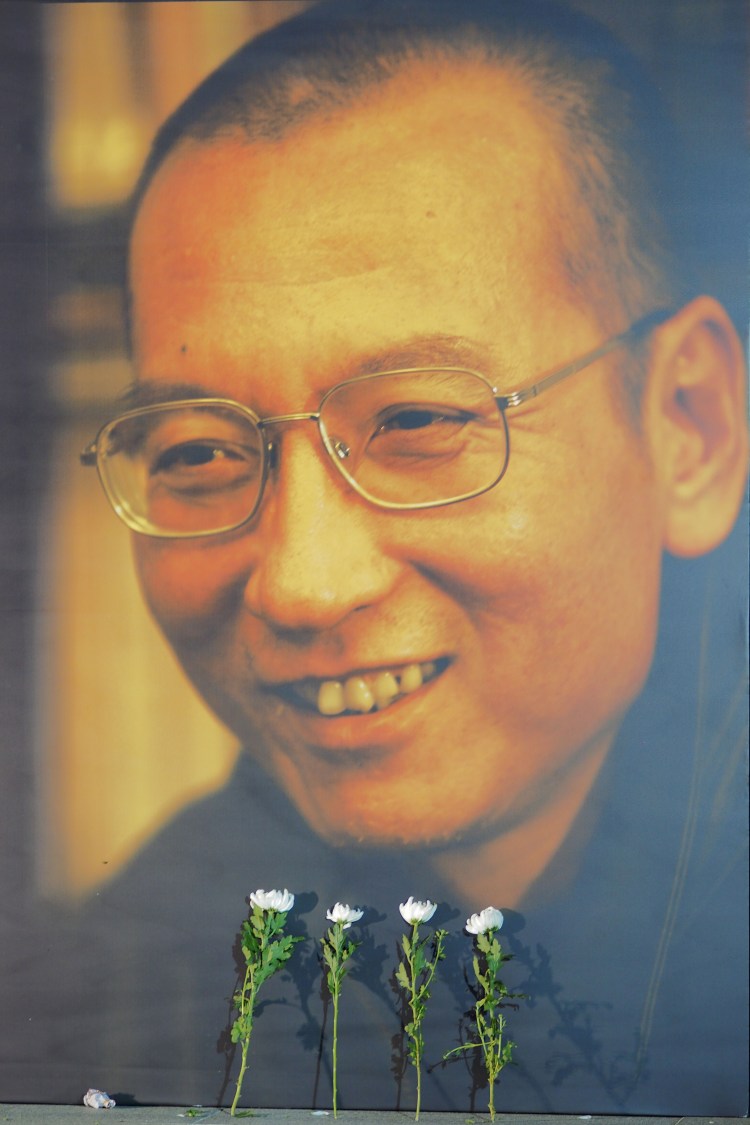
Memorial for Liu Xiaobo. Source: Etan Liam.

Through his work as an independent intellectual, Liu was an outspoken critic of the Chinese Communist regime, advocating democratic reform and the proliferation of human rights. As an academic, he became a visiting scholar at several universities including Columbia University, the University of Oslo, and the University of Hawaii.

He returned to China from the U.S. during the 1989 Tiananmen Square protests, which aimed for democratic reforms including freedom of speech. One of the leading academics behind the largely student-led protests, he played a key role as one of the “four gentlemen” who launched a hunger-strike in solidarity with the students. He drafted the manifesto, containing the slogan “We have no enemies!”. He later helped to broker a deal between the government and protesters for their peaceful exit from the square, amidst the brutal crackdown which left hundreds dead.

His quest for democratic reform did not end there, even as other outspoken figures fell into obscurity: “Others can stop. I can’t,” said Liu. He spent much of the remainder of his life in and out of prisons and labour camps. It was during a stint at one such re-education-through-labour camp that he and his second wife, Liu Xia, were married.

Liu Xiaobo’s final prison sentence began in 2009. He was imprisoned due to his role in drafting the Charter 08 manifesto, published on the 60th anniversary of the Universal Declaration of Human Rights the year before. It called for 19 changes, including the elimination of one-party rule, the guarantee of human rights, and freedom of association. The charter was initially signed by 350 Chinese intellectuals and human rights activists, and since its release has amassed over 10,000 signatures.

In 2010, Liu was awarded the Nobel Peace Prize, in recognition of “his long and non-violent struggle for fundamental human rights in China”, becoming the third person to receive the award while in detention after von Ossietzky (1935) and Burma’s Aung San Suu Kyi (1991). Thorbjoern Jagland, the chairman of the Nobel committee, told the audience that the award was “dedicated to the lost souls of 4 June [the Tiananmen Square Protests]”. Chinese authorities cracked down on activists in the lead-up to the Ceremony, with many placed under house arrest or surveillance. Beijing was furious at the award, with the official Xinhua agency saying that it had “launch[ed] a new round of China-bashing.”

The Members of the Norwegian Nobel Committee, by Marta B. Haga/MFA, Oslo. Liu’s seat was empty at the Nobel Ceremony in 2010, as he was not allowed to attend. Source: Flickr

Since the award in 2010, Liu Xia has remained under house arrest and been kept in near total isolation, despite a lack of conviction for any crime. She has been kept out of the public eye for fear that a democratic movement could rally behind her. In one brief appearance outside the trial of her brother, Liu Hui, she wept and shouted: “Tell everybody I’m not free!”.

Her detention was declared arbitrary by the Working Group on Arbitrary Detention, and therefore a breach of her human rights. Despite numerous protests, she remains in isolation. The event on Thursday was also intended to reignite efforts to have her released.

The story of Liu Xiaobo and Liu Xia, according to Professor Steve Tsang, reflects the growing confidence of the Chinese government that it can ignore Western criticism. Many international figures offered their condolences over Liu Xiaobo’s death, and some such as British Foreign Secretary, Boris Johnson, called for the Chinese authorities to “lift all restrictions” on his widow, yet, as Tsang argues, the international response was not backed up by anything concrete.

As Sonya Sceats and Shaun Breslin wrote for Chatham house in 2012, China’s economic clout has dissuaded leaders to take a harder line on human rights issues within the Communist state. Chinese diplomats have focused their efforts on rebuking any attack on their human rights record, undermining the Universal Period Review process in doing so. They have continually emphasised a sovereignty-centric approach, criticising human rights investigations as “interference in other countries’ internal affairs under the pretext of defending human rights”.

There is no consensus on how to deal with this ‘Chinese Challenge’, which comes at a pivotal time for the human rights movement; potential beacons for the movement such as the U.S. and the EU have been weakened by recent developments. Yet, events like the one held last Thursday show that Liu Xiaobo and Liu Xia’s plight has not yet been forgotten. As Sophie Richardson, Human Rights Watch’s China director, has said, “The Chinese government’s arrogance, cruelty, and callousness are shocking – but Liu’s struggle for a rights-respecting, democratic China will live on.”

The Rohingya Crisis: Is International Intervention the Answer?

Who are the Rohingya and what is happening to them?

In looking to the crisis in Myanmar and the plight of the Rohingya people, the extent of the devastation is clear. Since August, 537,000 have fled from the Rohingya’s place of origin, Rakhine state, to Bangladesh in an attempt to escape the systematic persecution they are facing at the hands of Myanmar’s military. The current violence was precipitated by an incident on the 9th October 2016, when an attack on police outposts in Rakhine state, which left 9 border officers dead, was blamed on the Arakan Rohingya Salvation Army (ARSA). In retaliation, the Myanmar army began a large-scale counter insurgency operation against the Rohingya population, an offensive which the UN has condemned as “a textbook case of ethnic cleansing”. Summary executions are frequent and indiscriminate; people are shot from helicopters at close range, and children and adults have their throats slit in front of their families. The recent UN report, based on interviews with refugees, describes the routine gang-rape of women and the destruction of homes and food supplies, with the clear intention of making it impossible for the Rohingya people ever to return to the area.

Abuse and marginalisation of the Rohingya people is long-standing in Myanmar. The Rohingya, who numbered over one million at the start of the year, are the largest of many Muslim minorities in the predominantly Buddhist country. Most live in the western state of Rakhine, which borders Bangladesh, and say they are the descendants of Arab traders who have lived in the region for centuries. However, the Myanmar authorities regard them as illegal immigrants from Bangladesh, deny them citizenship, and even excluded them from the census of 2014, rendering them the world’s largest group of stateless people.

After Burma gained independence from Britain in 1948, the Rohingya were initially acknowledged as one of the country’s ethnic groups. However, following the military coup of 1962, the ascending generals established themselves as protectors of a Buddhist socialist state and ruthlessly cracked down on minority insurgencies in the borderlands. From the 1970s onwards, the Rohingya have faced systematic persecution, both legislatively and militarily; they are denied the right to education, to healthcare, and to vote, and everything from their movement to the number of children they are allowed to have is restricted by Myanmar’s government.

This history of disenfranchisement, the recent exodus, and the failure of Myanmar’s elected leader and Nobel Peace Prize winner, Aung San Suu Kyi, to denounce the indiscriminate, state-backed violence has led to the question of whether international intervention into the crisis is necessary.

International intervention is necessary

The silence of the former paragon of democracy, Aung San Suu Kyi, on the ensuing violence has been deafening. At one time viewed as a symbol of resistance against the governing military junta, she advocated the need for a peaceful revolution in the country’s transition to a democratic state and in 2015 her party, the National League for Democracy, won Myanmar’s first free elections in over half a century.

In spite of her humanitarian past, Suu Kyi has refused to defend the Rohingya, characterising the coordinated military attacks against them as defence against terrorism. Whilst the latest military crackdown was indeed provoked by an attack on a police outpost by a Rohingya militant group, the response of the Myanmar military has been grossly disproportionate. They have targeted entire communities of civilians, despite militant groups’ declaration of a ceasefire.

The Rakhine Advisory Commission, an independent group appointed by Suu Kyi under pressure from the international community, recommended that Myanmar immediately address the citizenship rights and political representation of Muslims in Rakhine state, granting them healthcare and education rights and allowing displaced Rohingya people to return home. However, in a heavily criticised speech last month, which brought months of her silence on the issue to an end, Suu Kyi failed to denounce the reported atrocities, in an address which Amnesty International condemned as a “mix of untruths and victim blaming”.

Jono Davis for the St Andrews Economist has argued that international intervention in Rakhine state would be problematic. However, the Rohingya remain trapped in a buffer-zone between two countries which do not want them there (Myanmar considers them to be illegal immigrants and Bangladesh refuses to afford them refugee status), and with more than 15,000 refugees reportedly arriving in Bangladesh in the space of 48 hours, it appears that only international intervention can help to bring the plight of the Rohingya to an end.

Whilst it is likely that any form of unilateral military intervention would result in a war, inevitably destabilising Myanmar and likely incurring governmental change, more diplomatic means of putting pressure on Myanmar’s ruling elite do exist. Since August, the government has blocked UN aid agencies from entering parts of Rakhine state, where thousands of desperate civilians are in vital need of food, water, and medical supplies. World leaders must call on the government to reinstate access to this area for humanitarian groups. Meanwhile, holding an emergency aid conference to support the refugee camps in Bangladesh would help in drawing global attention to the crisis. Unilateral pressure must also be directed at the head of the Myanmar military, Min Aung Hlaing, who has recently demonstrated a desire to build ties with European and Asian democracies. Governments looking to expand relations with Myanmar’s military, such as the U.S. and China, must halt this process immediately as a signal of their condemnation of the action.

A more focused response could be presented by the Association of Southeast Asian Nations (ASEAN), an alliance interconnected by common ethnic and religious identities, as well as migration and economic relations, of which Myanmar has been a member since 1997. ASEAN could engage in preventive diplomacy with Myanmar, pushing the government and armed forces to end the violence in Rakhine state and highlighting legal and structural reforms which would facilitate an immersion of the Rohingya into Myanmar’s society. Nevertheless, a solution to the crisis will be contingent on the government’s willingness to engage with global partners, as well as a profound shift in socio-political attitudes towards ethnic minorities in Myanmar.

The Ethnic Cleansing of the Rohingya

The plight of the Rohingya people is a story of oppression and rejection, generation after generation. They are a stateless ethnic minority from the Rakhine state in Myanmar, as well as a religious minority, being predominantly Muslim in a Buddhist-majority state. There is currently a population of just over a million Rohingya, who can be differentiated from the general population largely by their unique dialect called Rohingya. They live in ramshackle ghettos, are traditionally the poorest group in the country, and are often described as one of the most persecuted minorities in recent history.

Under the 1982 Myanmar nationality law, they were actively denied citizenship which, according to the Human Rights Watch, has effectively disallowed the Rohingya ‘the possibility of acquiring a nationality’. Though they view themselves as a native people and can trace their history in the Rakhine area as far back as the twelfth century, they are unwelcomed by the majority of the Myanmar population and are perpetually persecuted by the government. The legal situation for the Rohingya has even been compared to the apartheid system – they have severely restricted freedom of movement, civic rights, and educational rights. Their situation has long been dreadful, and has only degenerated further in the past two years.

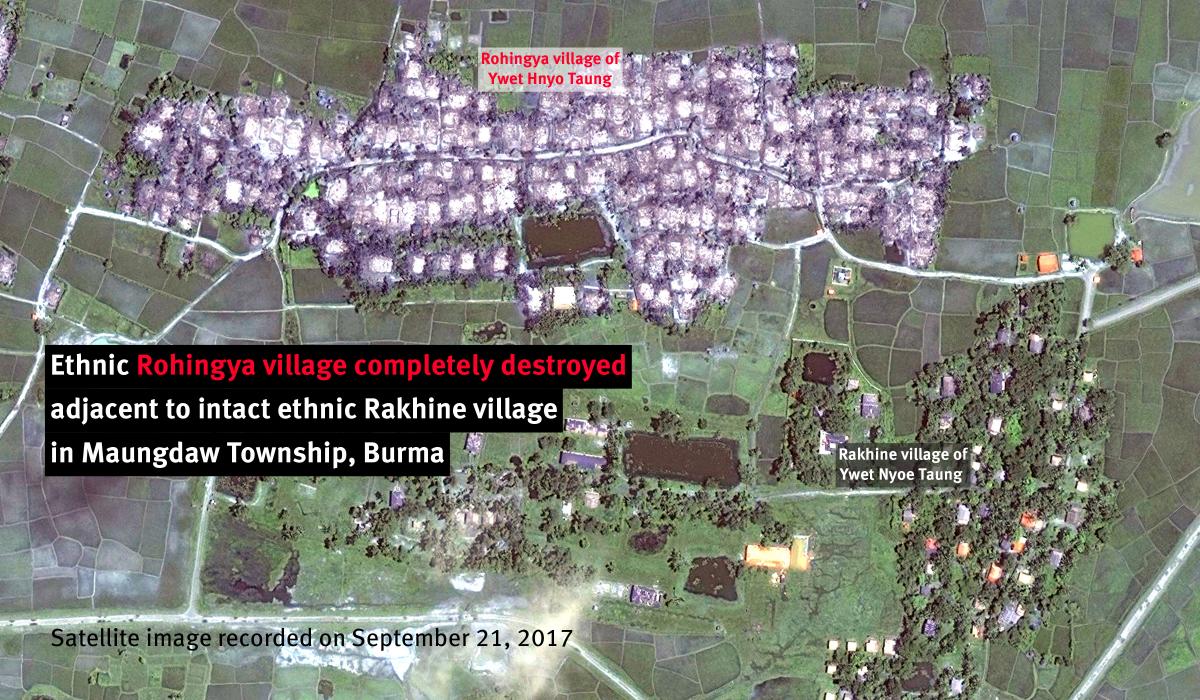
Since 2016, the Rohingya have faced increased persecution by the government following an episode in which Rohingya insurgents attacked over thirty Myanmar border posts. The attacks were, in part, a culmination of generations of communal hatred between the Rohingya and their Buddhist neighbors. In response to the attacks the government, backed by Buddhist mobs, attacked the Rohingya in their homes. The army and police have been accused of extrajudicial killings, gang rapes, mass-arson, and infanticides. However, the government claims that accounts of such events are exaggerated and have even maintained that the Rohingya burned their own villages. Nevertheless, despite Myanmar’s promise to the contrary, there is overwhelming proof of the occurrence of these atrocities and thousands of similarly tragic stories. There is footage of villages in the Northern Rakhine state being burnt to the ground and claims that their populations were abused by the military. Hundreds of people had been recorded dead by December 2016. In autumn of 2017 there were increased ‘military clearances’ of the Rohingya population involving the razing of villages, rape and murder of the inhabitants, and a forced exodus of the survivors.

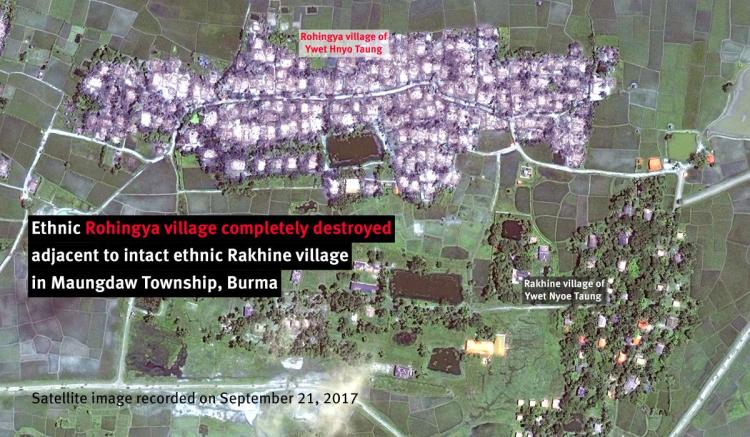
Satellite image of a destroyed Rohingya village, adjacent to an intact village.

Image courtesy of Human Rights Watch (covered by the Creative Commons License).

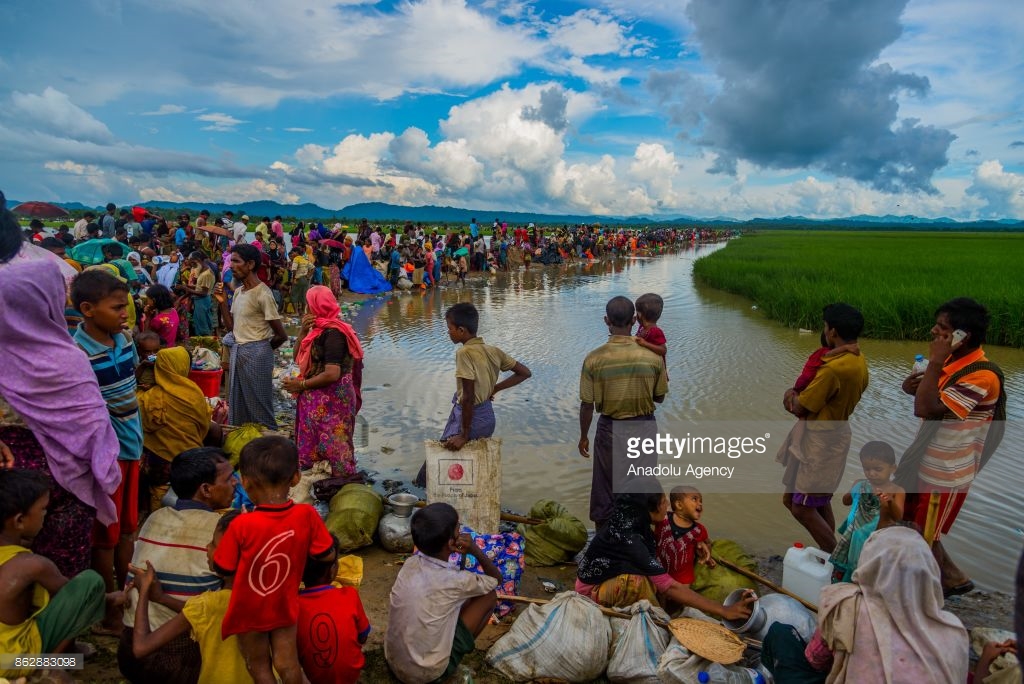
The severity of harm inflicted upon the Rohingya since 2016 and the most recent military clearances have resulted in nearly a third of the Rohingya population fleeing Myanmar, chiefly seeking refuge in nearby Bangladesh. This has created a massive refugee crisis, particularly since they are nearly as unwelcome in Bangladesh as they are in Myanmar. Migrants have fled most often in boats overflowing with desperate men, women, and children. Countless have died on such journeys from both the perils of the sea and the perils of machine-gun armed Myanmar helicopters. In shooting fleeing refugees, there is an abject cruelty shown to people who are only desperate to live and find a safe home.

Over half a million of these Rohingya refugees have managed to arrive in Bangladesh and it is estimated that 58% are children. Sprawling shelters have been erected near the border to form unofficial, disorganized refugee camps. According to the United Nations, the conditions are extremely poor, with a marked lack of access to consistent food and fresh water. There is a particular need for cholera vaccinations and latrine systems for the thousands of people living in tents. The response plans by the UN require an estimated 434 million dollars in donations.

The treatment of the Rohingya is an appalling violation of basic human rights and an extreme abuse of power by the regime. The most recent wave of persecution is but one in a series of abuses the Rohingya have endured. Though international aid organizations such as Oxfam and the Red Cross have been supporting an aid effort, they have largely been overwhelmed by the magnitude of the suffering and need. Proposals for sanctions to be placed on Myanmar have been summarily rejected, in part because, though the official story presented by the Myanmar government is flimsy, it makes any sort of disciplinary action by the global community difficult. Myanmar continues to maintain a story in which they have no direct involvement in the Rohingya people’s suffering, despite video evidence and first-hand accounts existing that prove the opposite. They continue to support, or at the very least allow, a comprehensive restriction and attack on the basic human rights the Rohingya.

Ala Kachuu: Bride-kidnapping in Kyrgyzstan

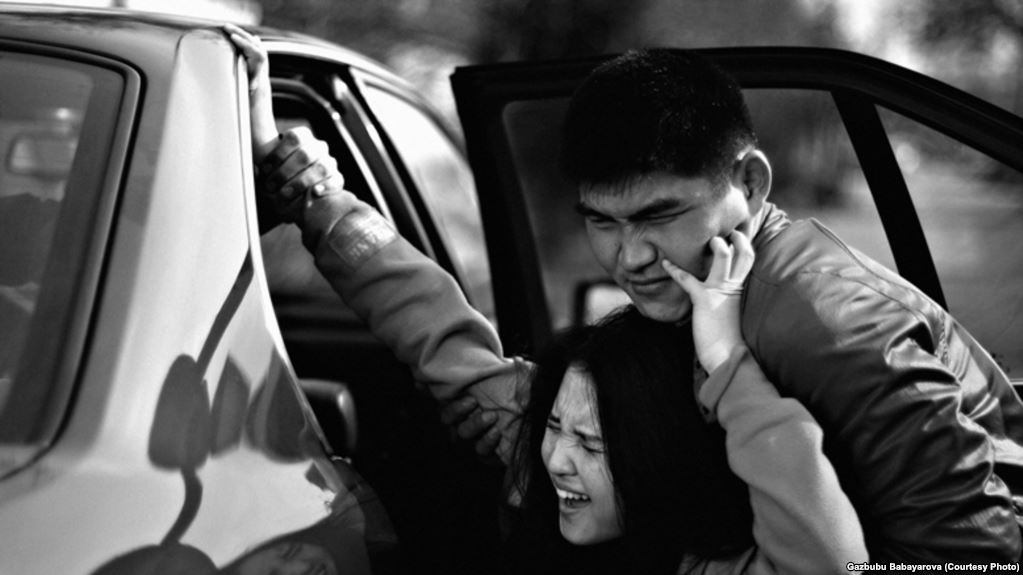
Ala kachuu, meaning ‘‘grab and run” in Kyrgyz, refers to the often-violent kidnapping of young women, who are then coerced into marriage by their captor. Bride kidnapping is an extremely stressful and traumatising experience that denies a woman her rights and violates numerous international declarations of human rights. These women often experience physical, emotional, and sexual violence, accompanied by social stigma that prevents them from fighting back or escaping. If the woman tries to escape, she risks dishonouring Kyrgyz tradition and alienating herself from her family and village. The practice strips consent and agency from abducted women, solidifying the bride’s victimhood.

Illustrative photo from the Kyz Korgon Institute, an Kyrgyz NGO that campaigns to eliminate the practice. Source: RadioFreeEurope

The typical scenario in Kyrgyzstan involves a young man, accompanied by several friends (and usually a bottle of vodka), who attacks a preselected young woman on the street, forcing her into a car and taking her back to his home. The man’s family then pressures the woman to consent to the marriage, with female members playing a large role in psychologically and physically forcing the woman to don the traditional “marriage scarf,” which evidences the agreement to marriage. With the bride’s reluctant assent in place, the kidnapped woman informs her parents of the arrangement and the ceremony cements her newly-wed status. In her article “Hunting for Women: Bride-kidnapping in Kyrgyzstan,” Lori Handrahan states that “bride-kidnapping appears to be a method for Kyrgyz men to mark their ethnic coming of age.” Ala kachuu is simultaneously a reification of a cultural Kyrgyz identity and the idea of “manhood” – at the expense of a woman’s freedom.

Approximately one third of ethnic Kyrgyz brides have been forced into a traumatic, non-consensual marriage. The Women’s Support Centre (WSC) in Bishkek reports at least 11,800 cases of bride abduction per year, with 2,000 cases involving rape. The Kyz Korgon Institute, an NGO that works to eliminate the practice, estimates that between 68 and 75% of marriages in Kyrgyzstan result from illegal bride kidnapping.

The practice of ala kachuu breaks numerous human rights laws, both domestic and international. Article 16 of the Universal Declaration of Human Rights (UDHR) explicitly states that “marriage shall be entered into only with the free and full consent of the intending spouses.” Kyrgyzstan is also party to the Convention on the Elimination of All Forms of Discrimination against Women (CEDAW), which the country ratified in 1997. Article 16 of the CEDAW asserts that all parties “shall take all appropriate measures to eliminate discrimination against women in all matters relating to marriage and family relations and in particular shall ensure, on a basis of equality of men and women: (a) The same right to enter into marriage, and (b) The same right freely to choose a spouse to enter into marriage only with their free and full consent.” Even domestic laws explicitly outlaw ala kachuu. Article 155 of the Kyrgyz Republic Criminal Code prohibits “forcing a woman to marry or to continue a marriage or kidnapping her in order to marry without her consent.”

According to the laws listed above, among others, ala kachuu should be prosecuted as a gross violation of basic human rights. However, despite the overwhelming legal condemnation, very few incidents are ever reported, let alone prosecuted. Kyrgyzstan’s President Almazbek Atambayev banned bride kidnapping in 2013, with a punishment of up to 10 years in prison. However, since 2008, only one perpetrator of the crime has been convicted.

According to the 2015 UN Convention of the Elimination of All Forms of Discrimination against Women, Kyrgyzstan has failed to undertake sustained measures to eliminate the harmful practice of bride kidnapping. The CEDAW Committee stated that they were “deeply concerned that bride kidnapping appears to be socially legitimized and surrounded by a culture of silence and impunity, and that cases of bride kidnapping remain underreported, as they are considered a private issue that should remain within the family.” The Kyrgyz social practices of secretive bride-kidnapping seem to be stronger than the legal code forbidding it. Bride kidnapping has been framed as central to Kyrgyz identity. In certain rural areas, bride kidnapping is seen as a ‘rich tradition’ and accepted as the norm. Social acceptance makes it difficult to acquire information about potential victims, with many family members protecting the kidnapper. A human rights perspective, however, dictates that the practice should be understood as a complex social institution, rather that a rich tradition — especially since bride kidnapping was uncommon prior to the twentieth century. Thus, it defies the usual classification of a so-called ‘traditional’ practice.

Civil society groups, like the Women Support Centre, seek to rectify the systemic violation of human rights in Kyrgyzstan. However, despite successes from lobbying and advocacy work that played a large role in pushing for the 2013 amendment to extend the punishment for bride kidnapping to 10 years, the groups still have a long fight ahead. Ala kachuu continues to be seen as a rite of passage for Kyrgyz men, and older women in the captor’s family continue to force the woman to don the marriage scarf.

While the Kyrgyzstan government fails to prosecute many cases of ala kachuu, cultural attitudes also contribute to the continuing violations of human rights. According to Chingiz Batyrbekov, professor of human rights at the American University of Central Asia, if the government wants to address this issue, the highest levels of authority need to engage in a sustained effort to increase public education and awareness of domestic and sexual violence. Batyrbekov thinks the government should be doing more, stating that “laws were adopted, but they don’t work… The government doesn’t see it as an issue. Only women MPs are addressing the problem.” Until the government decides to take a more active role in combatting the internationally-condemned practice of ala kachuu, human rights laws will continue to be violated.

More Than Just a Forgotten War: An Abandoned People

In March, 2015, the civilian population in Yemen was struck with disaster. Pinned between two opponents, the Saudi Arabia-led coalition, supported by the United States, and the Houthi forces, the Middle East’s poorest country, Yemen, (as reported by The New York Times), experienced the deadliest terror attack to occur there up to that date, The Wall Street Journal reports. Nearly all subsequent events have equaled or surpassed the damage of the first. Each side of the conflict supports a different leader—the Saudis, current President Abdu Rabu Mansour Hadi, and the Houthis, former President Ali Abdullah Saleh—and fights to continue or to restore his respective power. While the parties involved play political battle ship, nearly 5,000 civilians have been killed, over 7,000 injured, and 20.7 million people are in need of humanitarian assistance (United Nations Children’s Fund (UNICEF) reports).

Nearly every day civilians are targeted by airstrikes, landmines, and cluster munitions in their homes, at schools, and at hospitals, leaving nearly two million children out of school (reported by UNICEF). There are 2.9 million internally displaced persons (IDPs), and 14.8 million people in need of basic health care, unable to receive it. All parties in the conflict, including the spread of al-Qaeda and ISIL throughout the state — by way of minimal governmental structure — have blocked the access of humanitarian aid to those in need (Al Jazeera explains), who are approximately equivalent to the populations of New York City, Sao Paulo, or Beijing. While images representative of the conflict are of skeletal individuals and mushroom clouds of smoke, as reported by The New York Times, blockades to Yemen’s two main borders, Saudi Arabia and the Arabian Sea, prevent the entrance of essential food and medical supplies. Although one of the most devastating in modern day history, the conflict in Yemen, has been termed the “Forgotten War.”

Yemenis endure struggle day-in and day-out as all parties involved in the conflict violate the laws of war and numerous internationally-recognized human rights. The targeting of civilians, homes, and hospitals, as well as mistreatment of detainees has been rampant for the last two years, not to mention the recruitment and use of at least 1,800 children by all parties in the conflict, as reported by UNICEF. Internationally-banned antipersonnel landmines and cluster munitions, airstrikes, and indiscriminate rockets have been deployed by all sides, and although named on the annual United Nations “list of shame”, reported Human Rights Watch, neither the Saudi Arabia-led coalition nor the Houthi forces have stopped persecuting the Yemeni civilian population, who live in constant fear, and feel abandoned by the rest of the world.

As Severe Acute Malnutrition (SAM), Acute Watery Diarrhea (AWD), and Cholera run rampant, 385,000 children under five years of age suffer from SAM, and 1,915 have died from AWD and Cholera, UNICEF reports, and one million lactating women are expected to suffer from Acute Malnutrition, the United States, and other countries—Turkey, Canada, United Arab Emirates—continue to supply the conflict’s parties with weapons. Amnesty International reports that approximately 5.9 billion US dollars worth of weapons, including drones, bombs, torpedoes, rockets, and missiles have been supplied to the Saudi Arabia-led coalition throughout the conflict. Although there have been protests over these countries’ involvement in several of the nations, the results of protests have been insufficient; weapons sales have either continued, or have only temporarily stopped. James Lynch, Deputy Director of Global Issues Program at Amnesty International, had this to say: “The irresponsible and unlawful flow of arms to the warring parties in Yemen has directly contributed to civilian suffering on a mass scale. It’s time for world leaders to stop putting their economic interests first”.

Amidst the destructive conflict however, UNICEF has successfully sent a number of aid workers into targeted areas, and in the last year was able to administer vaccinations throughout several IDP camps. Additionally, on 29 September 2017 the UN Human Rights Council (UNHCR) mandated an international group of experts to cumulatively investigate war and humanitarian violations, on all sides of the conflict in Yemen. Senior Director for Research at Amnesty International, Dr. Anna Neistat, responded to the mandate: “This resolution is a victory for Yemenis whose suffering at the hands of all parties to the conflict has been overlooked by the international community. The resolution offers hope for those seeking justice and can serve as a stepping stone towards accountability”.

There are ways that others can help as well, such as donating to organizations that have provided aid on the ground to over a million people, for example UNICEF, Amnesty International, CARE, and the Disasters Emergency Committee. Other ways to help include signing these organizations’ petitions, but, more importantly, talking about this conflict to raise awareness, to ensure that the ‘Forgotten War’ is acknowledged.

Importance of Food Banks for Non-food Items

In recent years there has been an increase of food banks and centres in use in Britain. A number of factors contribute to their increase and there is not a simple answer or solution regarding how to help those that use them. Food banks provide more than just food; they provide toiletries, baby supplies, cleaning supplies, and sanitary products. Other than the tangible objects, they provide a space free from judgement where those in need are able to get provisions and support.

In 2016-17 the number of three-day emergency parcels provided by the Trussell Trust increased by 6.4%, or by almost 74,000 parcels. However, this is not a true reflection of numbers due to two reasons: people on average needed two food referrals, which means the number of food bank users was around 600,000 for the 2016-17 period. Secondly, the Trussell Trust does not run all the food banks in Britain, with many being small local banks run by a community. The increase in use of food banks is tied to the changes made to the welfare system, specifically the introduction of the Universal Credit system. Holidays are often very busy times for food banks, as parents of children who would usually receive free meals whilst at school, struggle to feed their children who are at home all day. Whilst the majority of donations to and parcels given out from food banks are mostly edible, there is an increasing need for non-food items.

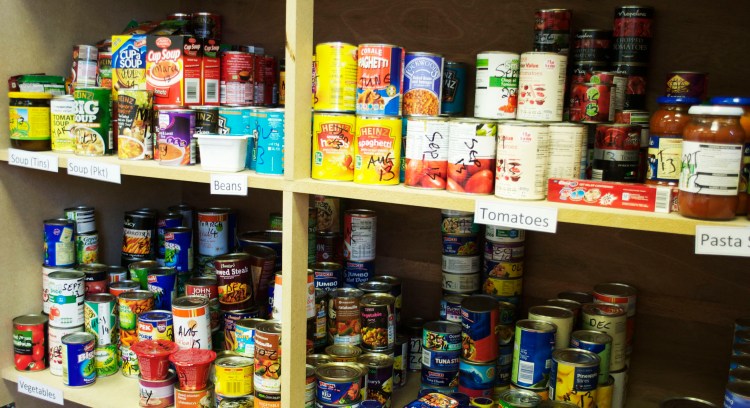
Food supplies at a food bank in Newcastle-Under-Lyme in England. Source: Flickr

Recently the Scottish Government announced plans to provide free sanitary wear to low-income women in Aberdeen as part of a six month pilot scheme, making Scotland one of the first countries to acknowledge the issue of ‘period poverty’. This issue has been raised by charities over the years but gained momentum and media coverage in recent years through the efforts of MPs such as Paula Sherriff and projects like the Homeless Period. Menstruation and sanitary products are still somewhat of a taboo subject to be discussed in public spaces, which only adds to the necessity of the discussion of period poverty.

Currently there is a 5% VAT rate on sanitary products, deeming them a so-called ‘luxury product’. After efforts by MPs and campaigners, the UK government has received backing from the European Commission to reduce the tax to zero, which means that after 2017 the tax will be abolished. Currently the money from the 5% tax is donated to various women’s charities in the UK, however this does not directly solve the issue of period poverty. Even with the reduced tax rate and cost, sanitary products are often substituted with toilet paper, socks, and even newspaper. For those in need of food bank support they face the choice of buying food or buying sanitary wear, and food is always the priority.

Other non-food items that can be donated include toiletries and cleaning supplies such as laundry detergent. Hygiene poverty is quickly becoming another problem for families that use food banks. The organisation In Kind Direct distribute goods donated by companies to charities in the UK and abroad. For many food banks essential goods such as toothpaste and toilet paper are provided by In Kind Direct and then given to families in need. A staggering 91% of charities that work with In Kind Direct said that without their support they would not be able to afford to buy the products and distribute them to those in need. Access to sanitary and personal hygiene products is an health issue, but this is also an issue of dignity and self-worth.

There is also a need for sanitary items for babies and young children. Baby wipes and nappies are needed, alongside baby food. One seemingly essential item that should not be donated is baby formula, as food banks do not accept formula in accordance with Unicef recommendations. The Unicef UK Baby Friendly Initiative aims to provide both breastfeeding and bottle-feeding mothers with access to nutritional food and health resources. They state that mothers who are breastfeeding should not be given formula milk at food banks and instead should be supported to continue breastfeeding. However, it can be hard for new mothers to get the right nutritional foods and appropriate support at food banks.

There is a stigma and shame associated with food banks that is further emphasised by the unsympathetic views of the media and MPs. Throughout the UK food banks are becoming an essential part of people’s lives, the increase in use is not “uplifting”; it is the result of the increasingly complicated welfare system and it’s detrimental impact on real people. Until the reasons behind the increase of poverty in the UK are directly addressed and attempts to improve the situation are made, the necessity of food banks will continue to rise.

There are many ways you can help support food banks, with the most obvious being donating to them. There are donation points in both Tesco and Morrisons in St. Andrews, and the local food bank, Storehouse, can be contacted via Facebook and their website, storehousenefife.org.uk. For more information about In Kind Direct and how you can support their work visit http://www.inkinddirect.org/get-involved/.

A Democratic but Self-Interested, Abusive Spain? A History of Catalan Repression and Spanish Conserv

“Riot police have clashed with voters and smashed their way into a polling station as an illegal independence referendum begins in Catalonia,” reported Marc Stone from Sky News. Last week’s excessive brutality and heavy-handed approach to crack down on participants in the referendum was an outrage for Spanish parliamentary democracy. The violation of the rule of law, as well as the alienation of people’s freedom of expression and vote stomps out democracy, thus uncovering a hidden, self-interested, and abusive regime.

Riot Police in stand-off as illegal Catalonia independence vote begins. Source: Sky News

Catalonia has been incessant in her demands for independence since 1931, but Catalan determination and self-identity were particularly the driving forces for secession from 2014, when the government announced a referendum to be held in the November of that year. However, the referendum failed to pass, with a turnout of only 35%. The consecutive year, another referendum was called, which fell just short of winning a majority. A third attempt at an independence referendum was made on 1 October 2017 by Catalan President Puigdemont, causing 893 civilians and 431 police officers injuries.

This populist wave, which Catalan hopes for independence may be viewed as part of, has been felt across the world. Yet, governments have reacted differently to this wave of populism. For instance, when the Brexit cause became prominent in the British Conservative Party, former PM David Cameron, a fervent defender of the EU partnership, allowed the Brexit referendum to take place. Similarly, the result of the US elections in November 2017 shook the world; Donald Trump, a millionaire businessman with no former experience in policy-making was chosen to be the next Western world’s leader. Nevertheless, neither the British nor American establishment have ever condemned or forced to change the decisions of their people. These choices are certainly criticised, but as democratic Western countries, ethics, human rights, and freedom of expression are the raison d’être. They should be countries that, by essence, are constituted and ruled by the will of their citizens.

Old lady injured when police prevents her to vote in the Catalan referendum. Source: Metro

Yet, Spain’s actions have considerably delegitimised its claims of a rightful use of force to manage an “illegal” referendum, and it is now at a critical moment regarding its democracy. People are stiffly debating about the degree of democratic liberties that the Spanish government allows, and the measures taken to enforce the law.

Indeed, UN human rights experts have expressed their worries at the Spanish government’s violations of fundamental individual rights, such as the rights to freedom of opinion and expression. These experts are urging the Spanish government to use force proportionately and only when it is necessary. Moreover, the EU Commission has condemned the violence, reiterating that it “should never be an instrument in politics”, especially against a country’s own civilians, and that Prime Minister Mariano Rajoy should manage this crisis “in full respect of the Spanish Constitution and of fundamental rights of citizens enshrined therein”. Spanish leading newspapers and major politicians, including Ada Calau (the leftist mayor of Barcelona who is ambivalent about Catalan independence) have even called for Rajoy’s resignation. Indeed, shocking images emerged of gravely injured Catalan voters, dragged out of polling booths by police – a man with blood running down his face, a woman claiming police broke her fingers one by one. Teenagers, women, elderly people were injured all the same.

Catalans, as well as Spaniards, and the rest of the world, were shocked by the violent escalation of events, and tried to make sense of it in two basic questions: why were the police so determined and violent in preventing the referendum, and how will Spain move forward from here? Catalonia’s history and its relentless quest for autonomy is at the heart of the current political crisis. Catalans have repeatedly been subjected to a conservatist Spanish government, who prohibited Catalonia from gaining too much political power and autonomy, causing increased and obstinate demands for secession.

Certainly, Catalonia has a long–standing tradition of nationalism and suppression. With a distinctive language, culture, and history stretching back to the early Middle Ages, many Catalans think of themselves as a separate nation from the rest of Spain. During the eleventh century, the County of Barcelona (Catalonia) was a distinct entity, having its own laws and customs. After unifying with the Kingdom of Aragon, a confederation englobing the North-Eastern area, the domain united with Spain when King Ferdinand of Aragon and Queen Isabella of Castile married in the fifteenth century. The early twentieth century was a pivotal period for Catalan nationalism. Leading Spain’s industrialisation, Catalans were able to revive their culture and language. However, Franco’s dictatorship dismantled all progress made on Catalan recognition by considerably repressing Catalan nationalism, restricting the Catalan language and culture, as well as revoking Catalan autonomy. An independence movement re-emerged after Franco’s death in 1971, restoring the Catalan parliament and the executive, the “Generalitat” (Government).
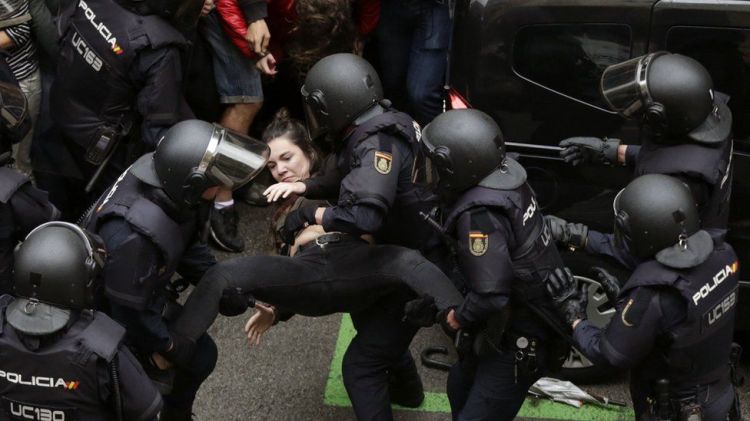
Officers were seen stamping and kicking protesters as they stormed buildings and seized ballot boxes in Barcelona. Source: BBC

Nevertheless, the root of the current conflict lies in 2010, when a ruling of Spain’s constitutional court limited Catalan claims to nationhood and autonomy. Spain declares that the referendum contradicts the constitutional status quo, but Catalans insist that this agreement was imposed on them and thus violates their dignity and rights. Indeed, it should be fair for Catalonia to retain some privileges, as the region is a critical contributor to Spain’s economy, concentrating about 20% of Spain’s 2013 GDP (€203.62 billion for €1.17 trillion), and actually giving more money to Spain than it receives by way of investments. Since the ruling of the 2010 agreement, Catalonia has attempted to upgrade its situation, but these efforts were unsuccessful, and Catalans claim that they “were left no option but to organise a referendum”. Separatist movements were further amplified after the economic crisis, when the Spanish government imposed austerity measures on the region. This harboured Catalan discontent, anger, and overall dissatisfaction with the regime, as the Spanish government was using Catalan wealth and its diversified economy to hold the rest of Spain together.

Hence, an independent Catalonia would have devastating consequences for Spain’s economy. If Catalonia, the industrial heart of Spain, were to leave, Spanish debt would be unsustainable. It is estimated to reach 125% debt-to-GDP ratio if Catalonia leaves and refuses to share the debt, which it might, considering the escalation of events and Spanish intransigence towards the Catalan cause. This abusive use of violence paralleled Franco’s oppression of Catalan separatists, and was an authentic expression of Spanish conservatism. Spain has no interest in giving in to these nationalist movements. The centralised state thought it could address Catalan demands for secession the same way it previously did during Franco’s dictatorship, but this tactic played against the regime. Spain is now facing a critical political crisis regarding its democracy, and therefore must confront the call for Catalan independence. To resolve this situation peacefully, Mariano Rajoy could agree to change the Constitution, granting the Catalans their lost privileges of culture and language, and to re-establish some sort of autonomous region, which would still be closely tied to Madrid. By doing this, they would change the status quo in favour of Catalan interests, thus satisfying their demands for recognition and rights. Furthermore, they would effectively prevent a worst scenario, where secession would cost 20% of Spain’s economic output and an explosive, unsustainable debt, which could plunge the country into a long economic recession.

Personal opinions of our writers do not reflect Protocol Magazine’s views on controversial issues.

#Spain #Europe #Catalanreferendum #opinion #independence

A Democratic but Self-Interested, Abusive Spain? A History of Catalan Repression and Spanish Conservatism

“Riot police have clashed with voters and smashed their way into a polling station as an illegal independence referendum begins in Catalonia,” reported Marc Stone from Sky News. Last week’s excessive brutality and heavy-handed approach to crack down on participants in the referendum was an outrage for Spanish parliamentary democracy. The violation of the rule of law, as well as the alienation of people’s freedom of expression and vote stomps out democracy, thus uncovering a hidden, self-interested, and abusive regime.

Riot Police in stand-off as illegal Catalonia independence vote begins. Source: Sky News

Catalonia has been incessant in her demands for independence since 1931, but Catalan determination and self-identity were particularly the driving forces for secession from 2014, when the government announced a referendum to be held in the November of that year. However, the referendum failed to pass, with a turnout of only 35%. The consecutive year, another referendum was called, which fell just short of winning a majority. A third attempt at an independence referendum was made on 1 October 2017 by Catalan President Puigdemont, causing 893 civilians and 431 police officers injuries.

This populist wave, which Catalan hopes for independence may be viewed as part of, has been felt across the world. Yet, governments have reacted differently to this wave of populism. For instance, when the Brexit cause became prominent in the British Conservative Party, former PM David Cameron, a fervent defender of the EU partnership, allowed the Brexit referendum to take place. Similarly, the result of the US elections in November 2017 shook the world; Donald Trump, a millionaire businessman with no former experience in policy-making was chosen to be the next Western world’s leader. Nevertheless, neither the British nor American establishment have ever condemned or forced to change the decisions of their people. These choices are certainly criticised, but as democratic Western countries, ethics, human rights, and freedom of expression are the raison d’être. They should be countries that, by essence, are constituted and ruled by the will of their citizens.

Old lady injured when police prevents her to vote in the Catalan referendum. Source: Metro

Yet, Spain’s actions have considerably delegitimised its claims of a rightful use of force to manage an “illegal” referendum, and it is now at a critical moment regarding its democracy. People are stiffly debating about the degree of democratic liberties that the Spanish government allows, and the measures taken to enforce the law.

Indeed, UN human rights experts have expressed their worries at the Spanish government’s violations of fundamental individual rights, such as the rights to freedom of opinion and expression. These experts are urging the Spanish government to use force proportionately and only when it is necessary. Moreover, the EU Commission has condemned the violence, reiterating that it “should never be an instrument in politics”, especially against a country’s own civilians, and that Prime Minister Mariano Rajoy should manage this crisis “in full respect of the Spanish Constitution and of fundamental rights of citizens enshrined therein”. Spanish leading newspapers and major politicians, including Ada Calau (the leftist mayor of Barcelona who is ambivalent about Catalan independence) have even called for Rajoy’s resignation. Indeed, shocking images emerged of gravely injured Catalan voters, dragged out of polling booths by police – a man with blood running down his face, a woman claiming police broke her fingers one by one. Teenagers, women, elderly people were injured all the same.

Catalans, as well as Spaniards, and the rest of the world, were shocked by the violent escalation of events, and tried to make sense of it in two basic questions: why were the police so determined and violent in preventing the referendum, and how will Spain move forward from here? Catalonia’s history and its relentless quest for autonomy is at the heart of the current political crisis. Catalans have repeatedly been subjected to a conservatist Spanish government, who prohibited Catalonia from gaining too much political power and autonomy, causing increased and obstinate demands for secession.

Certainly, Catalonia has a long–standing tradition of nationalism and suppression. With a distinctive language, culture, and history stretching back to the early Middle Ages, many Catalans think of themselves as a separate nation from the rest of Spain. During the eleventh century, the County of Barcelona (Catalonia) was a distinct entity, having its own laws and customs. After unifying with the Kingdom of Aragon, a confederation englobing the North-Eastern area, the domain united with Spain when King Ferdinand of Aragon and Queen Isabella of Castile married in the fifteenth century. The early twentieth century was a pivotal period for Catalan nationalism. Leading Spain’s industrialisation, Catalans were able to revive their culture and language. However, Franco’s dictatorship dismantled all progress made on Catalan recognition by considerably repressing Catalan nationalism, restricting the Catalan language and culture, as well as revoking Catalan autonomy. An independence movement re-emerged after Franco’s death in 1971, restoring the Catalan parliament and the executive, the “Generalitat” (Government).

Officers were seen stamping and kicking protesters as they stormed buildings and seized ballot boxes in Barcelona. Source: BBC

Nevertheless, the root of the current conflict lies in 2010, when a ruling of Spain’s constitutional court limited Catalan claims to nationhood and autonomy. Spain declares that the referendum contradicts the constitutional status quo, but Catalans insist that this agreement was imposed on them and thus violates their dignity and rights. Indeed, it should be fair for Catalonia to retain some privileges, as the region is a critical contributor to Spain’s economy, concentrating about 20% of Spain’s 2013 GDP (€203.62 billion for €1.17 trillion), and actually giving more money to Spain than it receives by way of investments. Since the ruling of the 2010 agreement, Catalonia has attempted to upgrade its situation, but these efforts were unsuccessful, and Catalans claim that they “were left no option but to organise a referendum”. Separatist movements were further amplified after the economic crisis, when the Spanish government imposed austerity measures on the region. This harboured Catalan discontent, anger, and overall dissatisfaction with the regime, as the Spanish government was using Catalan wealth and its diversified economy to hold the rest of Spain together.

Hence, an independent Catalonia would have devastating consequences for Spain’s economy. If Catalonia, the industrial heart of Spain, were to leave, Spanish debt would be unsustainable. It is estimated to reach 125% debt-to-GDP ratio if Catalonia leaves and refuses to share the debt, which it might, considering the escalation of events and Spanish intransigence towards the Catalan cause. This abusive use of violence paralleled Franco’s oppression of Catalan separatists, and was an authentic expression of Spanish conservatism. Spain has no interest in giving in to these nationalist movements. The centralised state thought it could address Catalan demands for secession the same way it previously did during Franco’s dictatorship, but this tactic played against the regime. Spain is now facing a critical political crisis regarding its democracy, and therefore must confront the call for Catalan independence. To resolve this situation peacefully, Mariano Rajoy could agree to change the Constitution, granting the Catalans their lost privileges of culture and language, and to re-establish some sort of autonomous region, which would still be closely tied to Madrid. By doing this, they would change the status quo in favour of Catalan interests, thus satisfying their demands for recognition and rights. Furthermore, they would effectively prevent a worst scenario, where secession would cost 20% of Spain’s economic output and an explosive, unsustainable debt, which could plunge the country into a long economic recession.

Personal opinions of our writers do not reflect Protocol Magazine’s views on controversial issues.

A Death in Detention: Life Inside UK Immigration Removal Centres

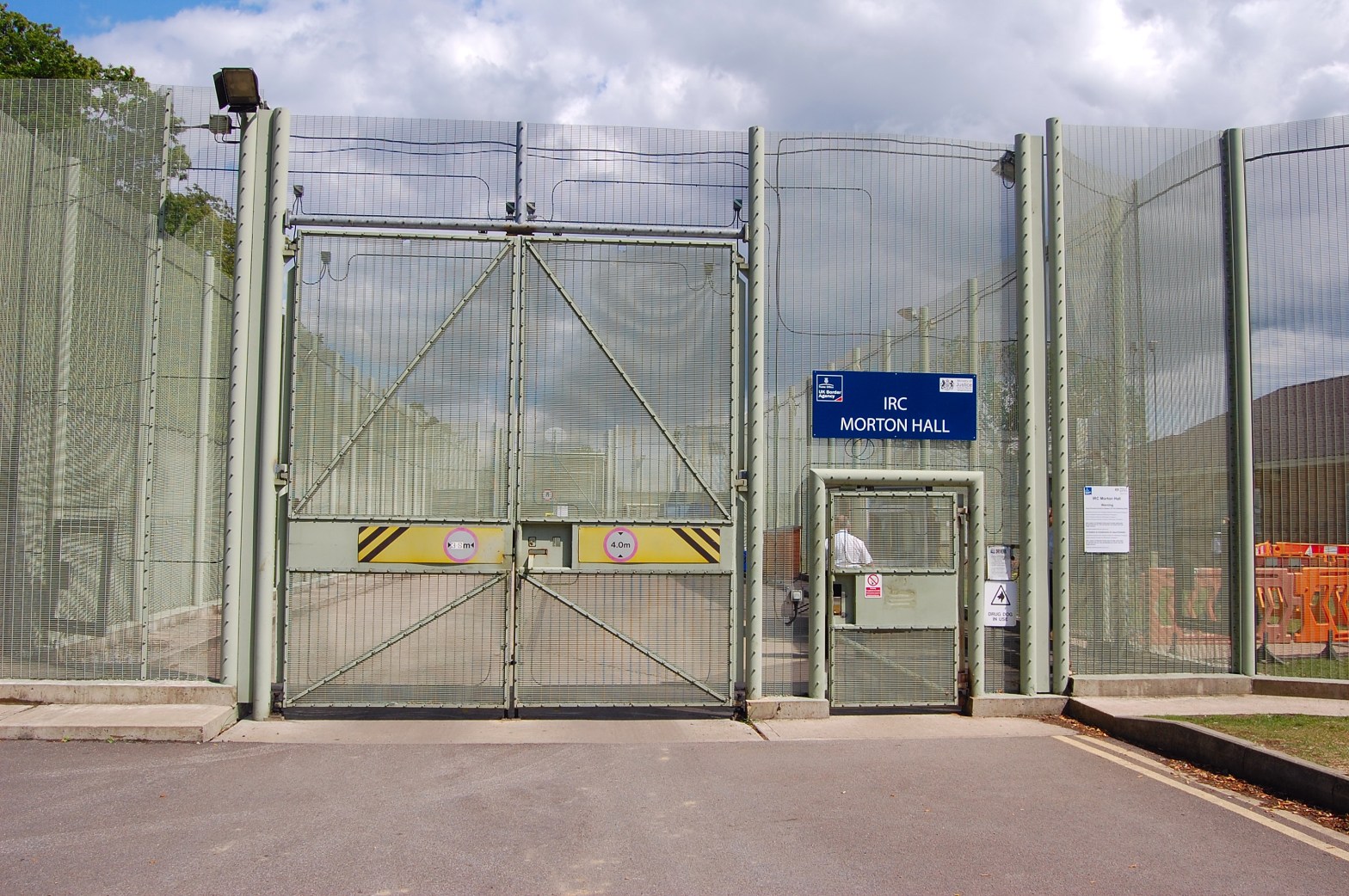
On 3rd October 2017, Morton Hall Immigration Removal Centre (IRC) – an ominous, high-security, 392-room deportation centre based in Lincoln – became the site of the third detainee death in UK centres in less than a month. Carlinton Spencer, aged 38, had apparently repeatedly called for medical assistance, while his health deteriorated. He was eventually taken to hospital, where he died within 24 hours. Detainee witnesses say that Mr Spencer’s death was a ‘result of gross negligence by the health professionals…and staff’ at Morton Hall.

By the end of 2016, around 3,000 people, including children, were detained under the Immigration Act. Detention powers can be used for a number of reasons, including holding asylum seekers who have had their claim refused, or those who have a claim in progress. Some detainees are held because they have breached the terms of their visas, while other are foreign nationals who have a criminal record and are in the process of being deported. However, 45% of the detention population are asylum seekers (those who seek refuge in the UK because of persecution in their country of origin). Detention centres up and down the UK vary in terms of detainee population and their management. Such centres are generally built near airports and modelled on prison standards, but differ in terms of detainee access. For example, IRC Campsfield near Oxford allows detainees to walk freely with access to an outdoor area, whereas detainees at Colnbrook and Brook House spend far more time locked in units with no fresh air.

Morton Hall IRC. Source: WikiMedia Commons

While tragic in its own right, Mr Spencer’s death is part of a wider and increasingly disturbing problem of detainee treatment within the UK immigration system. In September, a Chinese man died in a Scottish immigration removal centre, while in London, a 28-year old Polish man attempted to hang himself in a removal centre. He died four days later. Following his death, detainees in the same detention centre signed a letter of protest to the Home Office, asserting that it was “a disgrace that no one has been held accountable for such poor care. We are human beings not animals”. The charity Medical Justice also issued a damning statement: ‘Year after year, investigations into these deaths reveal ongoing systemic healthcare failings. We fear that as long as these failings continue to go unaddressed, there will be more deaths.’

These deaths may seem like extreme cases, but a recently aired BBC Panorama investigation also revealed serious mistreatment of detainees by the private security firm G4S, who, alongside a number of other corporations, are employed to provide security in the complex network of immigration centres around the UK. During this undercover documentary, security officers employed by the private company were seen choking, mocking and abusing detainees at Brook IRC near Gatwick. When one of the distressed detainees tried to strangle himself with a phone charger cord, the on-duty custody manager could be heard saying “Plug him in and he’ll be a Duracell bunny”. After the Panorama investigation aired, nine G4S staff were suspended from Brook House. Taken together, the deaths, abuse, and the apparent lack of engagement by the government demonstrate a worrying trend in the UK immigration system.

Unsurprisingly, the weight of the prospect of possible deportation back to a country where someone may face severe persecution or death, coupled with the uncertainty of their detention and the mistreatment in immigration removal centres, results in many detainees developing severe mental health problems. In 2015, 393 detainees tried to take their own lives, and a total of 2,957 detainees were on suicide watch during 2015, including 11 children. In an interview with Al Jazeera, one detainee at Colnbrook IRC talked about an Algerian man, detained for about 18 months, who had attempted to commit suicide, having received no response about his asylum status. The man cut his body with a blade screaming, “I want answer, why no-one give me answer?”.

The UK is the only country in Europe were indefinite immigration detention is allowed. To be clear, many of the detainees have not been charged with any crime, other than awaiting an immigration decision. In 2016, the longest recorded length of detention was over three and a half years. All this is despite a cross-party Parliamentary inquiry in 2015 denouncing this practice and advocating for a 28-day limit on detention for those fleeing persecution. The UK has also been warned by the United Nations High Commissioner for Refugees that the Government’s policy on detaining asylum seekers risks breaching international human rights law.

Protesters outside of Dungavel IRC in Scotland. Source: WikiMedia Commons

More recently, the Home Office has come under pressure from the UK High Court, when it ruled that the government had unlawfully detained people who had been tortured in their home country. The Home Office’s narrow definition meant that only those who had been seriously abused by official state agents could be considered torture victims, and therefore safe from detainment. This disregards any abuse conducted by traffickers, terrorists, and other nonstate forces. The case was brought by seven victims of torture, amongst whom were two men tortured because of their sexuality, and another who had been captured by the Taliban. The judgment is likely to encourage dozens of claims against the Home Office, with human rights campaigners and immigration lawyers calling for the immediate release of torture victims from detention centres.

With Donald Trump’s astonishing immigration measures in the US making global headlines almost daily, it is imperative to remember how immigration is being handled closer to home. As Brexit looms in the distance, the Home Office’s resources is already stretched to the limits, impinging on its ability to make positive changes to the immigration system. The events described in this article highlight the dangers of systematically detaining immigrants and asylum seekers in the UK. Perhaps we should not require such tragedies like Mr Spencer’s death to make us pay attention to the thousands of innocent people detained around the country.