How to Delete This Post

Ready to delete this post and add your own? You can do it when you’re logged in to your live site or in Preview Mode.

Simply click on the More Options icon (the 3 dots that appears on the post) and hit Delete Post. You can also head to Settings > Manage Posts and delete any post from there.

We recommend you first explore what you can do in this blog layout. Click through the category pages to discover some of the great features this blog has to offer and learn a few blogging tips along the way!

Grow Your Blog Community

With Wix Blog, you’re not only sharing your voice with the world, you can also grow an active online community.

Readers can become engaged members of your blog who like to share their thoughts, ideas and discover interesting people.

See All Your Members

Readers can easily sign up to become members of your blog and get a personal profile page. Members can follow one another and be followed, they can check out each other’s profiles, see what people have liked or commented on, and get notifications.

You can view all blog members by clicking the Members icon in the login bar.

Tip:

To quickly find individual members, use the Member search bar and sort by option.

#dream

Organize Your Blog With Categories

Categories are a great way to keep your posts organized. They also help visitors explore more content that interests them.

Every time you write a post, you can add it up to 3 different categories. Those categories will then appear in your blog’s navigation menu, so choose categories that you normally post about and also serve as the main topics of your blog, e.g., Food, Fashion, Travel, etc.

Each category of your blog has its own page that’s fully customizable. Add a catchy title, a brief description and a beautiful image to the category page header.

Here’s a tip:

For easy navigation, it’s best to keep your category names short – 1 to 2 word titles. And for a clean look on your blog’s navigation menu, we recommend max 7 categories.

Here’s how to manage your categories:

  1. Go back to the Wix Editor
  2. Head to Settings > Categories
  3. Choose the category you want to customize
  4. Click the 3 dots
  5. Click Edit

Blog on the Go

With Wix Blog you can do everything from your phone: write posts, follow members, manage comments & more. After you publish simply go to your live site on mobile and log in with with your Wix account.

Front row at a fashion show? Just ate the best pasta ever? Tell the world right away! You can post anywhere, anytime from your phone whenever inspiration strikes.

Create new posts, edit existing ones, save drafts or publish – you can do it all, even when you’re away from your desk. Your work will automatically look and work great on both desktop and mobile.

#vacation

Design a Stunning Blog

Your Wix Blog comes with 8 beautiful layouts to choose from. Whether you prefer a trendy postcard look or you’re going for a more editorial style blog – there’s something stunning for everyone.

From your blog’s settings, choose a layout for your blog feed that suits your style. For example, a tiled layout is popular for helping visitors easily discover more posts that interest them. Or, choose a classic single column layout that lets readers scroll down and see your post topics one by one. The full post layout opens the entire post in an endless scroll.

Every layout comes with the latest social features built in. Readers will be able to easily share posts on social networks like Facebook and Twitter, view how many people have liked a post, made comments and more.

Tip:

Mix and match your look. Choose one layout for your blog’s homepage and a different one for your category pages. You can change your layouts at any time, even after you’ve published your blog.

Here’s how to do it:

  1. Head to Settings > Categories
  2. Click on the 3 dots icon
  3. Click Edit

Manage Your Blog from Your Live Site

We’ve made it quick and convenient for you to manage your blog like a boss!

First Publish your site, then login directly to your live website on desktop or mobile.

Make sure you sign in with your Wix account, so you’ll be logged in as the admin to your blog.

You can manage your blog and post from your live website. Just log in to your blog with your Wix account.

Now you’re ready to write, edit and manage posts. Just click Create a Post and hit Publish. That’s it. It’s live for all your readers to see. Plus, you can manage all your post comments too – see what people are saying, like or delete comments & more.

If you’ve been working on a post and want to come back to it later, save it as a draft. You can Publish it at anytime, just head to My Profile > Drafts.

The Third Generation Project: What We Talk About When We Talk About Human Rights

The notion that people are entitled to certain inalienable rights has long been a part of the fabric of international relations, in theory if often not in practice. However, the form that these rights should take is far from straightforward, with tensions and tradeoffs to be made between civil, political, social, and economic rights, and between the rights of individuals and collective rights. Our understanding of where these tradeoffs are to be made and which rights are prioritised over others is never a neutral process, but reflects implicit judgements on what, and by extension who, is considered valuable. The prevailing emphasis on individual over collective rights, and on civil and political over social and economic rights, is not a fundamental truth, but a reflection of liberal Western values that often go unexamined.

Our rights can be divided into three ‘generations’. The first generation of these is civil and political rights – to freedom of speech, to participation in public life, to due process before the law, and the human right to life. Broadly speaking, these rights are negatively defined, and protect us from excessive interference in our lives by the state. Freedom of speech, for example, is not an invitation to say anything, anywhere, regardless of context or consequences, but a guarantee against being arrested or persecuted for what one says. After the first generation of civil and political rights comes a second generation of social and economic rights – rights to things such as adequate food, housing, and healthcare. In other words, second generation rights maintain that individuals have a right not only to be free from persecution, but also to a basic quality of life. When we discuss human rights issues in the UK, we are most likely to think of the protection of civil and political rights against threats to press freedom, but we can also think of rising food insecurity as a social and economic human rights issue.

Economic rights are a relatively new addition to international aid efforts, which previously tended to focus on the right to life through basic healthcare and disaster management. Access to first and second generation rights is interrelated: those who are economically disenfranchised will also struggle to exercise their civil and political rights, with restricted access to due legal process, to the press, and to the political process.

The right to a clean environment is considered a collective right

The various rights included under the labels of ‘first’ and ‘second’ generation share commonalities; they are understood as accessed, restricted, or denied on an individual basis and are both addressed by the 1948 UN Declaration of Universal Human Rights. In fact, the idea that human rights can also be understood on a collective basis was not articulated by the UN until the 1970s, in recognition of the fact that rights to a clean environment, to peace and stability, or to self-determination cannot be divided between individuals, but are denied or realised on the level of the community. These rights are much less ingrained in traditional Western political discourse, where the individual or state overwhelmingly remain the primary point of reference.

Collective rights do, however, appear in a number of non-Western constitutions. Unsurprisingly, Communist regimes in Russia and China wrote collective rights into their constitutions. They also stressed social and economic rights over civil and political ones. These rights were also codified in the 1981 African Charter of Human and Peoples Rights, which guarantees “peoples” rights to equality, to self-determination, to development, as well as the rights to “freely dispose of their wealth and natural resources” to “peace and security” and to “a generally satisfactory environment.”

Western politics continues to resist this interpretation of human rights. One easy retaliation to collective rights is to point to the ease with which authoritarian regimes can use the importance of third generation, as well as second generation, rights to justify suppressing first generation rights. The self-determination of the group, defined of course by the state, the preservation of material welfare, and protection of stability are all easy pretexts for restricting individual freedom of speech or assembly.

However, the reverse is also true. The Western liberal focus on individual rights – more often on the civil and political than the social and economic – makes it easy to resist calls for systemic change and ignore marginalised groups. This is demonstrated most starkly in the case of indigenous peoples, who are among the world’s most disenfranchised, and who the prevailing regime of individualised human rights, both in international treaties and domestic legal systems, largely fails to address. Individual rights can only go so far to protect cultures and ways of life that dominant states have spent centuries disenfranchising and persecuting. Recognising collective rights both explicitly acknowledges this reality, and is a long overdue response to the measures for which many of these groups themselves have been campaigning.

Environmental degradation and economic disenfranchisement are suffered, as well as perpetrated, on a collective basis, but a focus on individual rights shifts the search for solutions away from this fact. Instead, it encourages us to see individuals in isolation, where the weight of history and structural oppression are easier to ignore. This makes it easier to see discrimination as something perpetrated by an individual against another individual, rather than a structural process enacted by one group upon another group. An effective shift towards respecting collective rights requires us to place more emphasis on listening to groups that have been sidelined by traditional structures of power and knowledge, in particular activists, communities, and other actors that do not necessarily speak the language of academia. It also represents a shift in emphasis in terms of what is valued, by placing greater value on social belonging and the prospering of communities – in other words a recognition of the damage done by social marginalisation, in addition to that of political and economic disenfranchisement.

The Third Generation Project, a St Andrews-based human rights think tank, is dedicated to challenging the dominance of unexamined narratives that underlie how we think about human rights and to reframing this discussion with a focus on collective rights. Through their advocacy and research, the Project aims to draw attention to groups, issues, and sources of knowledge that have traditionally been sidelined in Western academic and policy circles. With a particular focus on land and water rights of indigenous peoples in North America and East Africa, and by putting community-led action at the heart of what they do, they hope to bring traditionally marginalised voices into the centre of the study of human rights and international relations, as well as to to push our understanding of rights beyond individuals and towards the rights of groups and communities.

To find out more about the Third Generation Project, visit their website.

CCTV and Its Effects on Privacy Rights

Closed circuit television has been used for surveillance and security purposes in the UK since as early as 1970, and the technology’s usage has broadened from originally only high risk targets such as banks to almost all high street shops. The predicted 4.5 million CCTV cameras thought to be in the UK are largely unmanned, and are now capable of producing very high resolution images. But as being recorded becomes more and more a part of our daily lives, controversy is emerging.

A security camera, by Anja Ranneberg

The usage of CCTV for suspect identification in court trials has caused controversy in the past as some question its accuracy and reliability when footage is not totally clear, or when there is a reasonable doubt that the film could be showing someone else. Now the opposite argument is used by some critics; innocent civilians who should not be recorded can have their faces recognised and tracked from up to half a mile away. Others simply have a problem with it because they believe that it is excessively intrusive to day to day life. There is at least one camera for every 14 people in the UK, and the fact that each person in the UK is captured up to 300 times a day by CCTV makes the UK the most recorded country in Europe.

Article 8 of the European Convention on Human rights is used by critics of CCTV in this debate to defend rights to private life, and weigh this right as more significant than the benefits of surveillance, even if CCTV potentially helps defend other human rights. It is a qualified right, however, meaning there are certain circumstances where some interference with it is justifiable, but still there remains a potential grey area over how exactly these circumstances manifest in the real world. Within Article 8 is the right to respect for an individual’s home and correspondence, simply meaning that every individual is entitled to a level of personal privacy compatible with a democratic society.

It has become common practice for cameras to be installed in UK schools for privacy reasons, but the Chelmsley Wood 2010 school case where cameras were installed in school toilets caused widespread discontent with the increase in rate of CCTV usage altogether. Some cite general and perhaps vague negative psychological effects of non-stop surveillance as a reason against widespread camera use, but in the past reasons against recording have been undeniably more legally grounded. The 1995 case of Geoffrey Peck, who was recorded attempting to commit suicide in Brentford, was an ongoing case of privacy infringement all the way up until 2003. The footage of his attempted suicide was widely circulated throughout the UK without Mr Peck’s consent, and because of this the European Court of Human Rights found that Article 8 had been violated. Although Mr Peck was in a public place, he was still entitled to some privacy. It was also noted that Mr Peck could not ever have been reasonably expected to foresee the extent of public exposure that ensued.

The 1988 data protection act goes some way to explaining the responsibilities of CCTV users, however because its purpose is to protect individual privacy, almost anyone is entitled to place cameras on their property provided the cameras are not to observe one specific individual. Invasion of privacy is only a violation of human rights in the context of a state infringing upon an individual’s privacy, since the Act of Human Rights only applies to states and not individuals. When an individual is viewing someone or their property using CCTV, the police often have to resort to using the harassment act to resolve the matter.

Cameras installed specifically to monitor behaviour and identify potential criminals must legally be registered with the Information Commission. These cameras are unambiguously covered by the Data Protection Act. The act can work in favour of those filmed too; if a video subject requests their footage it must in most cases be made available to them upon request, unless for some reason that would be legally inappropriate in that specific situation.

The issue of certain groups being in favour of widespread surveillance and others being in opposition must also be noted in the debate. Disagreement has been caused where it is not entirely clear cut if privacy is being infringed upon or not. People more likely to be harassed, perhaps for political or religious reasons, could claim that the presence of CCTV protects their other rights, and that people may be less likely to commit crimes of harassment or abuse if they are monitored. Yet alongside this, many criticise that CCTV is not the answer to discrimination and that deep rooted attitudinal changes must take place in society to stop prejudice and abusive behaviour from occurring.

Overall the usage of CCTV, in the UK at least, is set to rise as population does. Although the metropolitan police have admitted surveillance is not a perfect tool, no financially equivalent alternative seems available at this point in time. Some feel safer with potential criminals being heavily recorded, and others feel uncomfortable that this includes innocent civilians being watched as well. Opinions in favour or against CCTV simply rely on the significance each individual places on its benefits and drawbacks.

To read about the history of human rights in general, Amnesty International has a broad history of Human Rights Law and its enforcement. For a more specific look at the history of CCTV and privacy rights in the United Kingdom, Gallagher’s 2003 paper on the matter makes for very interesting reading.

The Wage Gap: “If You’re a Woman, You Will Earn Less Than a Man”

The wage gap is a buzzword of sorts, having been discussed by Patricia Arquette in her Oscar acceptance speech and by Hillary Clinton on the campaign trail. Despite its relevance as a mainstream topic of discussion, it continues to persist. But why does the wage gap occur? If politicians, actors, and the more than 5 million individuals who took part in Women’s Marches agree that gender based income inequality is wrong, why does it continue?

First, simply put, women are discriminated against in the workforce in everything from hiring to promotion to salary. Women, even when they are just as qualified as men, and even when they are more qualified than men, are less likely to get the job, the promotion, or the raise, for no other reason than that they are women. Furthermore, sexual harassment in the workplace plays a huge role in the wage gap. Over half (52%) of British women have reported being sexually harassed while at work. The consequences of such actions result in women leaving jobs, missing work, and being less focused in work settings, all factors which are a detriment when it comes to promotions, raises, and new job opportunities.

98% of occupations experience a wage gap. Logo from London Student Feminists.

In addition, occupational segregation contributes to the wage gap. Women, due to a multitude of reasons, are less likely to pursue certain careers. As late as 2000, 66% of American women were working in just 21 of the United States’s over 500 occupational categories. Further agitating this discrepancy when it comes to professional career paths, work daned ‘women’s work’ is consistently worth less. Nurses aids, childcare workers, and cashiers earn significantly less income than perceived male jobs such as janitors, parking lot attendants, and construction workers.

Finally, women’s role as mothers contribute, unfairly, to the wage gap. Women are nine times more likely than men to be stay at home parents, a number that has been increasing in recent years. Nearly 30% of American women are stay at home moms, a figure that has a drastic impact on the women who do chose to work outside the home. Because women are so much more likely to be a stay at home parent than men employers are less likely to hire, promote, and give raises to women of childbearing age. Furthermore, many women find it difficult to reenter the workforce after maternity leave, citing a devaluation of their work, hostility, and prejudice from coworkers. The prejudice that women face in terms of family planning does not just make it more difficult for them to achieve career milestones, but it results in them earning a lesser wage as well.

While the reasons why the wage gap occurs is key to solving gender inequality, the practical ramifications of consistent gender based income discrepancy can provide more relatable.

In the United States women make an average of seventy seven cents on the dollar. However, this oft stated figure does not tell the whole story. Everything from race, age, education, and location plays an integral part in how much an American women can expect to earn in comparison to her male counterpart. Asian American women are among the highest wage earners in the US, making on average 90% of what men make. Caucasian women follow close behind at 76% with African American women and Hispanic women rounding it out with 62% and 54% respectively. While race certainly plays a distinctive role in the future earning potential of American women, it is often indicative of wider socio-economic factors. As counterintuitive as it may first appear, education does not necessarily correlate to a smaller wage gap, in fact, there is substantial evidence otherwise. This could be compounded by the fact that the wage gap itself increases exponentially after the age of 35. Young workers at the start of their careers are much more likely to make equal salaries than workers further along in their careers. The wage gap is 90% for workers under 35. Yet after 40, income inequality between men and women becomes drastically more marked.

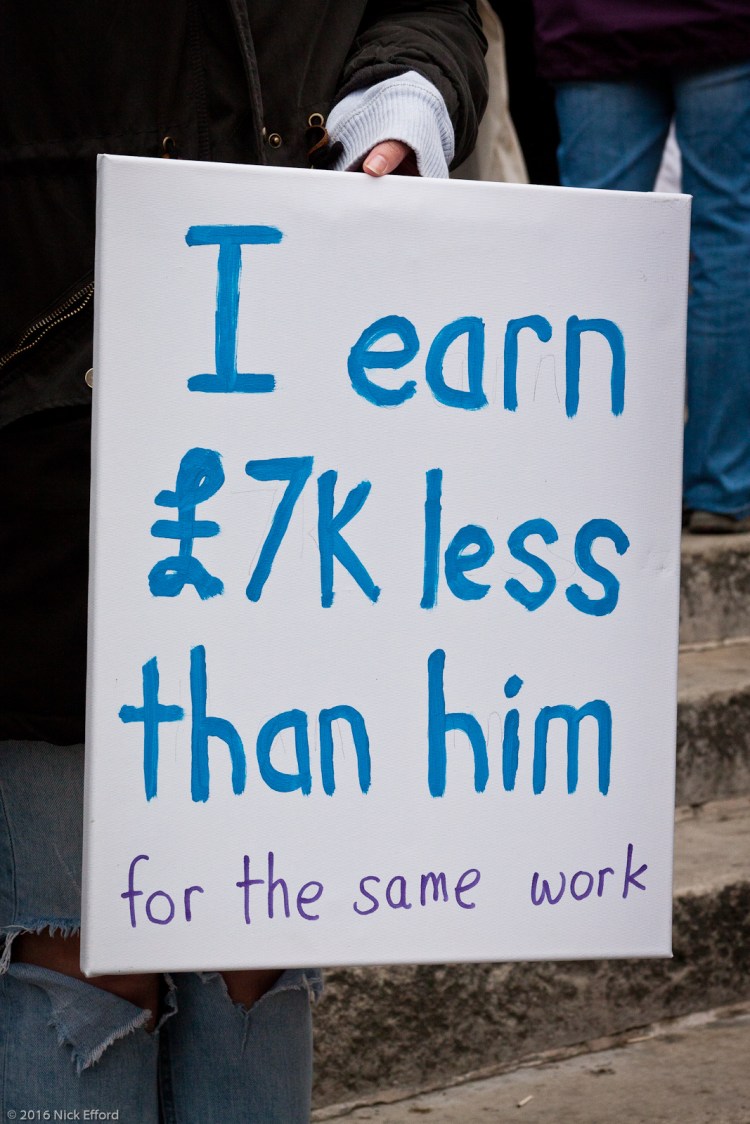
Female protester advocating for equal pay, by Nick Efford

In the United Kingdom women also make substantially less than men, especially in professional fields. As Theresa May remarked, “If you’re a woman, you will earn less than a man.” Despite this grim forecast, British women can rejoice in that hourly paid female workers actually make more than hourly male workers, by 6.5% or 52p an hour. However, on the whole British women still lag behind men in compensation, and the median hourly wage for women in part time jobs is 37% less than the hourly wage for women in full time jobs. This staggering figure contributes to the wage gap due to the fact that an astronomical 42% of the British female workforce consists of part time workers compared to a miniscule 13% of the male workforce. Because so many more women perform part time work, and get paid so much less for it, the wage gap in Britain expands. While the wage gap as a whole has shrunk in the last decades, women in professional fields, women in their forties and older, and women who have graduated university have made much less marked gains and in some instances even regressed. Comparatively, women in their twenties who work full time and women with GCSEs experience negative wage gaps. Similar to the situation across the pond, women as a whole make less than men in Britain, however a wide range of socio-economic factors from age, to education, to career path play a large role in determining the earning capabilities of women.

If continued inequality faced by women in the workforce is something you feel strongly about, if you want to work to help end the wage gap, if you are a women who has or eventually will enter the workforce, or if you have a mother, sister or friend who has, is, or one day will work, getting in

Scotland, the European Union, and Brexit

On September 18th 2014 voters in Scotland were asked, “should Scotland be an independent country?”. With 55.3% of votes, the answer was no. However, the issue of independence is still a central part of Scottish politics, especially in the wake of the Brexit vote. Nicola Sturgeon, the First Minister of Scotland and leader of the Scottish National Party (SNP), has announced the Scottish government’s intention to hold a second independence referendum in the wake of the vote to leave the European Union. Although membership of the EU is perhaps the most important factor in this debate, there are a number of factors that were evident in the last independence campaign and new issues that have since arisen.

After the May 2016 Scottish Elections the SNP stated the conditions in which a second independence referendum would be considered: if there was clear and sustained evidence that independence has become the preferred option of a majority of the Scottish people, or if there was a significant and material change in the circumstances that prevailed in 2014, such as Scotland being taken out of the EU against its will. One of the main reasons for many people voting ‘no’ in the first referendum is that they wished to remain part of the EU, and for that to be guaranteed, Scotland had to remain part of the UK. On June 23rd 2016 the United Kingdom voted to leave the European Union, with 62% of voters in Scotland voting to remain.

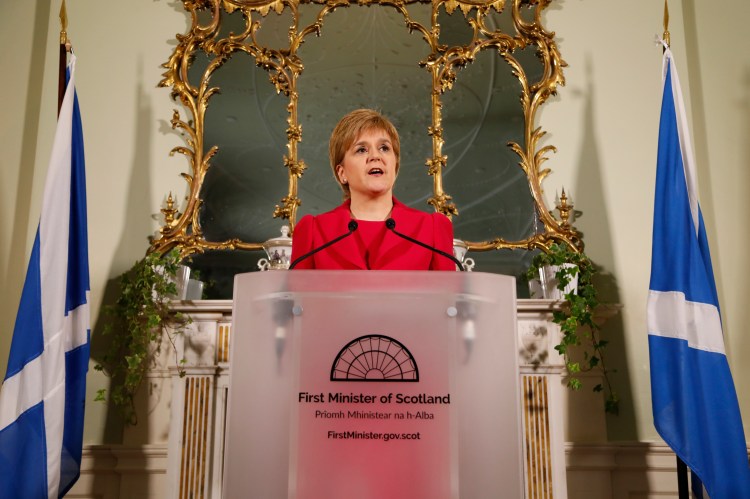
Nicola Sturgeon announcing plans for a second independence referendum, by the Scottish Government

On March 13th 2017 Nicola Sturgeon announced her intention to hold a second independence referendum, and at the end of March, the Scottish Parliament voted 69 – 59 in favour of another referendum. Opposition leaders Ruth Davidson (Scottish Conservative) and Willie Rennie (Liberal Democrats) have spoken out against the calls for a second referendum, stating that it is selfish of the SNP to push their independence agenda. Since the creation of a devolved Scottish parliament the SNP have made clear in their manifestos that an independent Scotland is a priority, throughout the years this has been an issue of contention within Scottish politics and within Scottish society.

One of the main problems with understanding how Scotland would function as an independent country is that some basic understandings of an independent Scotland are based on unsubstantiated claims whilst others are completely unknown, factors such as EU membership, whether the Queen would remain head of state, and issues surrounding North Sea Oil. It has been pointed out that arguing that the majority of Scots want to remain in the EU as a justification for a second independence referendum, when in 2014 the majority voted against independence, is hypocritical and unfair. Arguably this is not an appropriate time for the UK and Scottish governments to even be considering a second independence referendum, there is too much confusion and disagreement over Brexit and what leaving the EU entails. However, discussing this issue with the UK government whilst it is still part of the EU, and thus has some power and influence, may be beneficial to an independent Scotland joining the EU. Current Prime Minister Theresa May has stated that there will be no consideration of a second Scottish independence referendum until the UK has left the European Union. There is also the matter of post-Brexit sentiment within the UK, with many unable to accept that Scotland would leave the UK as a result of the Brexit vote. How an independent Scotland with EU membership would interact with a non-EU Britain is unknown, with issues ranging from trade to having to show passports at the England-Scotland border.

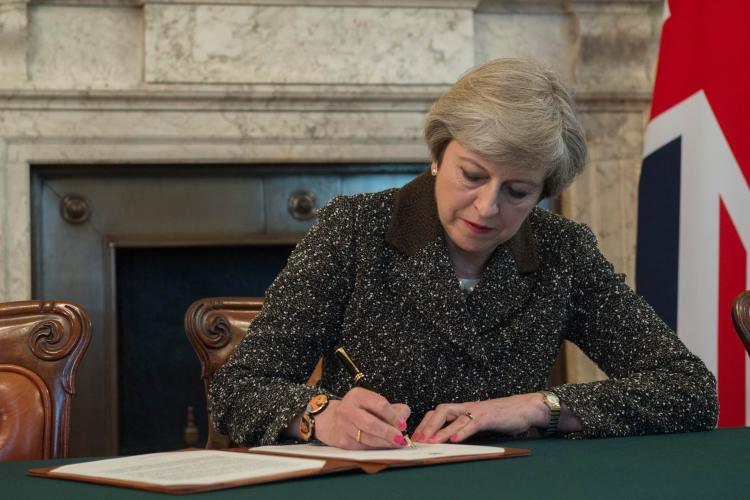
Theresa May triggering Article 50 and the UK departure from the European Union, by Jay Allen

One of the key issues of the new independence debate is whether it would be possible for an independent Scotland to become a full member state of the European Union. The European Commission’s head of representation in the UK stated that Scotland would need to formally apply to become a member state but ‘could be fast-tracked because it already complies with EU rules and regulations’ However, it is not known how an independent Scotland would benefit from the EU in comparison to how it currently does as part of the UK within the EU. There was the threat that some EU member states would veto Scotland’s attempt to join, with Spain fears over Catalonia gaining independence becoming the main reason they would veto Scotland. Whilst the Spanish Foreign Minister stated that Spain does not “welcome the disintegration of the UK,” he has confirmed that Spain would not veto Scotland joining the EU.

Despite the overall support within Scotland to become an EU member state, there are still many people who voted to leave who also want an independent Scotland. Using many of the same arguments that the Vote Leave campaigners did, that the EU is another body that exercises control over Scottish issues and regulations. Arguably the rules and regulations imposed by the EU are more beneficial than detrimental to Scotland. Currently the status of human rights within the UK is stable, as the European Convention on Human Rights (ECHR) is separate from those implemented by the EU. There was concern that the UK government wished to create a ‘British Bill of Rights’ to replace the current human rights act, however this is no longer the case as it has been decided that the constitutional focus will be better suited elsewhere after Brexit. Scotland benefits from EU funding for areas such as farming and scientific research, leaving the EU could be damaging to these industries. Many of the arguments for becoming an EU member state are the same arguments used by the Vote Remain campaign during the Brexit vote.

The arguments for Scottish independence are stronger after Brexit which may help the SNP to gain more support. Yet Brexit has also created a somewhat unstable and unknown political situation and another referendum would complicate matters further. Both the first independence referendum campaign and the Brexit campaign relied on uncertainties and estimations about the post-referendum result. The same can be said about a proposed second independence referendum, with all arguments for and against relying on facts and figures about what an independent Scotland could be. There are no certainties about any of the promises or fears that have been expressed regarding Scottish independence, and this is understandable as it is a scenario that neither Scotland nor the rest of the UK had seriously considered until the first referendum. The issue of Scottish independence and a second independence referendum will continue to be of central importance within Scotland, the UK and Europe. The debate and campaign will most likely increase in both support and protest as the process of the UK leaving the European Union begins. It is unknown what will happen if another independence referendum results in another no vote, will the SNP continue to push their independence agenda or accept the result?