特朗普的美国监狱私有化的复兴

This is a translation of Callaway McCarren’s article The Resurgence of Prison Privatization in Trump’s America.

The CCA-run Idaho Correctional Center.

Source: Charlie Litchfield

在赫芬顿邮报的一篇文章中,伯尼·桑德斯指出大规模监禁和使用营利性监狱作为美国最深的缺陷,他说,“我们有更多的人在监狱里,比世界上任何其他国家,包括共产主义中国,一个专制国家四次我们的规模。美国的人口不到世界人口的5%,但我们约有四分之一的囚犯被监禁 – 约220万人。与其他国家相比,美国监狱人口的庞大规模应足以成为一个警告信号,表明必须对我们目前的刑事司法系统采取措施。

在实践中,营利性监狱鼓励人们将低级别或非暴力犯罪锁定,因为囚犯人数越多,拥有和经营这些私人设施的公司的利润就越高。根据量刑项目,一个非营利组织致力于通过推动量刑政策改革,解决不公正的种族差异和做法,以及倡导替代监禁来建立“公平有效的刑事司法制度”,约占总州和州的8.5%。联邦监狱人口目前被关押在私人监狱。目前,各州的私人监狱设施没有现成的一致监管做法。虽然23个州根本不使用私人监狱,但新墨西哥州的40%的监狱人口都是由大公司经营的私人设施。

监狱设施的私有化不仅影响到犯有刑事罪的人,也影响到移民人口。美国移民和海关执法局2016年的一份报告显示,私人监狱当年拥有超过75%的移民被拘留者。这些拘留设施的条件往往令人遗憾,因为被拘留者抗议他们在人口中成为常态的严酷情况。半岛电视台为这一主张提供了进一步的证据:“美国宪法禁止对囚犯进行残忍或不寻常的惩罚。越来越多的私人监狱甚至达不到最低标准。一个令人震惊的例子是监狱局的合同,要求将10%的私人监狱病床单独监禁。由于私人监狱设施可以通过保持所有床位充分来最大化其利润,因此会导致过度使用和滥用单独监禁。这些策略的显着记录包括移民母亲因为在拘留中心抗议不卫生,不安全和不人道的条件而被单独监禁而受到惩罚的情况。

在过去两年中,特朗普政府已经开始通过与全国几家私营监狱公司续签合同,取消奥巴马取得的进展。这是在特朗普政府执政的第一个月内完成的,总检察长杰夫塞申斯推翻了前政府决定逐步停止使用私人监狱。

两个不同的公司主导私人监狱景观;美国惩教公司和The Geo Group,Inc。2017年,总统在迈阿密地区的一个高尔夫度假村举办了GEO集团年度领导会议。 “华盛顿邮报”指出,“尽管总统已经瞄准游说者和华盛顿特殊利益集团,并发誓要”消耗沼泽“,但GEO集团已经重新站稳脚跟,同时逐步增加了对游说和竞选捐款等传统策略的支出。与此同时,CCA还明确表示他们与经济收益有关,并采用美国刑事司法系统目前严厉的标准,在向美国证券交易委员会提交的2010年度报告中承认:’对我们的设施和服务的需求可能会受到不利影响。 。 。宽大的定罪或假释标准和量刑做法。

来自CCA和GEO集团运营设施的犯人囚犯袭击和非法死亡诉讼的记录显示,与国营监狱相比,私人监狱在确保犯人安全方面无效。在一项对比两个爱达荷惩教设施的研究中指出了这一点,该设施指出,在2007年9月至2008年9月期间,CCA运行的爱达荷惩教中心有“132:记录的犯人囚犯袭击次数”.42:记录的数量在同一时间框架内对国营的爱达荷州惩教所进行囚犯囚犯袭击(当时两所监狱都有大约1,500名囚犯)。这些实例和统计数据绝不仅限于爱达荷州的私人惩教设施。

虽然在某些方面是一个党派问题,但应该看到使用大规模监禁和继续雇用私人惩教设施的核心内容:以政府,纳税人和社区资源为代价侵犯基本人权, 私人监狱行业中少数奸商的收益。 这是一个不成比例地阻碍少数民族,移民和其他弱势群体自由的行业,以便让CCA和GEO集团(以及政治家)等团体继续获益。 在特朗普政府执政期间继续执行美国监狱系统是一个早就应该改变的监狱系统。

Homelessness, Rights, and Dignity

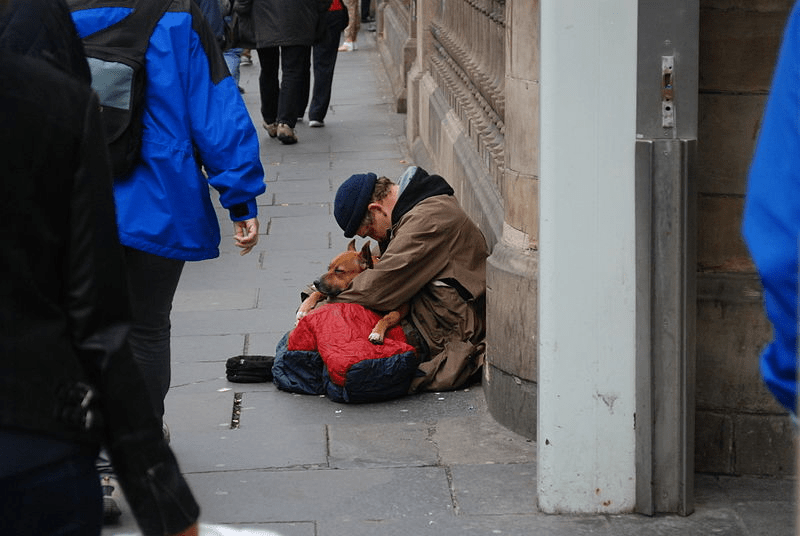
A homeless man sitting hunched over, clutching his dog, on the streets of Edinburgh

Source: Wikimedia Commons

‘In its majestic equality, the law forbids rich and poor alike to sleep under bridges, beg in the streets, and steal loaves of bread.’

– Anatole France, Le Lys Rouge

Human beings are embodied creatures, and as such every aspect of our lives is tied in some way to physical space. Even the most cerebral of our activities, such as thinking, require a physical location where they can take place. Given this fact, it is obvious that the rights we possess as human beings are inextricably linked to some physical space or spaces. In order to have a right there must be a place to exercise that right, and this is true in every instance: without a physical space in which a given right can be exercised, it would be absurd to argue that a person has that right at all. For example, the European Union guarantees the right to free compulsory education: unless member states set up schools offering this service the right is not really guaranteed. It is equally true, however, that the possession of a right does not mean we have the right to exercise that right wherever we like: to limit the exercise of a right to certain physical spaces is not a restriction on that right.

These are, I hope, two wholly uncontroversial points: rights are tied to physical space, and it is not automatically unacceptable to limit certain rights to certain physical locations. However, in this article I want to consider how these aspects of rights can exclude certain people, specifically those who own no private property. Specifically, I want to discuss how public space relates to human dignity, a concept central to both the Universal Declaration of Human Rights and International Covenant on Civil and Political Rights. It seems obvious that basic human activities such as sleeping, bathing, and urinating must be treated as central to human dignity since it is difficult, if not impossible, to retain a sense of dignity without them. Certainly being deprived of the capacity to sleep, bathe, and urinate severely undermines one’s right to dignity.

For the homeless, all of the rights that they possess must be exercisable in public spaces, or else they become contingent on the will of private property owners. For example, let us imagine that the right to free speech was only available on private property, not public space. Since the homeless do not own any property, and those who do can forbid them entrance at will, they could in effect be prevented from ever exercising their right to free speech. Public spaces are the salvation of the homeless when it comes to their rights – if they could not exercise their rights in public spaces, there would be the genuine risk of them not being able to exercise their rights at all. Most private proprietors actively discourage the homeless from entering their property, with many setting up anti-homeless spikes to prevent rough sleepers from using their property as shelter from the elements.

Anti-homeless spikes on a window ledge outside a shop

Source: Wikimedia Commons

However, even in public spaces the homeless are often actively discouraged or outright forbidden from engaging in activities required to lead a dignified life. What this means, in effect, is that they are being deprived of one of the most fundamental rights a person can have. Most of us have no particular issue with a piece of legislation which forbids sleeping, bathing, or urinating in public spaces, and we might even believe that such legislation is a good thing; but we must remember that this is because we are lucky enough to have homes which grant us the unconditional right to sleep and urinate. For the more than 300,000 Britons who lack permanent residence such legislation can have the impact of effectively depriving them of their ability to sleep, or bathe, or urinate.

The number of public toilets in the UK has been steadily and rapidly declining for the last decade, with many areas now having none at all. What’s more, there is no legal requirement for local authorities to provide public toilets: there is nothing to stop this trend from worsening. What all of this amounts to is the removal of a marginalised group’s unconditional right to a basic element of human dignity. The right to urinate or bathe depends on having a space where one is free to urinate or bathe. For most of us this is our home, but for those without a home these rights effectively do not exist – private spaces such as restaurants or bars are often not an option as they will discourage or actively forbid the homeless from entering.

Similarly, sleeping in public has been cracked down on, something much more noticeable as the number of rough sleepers in this country rises. This crackdown is not always as plain as police officers asking homeless people to move: much architecture in public space is now anti-homeless, or “hostile architecture”, designed to prevent people from sleeping there. For example, public benches are frequently now designed in a way that prevents people from being able to lie down comfortably on them.

Depriving people of the right to urinate and sleep are both methods used in torture. The fact that such deprivations are occurring for thousands of citizens on a daily basis reveals a horrific act of negligence on the part of the government. Such negligence arguably qualifies as a failure to meet the article forbidding degrading treatment under the EU Charter of Fundamental Rights. To deprive people of the capacity to sleep, bathe, or urinate undoubtedly undermines their right to dignity, and so for the homeless these are activities which must be exercisable in certain public spaces.

The current state of homelessness in the United Kingdom constitutes not just an economic or social problem but a failure on the part of the government with regard to citizens’ rights to human dignity. While economic and social solutions need to be at the forefront of addressing the issue of homelessness, so too does a consideration of the right to dignity of homeless people. Such consideration demands the creation of public spaces for sleeping and bathing, and the construction of public toilets. These actions will not end the homelessness crisis, nor can they single-handedly make life more liveable for those without permanent residence. Nonetheless, as long as we live in a society in which homelessness occurs, failing to construct and maintain such public spaces means failing to ensure the basic dignity of certain citizens. This is something no government should tolerate.

Pekerja Seks Menghadapi Ketidakamanan Tanpa Backpage

This is a translation of Jessica Craig’s article ‘Sex Workers Face Insecurity in a World Without Backpage.

Pada tanggal 6 April 2018, situs iklan Backpage disita oleh otoritas federal Amerika Serikat. Pemberitahuan dari agensi yang terlibat dalam tindakan bersama terhadap Backpage mengganti link situs dan menghubungkan pengunjung pada informasi mengenai tujuh staf Backpage. Ketujuh antaranya dituduh melakukan pencucian uang dan melanggar Undang-Undang dengan membantu penduduk menjalankan prostitusi. Backpage adalah salah satu dari beberapa situs web mengiklankan pekerjaan seks yang telah ditutup sejak peraturan baru yang bertindak untuk mempersulit perdagangan seks online. Meskipun undang-undang baru ditujukan untuk melindungi korban perdagangan seks, dampaknya sangat besar bagi banyak pekerja seks yang menyetujui penggunaan Backpage dan situs-situs serupa untuk membuat pekerjaan mereka lebih aman.

Situs tersebut mengadakan iklan berharga sekitar $ 7 dan menjadi peluang bagi pekerja seks untuk menyaring calon klien baru. Dengan demikian, Backpage menjadi salah satu situs utama untuk iklan kerja seks di Amerika Serikat dan Kanada, dengan keuntungan situs web melonjak dari $ 11,7 juta pada 2009 menjadi $ 135 juta di 2014.

Penyitaan Backpage adalah hasil Undang-undang Penghentian Perdagangan Seks yang Menghentikan (SESTA) dan Undang-Undang Perdagangan Seks Melawan (FOSTA), yang disetujui oleh Kongres pada 21 Maret. Autoritas menuduh bahwa administrator Backpage menghapus istilah dari iklan yang digunakan oleh pedagang seks anak yang menandai orang yang diiklankan adalah anak di bawah umur. Contohnya adalah dinamakannya salah satu anak ‘Lolita’. Ini memungkinkan iklan korban perdagangan seks anak di situs web dan mencegah aktivitas yang mencurigakan agar tidak diteruskan ke petugas penegak hukum. Para pendukung SESTA dan FOSTA percaya bahwa undang-undang baru akan membantu melindungi anak-anak dan orang dewasa yang dijual ke perbudakan seksual online. Undang-undang ditandatanggani oleh Presiden Trump pada 11 Maret kemarin. Salah satu saksi adalah Yvonne Ambrose, yang putrinya yang berusia 16 tahun, Desiree, dibunuh pada tahun 2016 setelah dijual di Backpage.

Namun, undang-undang baru telah menghasilkan kontroversi karena Bagian 230 dari Undang-undang Kepatutan Komunikasi, yang melindungi administrator situs web dari tanggung jawab atas konten yang diposting oleh pengguna mereka. Tanpa Undang-Undang Kepatutan Komunikasi, situs-situs seperti YouTube dan Reddit kemungkinan akan tidak ada lagi karena mereka akan bertanggung jawab atas konten yang melanggar hukum yang dipasang oleh sebagian kecil pengguna (seperti penyebaran pidato kebencian). Para pendukung Undang-Undang Kepatutan Komunikasi berpendapat bahwa itu tidak dapat dipertahankan untuk platform yang sangat digunakan untuk memoderasi semua konten mereka. Karena implikasinya terhadap kebebasan daring, Asosiasi Internet (yang mewakili raksasa seperti Facebook dan Google) hanya akan mendukung SESTA dan FOSTA setelah tindakannya dengan jelas menyatakan bahwa situs web hanya akan bertanggung jawab jika mereka dengan sengaja menginangi perdagangan seks dan tidak melaporkannya.

Berdampak pada Youtube dan Reddit, SESTA dan FOSTA juga memiliki konsekuensi besar bagi pekerja seks dewasa yang setuju dengan situs seperti Backpage untuk mencari pekerjaan. Ditutupnya Backpage diikuti oleh hilangnya ketidakamanan bisnis dan pekerjaan bagi penggunanya, serta hilangnya kemampuan untuk menyaring klien dan berbagi ‘daftar hitam’.

Setelah SESTA dan FOSTA dijalankan, Craigslist secara sukarela menutup bagian Personalsnya. Beberapa pekerja seks menutup situs web mereka, atau beralih ke bentuk komunikasi yang lebih terenkripsi untuk menghindari tindakan hukum. Situs VerifyHim, yang digunakan oleh pekerja seks untuk berbagi informasi tentang klien potensial, sejak itu menutup forumnya dan menghentikan operasinya.

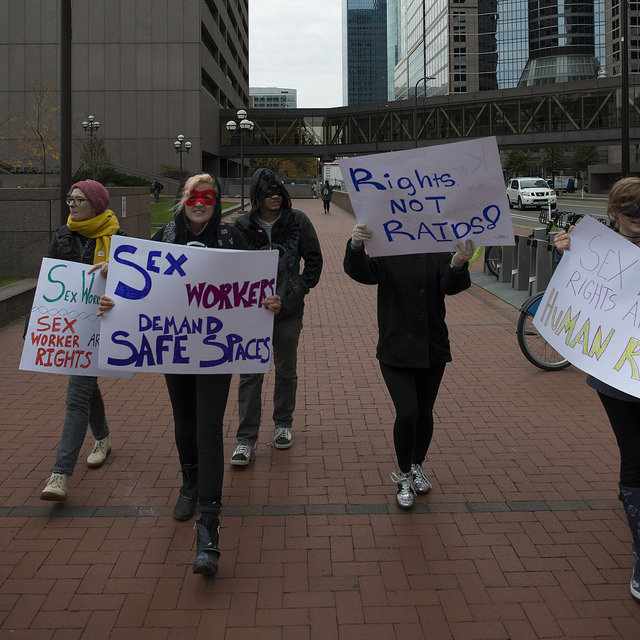
Sex workers' protest in the streets of New York. They are holding banners demanding their rights.

Source: Fibonacci Blue

Banyak pekerja seks sekarang menghadapi prospek untuk terlibat dalam pekerjaan seks – beberapa untuk pertama kalinya. Tanpa kemampuan untuk melindungi keamanan pribadi yang diberikan oleh situs iklan online, banyak pekerja seks akan menghadapi kekerasan dalam pekerjaan mereka. Sebuah penelitian Pusat Keadilan Urban menemukan bahwa 80% pekerja seks yang bekerja di jalan telah mengalami kekerasan.

Selain memfasilitasi kerja seks yang lebih aman, situs-situs yang terpengaruh oleh undang-undang baru telah berkontribusi pada keselamatan masyarakat secara keseluruhan. Para peneliti di Baylor dan Universitas West Virginia mengamati penurunan 17,4% dalam tingkat pembunuhan perempuan-korban antara 2002 dan 2010. Statistik tersebut dapat dikorelasikan dengan peluncuran bagian ‘layanan erotis’ Craigslist di seluruh Amerika.

Kritik SESTA dan FOSTA berpendapat bahwa tindakan tersebut akan gagal untuk mengurangi perdagangan seks online karena tidak adanya platform untuk pekerjaan seks yang lebih aman. Mary Anne Franks, Direktur Kebijakan Inisiatif Hak Sipil Cyber, berpendapat bahwa persyaratan hukum untuk situs web untuk mengetahui tentang aktivitas ilegal yang dapat dikenakan biaya dapat mendorong operator platform untuk berhenti mencari aktivitas ilegal di situs mereka untuk menghindari tanggung jawab. Dia menyarankan bahwa, sebaliknya, Undang-undang Kepatutan Komunikasi seharusnya diperbarui untuk memberi insentif kepada platform utama untuk mengawasi situs mereka dan menghindari kegiatan ilegal. Lebih lanjut, lawan SESTA dan FOSTA menyarankan bahwa iklan korban perdagangan seks dijual secara online akan beroperasi lebih jauh di bawah tanah, sehingga lebih sulit bagi polisi untuk melacak mucikari dan memulihkan korban perdagangan seks.

Percakapan seputar penyitaan Backpage bebericara mengenai masalah lebih besar, yaitu tentang hak pekerja seks. Sementara beberapa bentuk pekerjaan seks adalah legal, prostitusi tetap ilegal di 49 negara bagian AS (dilegalkan di beberapa wilayah Nevada) dan hak-hak pekerja seks telah diabaikan dalam percakapan publik tentang membuat internet lebih aman.

Bagi banyak orang, SESTA dan FOSTA bukan jawaban untuk mengatasi masalah ini. Pengguna Backpage menggunakan mekanisme keamanan penting yang diberikan situs itu untuk menyetujui pekerja seks dewasa sekarang telah hilang. Seorang pekerja seks bernama Sarah memberi tahu The Cut: ‘Halaman belakang tidak mengubah saya menjadi pekerja seks, lebih dari YouTube dapat mengubah orang menjadi musisi atau komedian. Itu hanya mediumnya. Media yang mudah diakses dan gratis.’

Pekerja seks telah menanggapi penutupan Backpage dengan membangun ruang baru untuk terlibat dalam komunitas pekerja seks online, dalam rangka memerangi ancaman yang meningkat keselamatan mereka. Gerai-gerai saat ini termasuk Switter, sebuah ‘ruang sosial pekerja seks yang ramah’ yang didirikan oleh pekerja seks dan mendukung Lola Hunt, dan Red Umbrella Hosting, sebuah situs web hosting untuk para pekerja seks yang didirikan oleh Melissa Mariposa sebagai tanggapan atas SESTA dan FOSTA. Sementara efektivitas SESTA dan FOSTA dalam mengurangi perdagangan seks online harus dievaluasi dari waktu ke waktu, dampak dari tindakan terhadap pekerja seks yang sah telah terjadi dengan dan merugikan. Meskipun demikinan, lebih banyak yang harus dilakukan untuk mengakui hak pekerja seks dan untuk membela keselamatan mereka.

Click on the following link for original article: Sex Workers Face Insecurity in a World Without Backpage

Crystal Mason: A Case Study in Electoral Fraud Sentencing, Voter Suppression and Racism

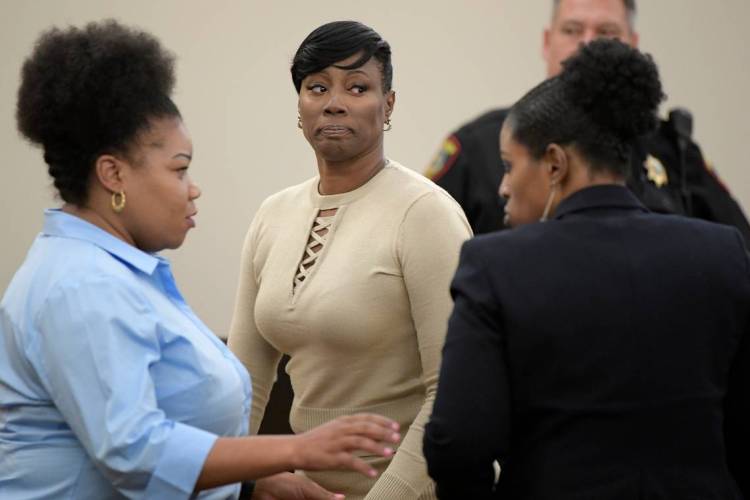
Crystal Mason. Source: Max Faulkner/Fort Worth Star-Telegram

In 2011, Crystal Mason, an Afro-American woman from Fort Worth, Texas, was charged and plead guilty to tax fraud and was sentenced to three years in federal prison. On 8 November 2016, while still on probation, Mason went to her local polling station to vote in the Clinton vs Trump presidential election. On her arrival, and to her surprise, Mason was informed that she was not on the electoral register and following the advice of a poll centre worker cast a ‘provisional ballot pending further checks‘. In March 2017, Mason was handcuffed and held in custody for a night as four months after the fact she discovered the reason for her absence on the register – in Texas, one of the states where ex-convicts can vote, it is a crime to vote while on probation – a fact Mason claims she was not made aware of. In March 2018, Mason was sentenced to five years in prison for her crime of voting. In August of this year, as a result of this conviction, she was also deemed to be in breach of the terms of her parole and sentenced to 10 months in federal prison. On Thursday, 27 September, Mason surrendered to authorities and was taken to federal prison, where she will remain until July 2019 and her 5-year sentence in state prison will commence. Numerous appeals have been rejected and if Mason fulfils this sentence, she will not be released until 2024. A prisoner for casting a provisional vote that was never counted.

While convictions for voter fraud are uncommon in Texas, Crystal Mason’s case is not isolated. Rosa Ortega, another woman of colour who had legally lived in the USA since infancy with permanent right to remain was prosecuted under similar circumstances. Her conviction was because despite her green card status, without citizenship legally she wasn’t eligible to vote. Having voted twice in 2012 and 2014 she was sentenced to two eight-year sentences running concurrently followed by deportation to her native Mexico, despite alleging she was unaware that she couldn’t vote.

Naivety could optimistically suggest that these two cases illustrate the lengths to which Texas, and indeed America, will go to to protect its democratic system, and of course this is important as voter fraud has the potential to pervert democracy. What is striking, and frankly terrifying, about these two cases is the severity to which the Texan justice system has prosecuted and arguably persecuted Mason and Ortega, for a crime which in both cases was feasibly an honest mistake and had no direct benefit to either individual.

To contextualise the severity of these sentences, they can be contrasted to that of Terri Lynn Rote, a white Iowan who was convicted for attempting to vote twice in the 2016 election. For this crime, which she knowingly committed, she has been sentenced two years’ probation and a $750 fine, and assuming she pays the fine, at the end of her probation period her record will be cleared. This disparity between sentences suggests that the severity of Mason and Ortega’s is not purely down to the brutality that voter fraud is dealt with, but to external factors too.

The inconsistency in sentences given by district attorney’s in Texas clarify that the difference in sentencing between Mason and Rote was not solely due to state policy either. In March of this year, Justice of the Peace Russ Cassey, a white conservative, pled guilty to faking signatures in order to gain a position on the election ballot for re-election to his existing role. Where it can be argued Mason had nothing to gain from her crime, Cassey was rigging an election, with the aim to keep his post with a salary of $125,911.76 a year. Where it can be argued Mason had no knowledge she was committing a crime, Cassey not only explicitly broke the law but accused his competitors, Lenny Lopez and Bill Brandt, for the crime he himself committed. And for this abuse of power the same district attorney sentenced Cassey to five years’ probation. Given the disparity in harshness of these sentences, between Mason, Ortega, Rote and Casey, it is clear there is institutional inequality in the American Justice system in relation to electoral fraud, which arguably on multiple levels breaches human rights.

The fact that Mason and Ortega couldn’t vote in the first place is in breach of Article 3 of the First Protocol: the right to free elections. A fundamental human right is that of free expression and in disenfranchising both women Texan law shows institutional disregard of this right. While Mason’s case is not isolated, it is an extreme enough to have caught the attention of numerous news outlets and begs the question to what purpose has Mason been an example? It is argued by many that the recent and brutal recrimination of those who commit electoral fraud, is an act of voter intimidation, in an attempt to alienate the electorate. And indeed, there is evidence it may be working, specifically in Fort Worth where, according to researchers at Portland State University, turnout is 6% on average and for those aged 18-34 turnout is just 1.5%.

Another alarming feature of these convictions and their corresponding felons is race, and the correlation of minority ethnicities and voter suppression. Race discrimination is in clear contradiction with the human rights and while this correlation does not necessarily imply causation, Mason’s lawyer Alison Grinter argues ‘Black people in Fort Worth hear about her case and they understand that they are not welcome in the voting booth‘. Grinter’s claim is not isolated or unfounded either, according to the NPR. In Georgia 53,000 voter registrations were blocked on the grounds the application was not a perfect match to an individual’s ID and has been dubbed ‘disenfranchisement by typo’, and 80% of those were minority ethnicities.

Crystal Mason is a victim of democracy in one of the most developed countries in the world. While her case is symptomatic of a fundamental breach of human rights on multiple levels it is easy to forget that Mason is a human being, who is as I write this in prison and separated from her children. I can only hope that her case is a catalyst for an international demand for change, and not just another symptom of a democracy failing those it is supposed to represent.

Amnesty’s Write for Rights

This week, Amnesty International St Andrews hosted a Write for Rights in support of Vitalina Koval, an LGBTI activist in the Ukraine. In 2017, while taking part in the International Women’s Day March in Ukraine, Vitalina and other protesters were attacked by several young men who threw red paint all over her, causing her to suffer from chemical burns. Though Vitalina informed the police of this hate crime, they did nothing to help her.

Amnesty is calling on the Minister of the Interior, Arsen Avakov, to carry out a proper and impartial investigation of these crimes and to recognise Vitalina’s important contribution to women and LGBTI rights in the Ukraine.

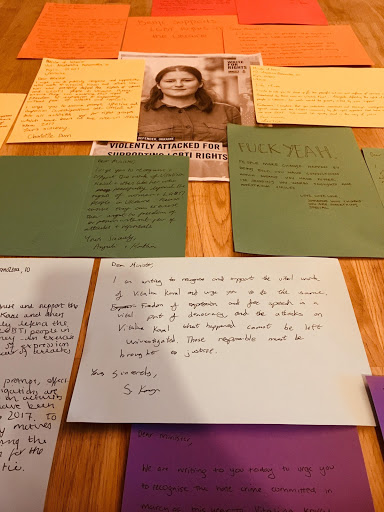
Here in St Andrews, Amnesty asked students to support Vitalina by writing on colourful pieces of paper which, when put together, form the LGBTI flag.

For more information on this case or to sign the petition, visit Amnesty International’s website.

#AmnestyInternational

Amnesty's Write for Rights

This week, Amnesty International St Andrews hosted a Write for Rights in support of Vitalina Koval, an LGBTI activist in the Ukraine. In 2017, while taking part in the International Women’s Day March in Ukraine, Vitalina and other protesters were attacked by several young men who threw red paint all over her, causing her to suffer from chemical burns. Though Vitalina informed the police of this hate crime, they did nothing to help her.

Amnesty is calling on the Minister of the Interior, Arsen Avakov, to carry out a proper and impartial investigation of these crimes and to recognise Vitalina’s important contribution to women and LGBTI rights in the Ukraine.

Here in St Andrews, Amnesty asked students to support Vitalina by writing on colourful pieces of paper which, when put together, form the LGBTI flag.

For more information on this case or to sign the petition, visit Amnesty International’s website.

Equal Rights for Women to Fight

On 25 October 2018, history was made as the final barrier to women in the military service was broken down with the announcement that all roles in the armed forces are open to women recruits in the UK. The defence secretary, Gavin Williamson, announced on the planes of Salisbury (home to the defence training estate) that women in the British Army, Royal Navy and Royal Air Force have the ability to request a transfer to an infantry role as of December this year. New applicants will further be able to apply for infantry roles from 21 December.

Three female soldiers of 2nd Battalion

Three female soldiers of 2nd Battalion. Source: National Army Museum

This reform has been reigned as a victory towards furthering gender equality in one of the most controversial job sectors, expressed eloquently by Williamson himself: ‘I am delighted that for the first time in its history, our armed forces will be determined by ability alone and not gender.‘ After extensive psychical and psychological research investigating the three prominent risks women face in the front-line — musculoskeletal injury, psychological issues and impaired reproductive health — it was determined that women and men would have to pass the same physical examination that requires high levels of stamina, strength, and muscular endurance. Analysts of the defence forces have argued that this ruling has come too late given that women have been performing on the field since the 2016 restriction to women in combat was lifted under the former Defence Secretary, Sir Michael Fallon. Women have reportedly been on the field assisting as pilots, intelligence specialists, medics, drivers in many of Britain’s campaigns in the 21st century, most notably serving in Iraq and Afghanistan. Since November 2016, there have been 35 women in either the serving or training stations for the Royal Armoured Corps, with several already deployed to their new combat roles in Estonia and Oman. Commander Field Army, Lieutenant General Patrick Sanders CBE DSO has also praised this legislative passing as a boost in strength to the armed forces, as he states: ‘Some of the best soldiers and most promising officers I know are women…Simply put the infantry will be more effective in war if we include the best talent our country can breed – male and female.’ Many seniors in the field have hence lauded this move as a strategically empowering decision for both security and equality in opportunity.

The journey for women in the military preceding this article of legislation has, however, come with obstacles. It was only since women were given the right to vote in 1918 that a female mobilised militant organisation was given due recognition. Queen Mary gave her name to the Women’s Auxiliary Corps, formed in World War I, which then gave inspiration to the creation of the Auxiliary Territorial Service, giving members full military status. Whilst women were gaining some momentum to prove themselves capable of military service, systematic oppression of their abilities was still enshrined in legislation, such as in the 1975 Sex Discrimination Act, where continued exclusion of women from combat roles was still allowed. Providing full equality to women to compete with men for the same combat and infantry positions disbands the previous prejudice in British law.

Auxiliary Territorial Service parade at HQ Eastern Command Hounslow

Auxiliary Territorial Service parade at HQ Eastern Command Hounslow. Source: National Army Museum

Unfortunately, it cannot be guaranteed that this law will automatically fix all gender inequality faced in the army from here on out. Such a prominent change to social structure within the army will not come without criticism and scepticism from those currently serving and those examining the legislation. Analysts have conferred that although women can apply to more roles in the military, it won’t translate to a significantly higher uptake of women serving as they are less likely to pass the physical tests than men. Only 1 in 10 people in the armed forces are women, and forecasters predict little change to this number as the tests disadvantage women by 20 to 40 percent. Kate Medina, who formerly served in the Army reserve, highlights the biological difference between men and women, concluding that women are naturally weaker and less capable of front-line combat. She states that women have 2/3 less upper body strength when it comes to hand-on-hand combat, and that they are twice as susceptible to injury. Critics also raise concerns that women on the front-line ruin social cohesion and create tension as it challenges social attitudes of existing infantry soldiers. Colonel Richard Kemp, a retired officer, has expressed that the new law ‘would cost lives and lead to divisiveness‘, slowing down the operation of special armed forces. On the contrary, studies such as the ‘Women in Ground Close Combat 2014’ report have disproved these ideas, concluding that ‘strong leadership’ is the most dependant variable of cohesion, rather than gender ratio.

Ultimately, it is naïve to assume that this new piece of legislation will automatically diminish the enshrined gender bias and inequality faced in the British armed forces. What we can celebrate is that the military has taken a large step towards achieving equal opportunity in its recruiting process, and that capability difference is no longer assumed based on gender. Whilst this move may receive the natural backlash and cynicism any significant socially challenging law will, it resembles a positive and modern day progression towards advancing the professional opportunities of women. It is triumphs such as these that drive all women to fight their own front-lines.

Prisons on the Frontier: China’s Latest Human Rights Crisis

For over two hundred years, the Central Asian Uyghur people have represented one of the earliest and most visible examples of Chinese imperialism. When the Qing dynasty conquered huge swaths of what is now considered northwestern China in the 18th century, they incorporated the traditional Uyghur homeland as the province of ‘Xinjiang’ (New Frontier). Since then, an almost constant tension has existed between the predominantly Muslim Uyghur majority in the region and the Han Chinese central government in Beijing. Several large-scale revolts against Qing rule occurred throughout the Imperial Era and, in the closing days of the Chinese Civil War, an independent republic was briefly created under the banner of the ‘East Turkestan Republic’. However, the arrival of Communist troops into the capital, Urumqi, in late 1949, quickly squashed aspirations for an Uyghur ethnostate. In subsequent decades, Beijing quickly began implementing a strict policy of cultural and ideological assimilation. Massive settlement campaigns encouraged the movement of hundreds of thousands of Han Chinese citizens to the region, and a flurry of administrative and educational reforms sought to rid the Uyghurs of their Muslim faith and traditional Turkic-culture in favor of non-religious Communist ideals and ‘Hanized’ cultural norms. However, these efforts only served to stoke the fires of nationalism among many Uyghurs, and have contributed to the rise of violent and terroristic “patriotic movements” within the province. From 1991 to 2001, the Chinese government has reported over two hundred violent incidents that could be attributed to Uyghur paramilitary independence groups. Militant separatist groups like the “East Turkestan Islamic Movement” have been responsible for car bombings, assassinations, public knife attacks, and the murder of Chinese police officers and soldiers serving in the province. Beijing has responded with several waves of violent crackdowns, as well as the systematic repression of Uyghurs from positions of political and societal authority. Professor James Millward at Georgetown University pointed out in an interview last year that many government positions at every level of the Xinjiang provincial administration require Han ethnicity as a condition for employment, and that Uyghur cultural practices like the required Muslim ‘Hajj’ pilgrimage to Mecca have been severely restricted by authorities.

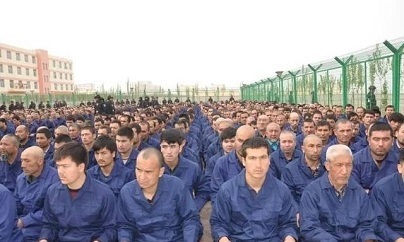
Detainees in a re-education camp, 2017

Detainees in a re-education camp, 2017. Source: Wikipedia


More recently though, it appears that Beijing has escalated the crisis to unprecedented levels. In April 2017, it was reported by several human rights watchdog groups that the Xinjiang provincial government had begun rounding up large numbers of Uyghurs deemed to hold ‘extremist tendencies’, and placing them in so-called ‘Vocational Skill Education Training Centers‘ in order to carry out ‘anti-extremist ideological education’. Independent media outlets have claimed that, in practice, they are little more than political re-education camps. In a report published in late August, the UN Committee on the Elimination of Racial Discrimination claimed that over one million Uyghurs had been forcibly detained and sent to such centers, and expressed alarm at such large numbers of people being ‘held for long periods of time without charge or trial, under the pretext of countering terrorism and religious extremism‘. While the Chinese government originally denied that such centers exist, mounting evidence from international organizations has led to the provincial administration quietly (and retroactively) legalizing the centers for the purpose of ‘psychological and behavioral correction‘. However, official government spokesmen have still maintained that Uyghurs enjoy equal rights and freedoms to all other Chinese citizens and that no religious or cultural suppression has been taking place. Indeed, several informational videos and articles published by the Chinese United Front Work Department showcase happy, contented ‘vocational skills trainees’ in the centers expressing how thankful they are to have been ‘reformed’, as well as their excitement at being able to become productive members of the Chinese nation. However, other former detainees have reported systematic abuse at the hands of camp guards, as well as mass incidents of ‘intensive brainwashing sessions’, which former US ambassador to the UN Nikki Haley has labeled as ‘straight out of George Orwell‘. While the Chinese regime claims they are merely fighting terrorism and religious extremism, many critics have expressed doubts in the efficacy of such an ‘extra-legal’ blanket crackdown. Such critics (like former Ambassador Haley) have claimed that the regime’s strategy may end up being counterproductive, and create ‘the very radicalism they claim to be tamping down’.

Radio Free Asia has reported on one such case, which has the potential to further destabilize the province for the foreseeable future: that of Muhammad Salih Hajim, a prominent Uyghur Islamic scholar who formerly taught out of Urumqi. Hailed by the World Uyghur Congress as ‘one of the most respected and influential Uyghur religious scholars‘, Hajim was arrested for ‘promoting terrorism‘ on 25 December 2017, along with his eldest son and daughter, his daughter’s husband (himself a well known Uyghur poet), and several other members of the extended family. His three youngest children were ostensibly placed in state-run orphanages, but no international observers have been able to locate them to date. Hajim died under mysterious circumstances just forty days later, and Chinese police officials have reportedly informed family friends ‘not to hold out any hope’ for his imprisoned children. Hajim was widely considered to be a moderate cleric, who sought primarily to promote Uyghur religious autonomy and cultural identity. However, his death has sparked calls for more aggressive militant action against the authorities, thereby creating the very radical behavior and threat of violence that Chinese authorities were trying to pre-empt.

Whatever the effect of further Uyghur nationalist action, the re-education campaign has been disastrous for Chinese prestige around the world. Several UN commissions have published reports formally condemning the behavior of the People’s Republic, and governments from the United Kingdom to Iran have been quick to denounce the perceived ethnic and religious suppression of the Uyghur people. However, given China’s place as a permanent member of the UN Security Council, as well as its position as a G7 nation, an outright ultimatum for policy change from the international community is unlikely. For now, all eyes look to the escalating Sino-American trade war, with the thought that any evidence of pervasive human rights abuses will provide Western governments (and particularly the United States) with a major boost in public support for confronting the PRC economically and strategically in East Asia and around the world.

Defying Suppression, One Word at a Time: St Andrews’ Banned Literature Night

Source: Flickr

On the crisp,late-autumn evening of Tuesday 13th November, students gathered in the cosy, lively atmosphere of Aikman’s to listen to and share personal and universal stories condemned to silence around the world. Co-hosted by Amnesty St Andrews, Protocol Magazine and Inklight, the event celebrated banned literature on the theme of forbidden love, countering the tendency to suppress LGBT topics in poetry and prose through the spoken word. The Banned Literature Night raised vital funds for the UK Lesbian & Gay Immigration Group.

Though the mulled wine flowed freely between bottle and glass, the theme of the evening was a sobering one. Scattered across tables and chairs were numerous examples of banned literature, from the explicitly controversial, such as The Catcher in the Rye and The Handmaid’s Tale to the seemingly innocuous, including Harry Potter and the Philosopher’s Stone. Each have been banned from different countries across the world in recent history, outlawed for their potential to promote ‘undesirable’ ideas of various kinds to readers. For instance, in 1999, Harry Potter and the Philosopher’s Stone was banned in the Australia, Canada, and parts of the U.S., primarily because its focus on fantasy, magic and witchcraft was deemed too violent, and a threat to Christian values. But the specific focus of the event was on the theme of forbidden love, particularly in the context of the LGBT community.

The main part of the evening constituted a number of highly thought-provoking, moving readings from a variety of texts on the theme of forbidden LGBT love throughout the world. The readers took us seamlessly across the continents, from Europe and the U.S. to the Middle East, and across to Africa. Writing on the Wall, a poem from Nigeria, was a striking representation of the suppression of LGBT rights and freedoms in a strictly religious country where homosexuality remains illegal and is punishable by imprisonment.

Listening to a reader during the Banned Literature Night in Aikman’s. Source: Amnesty St Andrews

Perhaps the most moving moment of the evening was when speakers chose to read aloud unpublished poetry written by friends about their own experiences of being forced to suppress their sexual orientation for the sake of convention. Both from India, the first poem, Who will take care of you in your old age? expressed a cynical view of modern love and its material and practical focus, which the poet believes detracts from the blossoming of true and genuine romance, in whatever form that may take. Take Me to Church was an incredibly powerful expression of a young Indian woman’s struggle to reconcile her sexuality and the astutely religious nature of her home country. ‘In the beginning was the Word’, she writes, ‘and the Word was love’. Such phrases attest to her own ability to accommodate her sexuality in the context of her personal faith, further highlighting her deep frustrations at the refusal of organised religion to do so. Though the legalisation of sexuality in India in September 2018 has been a late but crucial step forwards, ‘legal’ and ‘acceptable’ are by no means synonymous; legislation marks progress, but cannot be taken as a magic bullet for centuries of entrenched cultural prejudices.

Closer to home, the readings included some historic examples of literature banned in Europe during the 20th century. The Man Condemned to Death by the French writer Jean Genet reflected upon his own experiences of being homosexual, including his imprisonment and life as a vagabond and prostitute in the 1920s. The enforced suppression of his sexuality caused him to experience periods of depression and even drove him to attempt suicide. The fact that suicide is currently the leading cause of death amongst LGBT students, with around 45% having considered suicide, is a stark demonstration that, despite the many years that have passed, these issues have far from disappeared.

Across in Spain, Federico García Lorca’s poem The Little Mute Boy, about a ‘little boy… looking for his voice’ encapsulated the spirit of the evening by tying many themes together in a few short stanzas. It explores the struggle for a child to have his voice heard and, in doing so, touches not only upon the general suppression of freedom of speech in violently nationalist 1930s Spain, but could also be interpreted as an expression of Lorca’s little-known homosexuality. Though his assassination in 1936 by nationalist militia may have silenced him in the prime of his literary career, it was, by then, far too late; he had long since found the voice he’d been searching for.

It would be easy to equate the banning of literature with distant, developing countries or times long since past, when ‘things were different’. Geographical and historical distance can shield against emotions, but when the issues are so current and raw, it is impossible to shy away. Another striking element of the evening was the amount of LGBT literature banned in the U.S. and other ‘westernised’ countries to this day. The reading of Walt Whitman’s A Glimpse, about the quiet contentment of two male lovers, highlights the inherent contradictions embedded within the attitudes of American society. Whitman’s most famous collection of poetry, Leaves of Grass, was banned in the 1880s, with its sensual and homoerotic nature being dubbed as the equivalent of Whitman ‘walking naked through the streets’. Yet, despite these attitudes, Whitman is honoured in the U.S. today as a national literary icon.

Such acts as naming bridges, roads and schools after the iconic homosexual writer may give one the mistaken impression that American attitudes towards homosexuality have changed. However, whilst much progress has undoubtedly been made in the century since then, prejudices towards LGBT literature remain. Just last year, featuring in the top ten of the banned literature list was Tango Makes Three, a short story based on the true events of two male penguins falling in love and raising a chick together at Central Park Zoo. The story is frowned upon for promoting an acceptance of ‘unconventional’ family set-ups, particularly given that it is aimed primarily at children. That such prejudices are still harboured in such highly developed nations in the present day serves as a sobering reminder of the serious and widespread nature of contemporary intolerance of difference, and the need to tackle it at its roots.

Although Tango Makes Three is currently being introduced into schools across the U.K. in an attempt to normalise differences in family composition, and prevent the emotional isolation of the children of same-sex couples, the country can justify no moral high ground from which to frown down upon her neighbours. Thatcher’s ‘Section 28’ amendment of the Local Government Act in 1988 declared that local authorities in the U.K. ‘shall not publish material with the intention of promoting homosexuality’, or ‘promote the teaching in any maintained school of the acceptability of homosexuality as a pretend family relationship’. These measures were nothing short of draconian and, not revoked until 2003, have left in their wake a poisonous legacy of ignorance.

Whilst the censorship of LGBT literature has served as a dominant means through which ‘unconventional’ sexuality has been repressed, it is also the most vital vehicle which can be used to drive out these prejudices. Though one purpose of the literature is to foster a sense of belonging within the LGBT community itself, one does not have to identify as LGBT in order to appreciate the themes explored here. Far from it; literature is designed to place the reader in the context of another’s world, provoking feelings of empathy and tolerance. This is particularly the case since the suppression of love of any kind is a universal theme to which few are unable to relate.

The banned literature night was a moving and memorable evening. Though many readers only put themselves forward on the night, to share whatever they wished to, the geographical diversity of the poetry and prose which emerged was staggering. This is a testament to the fact that, even in an isolated corner of north-eastern Scotland on a chilly November night, the spoken word still resonates just as powerfully as an antidote to the senseless and damaging censorship of literature.

Why We Won’t Stop Fighting: Hope in the Form of Men like Recent Nobel Prize Winner Denis Mukwege

Reasons to keep marching on after the confirmation of Supreme Court Justice Brett Kavanaugh.

Doctor Mukwege, recipient of the Nobel Peace Prize

Doctor Mukwege, a recipient of the Nobel Peace Prize. Source: The Right Livelihood Award

On 6 October 2018, the United States Senate confirmed Brett Kavanaugh to fill the vacant position left on the United States Supreme Court by the retirement of former Justice Anthony Kennedy. This event proved to be heartbreaking for women across America and abroad. Both men and women, from our neighbours to our senators, took to social media to express their grief. Hundreds gathered outside the United States Capitol building to protest the confirmation in person. A group of students at Ithaca College in the New York even gathered to pray for Justice Ruth Bader Ginsburg to live until after President Trump is out of office.

The outcries against Justice Kavanaugh’s confirmation have not come without reason. Three women – Doctor Christine Blasey Ford, Deborah Ramirez, and Julie Swetnick – came forward and accused Justice Kavanaugh of sexual harassment or assault during their high school or college years. Doctor Ford agreed to appear at a hearing before the Senate Judiciary Committee in which she testified bravely against the then-potential confirmation of Kavanaugh. His reactions were nothing short of telling – a speech characterized predominantly by yelling and self-victimizing accusations, suggesting a man who cannot face the truth of his wrongdoings. This is evident in exclamations such as: ‘Since my nomination in July, there has been a frenzy on the left to come up with something, anything, to block my confirmation.‘ Here, Justice Kavanaugh mistakes his own personal karma for an attack orchestrated against him solely for political gains. What he attempts to suppress is that the surfacing of the accusations are simply a case of people fighting for people. In neglecting to own up to his mistakes, Kavanaugh reveals a lack of sympathy and compassion for his victims.

Justice Kavanaugh is not the man for whom my mother, my aunt, and I, as well as hundreds of thousands of other women marched last January. We marched for security and respect, two qualities we very likely may not feel our government represents for as long as he sits on the court.

Kavanaugh on trial in 2018

Kavanaugh on trial, 2018. Source: Vanity Fair

Despite the public disappointment, I do not feel it is time to abandon all hope. Only one day before Kavanaugh’s confirmation, the Nobel Committee announced that Doctor Denis Mukwege would be one of the two Peace Prize recipients for 2018. It is men like Doctor Mukwege who give women of the world reason to keep our heads up.

In 1999, Doctor Mukwege founded Panzi Hospital in Bukavu, Democratic Republic of the Congo, with the original intent to decrease the maternal mortality rates. However, his very first patient came not to deliver a baby, but to receive medical attention after having been brutally raped. Years after the treatment of this patient, the hospital has since become an international foundation that helps rape victims with emotional, physical, and spiritual trauma through a five pillar program. Doctor Mukwege and his team have treated tens of thousands of patients, spanning all ages. Physical and psychological treatment paired with training in skills to improve their socioeconomic status renders the women exponentially more confident and capable when they leave the hospital.

The victims who seek help from the Panzi Hospital are most often survivors of rape by members of both the Congolese militia, and the rebel groups the militia has been fighting since 2003.

Shortly after winning the Sakharov Prize in 2014, Doctor Mukwege was interviewed by Fredrik Skavlan, a Norwegian television talk show host. When asked his thoughts on the practice of rape as a weapon in the Congo conflict, Doctor Mukwege replied that ‘…[it is] a really effective weapon…even more effective than all the classic weapons that we have, because…it is not only to destroy physically, the victim, it’s also to destroy the family, to destroy the community…there is, now, children born after rape who are suffering for what happened to their mother’. Doctor Mukwege later noted, ‘I have seen even husband[s] who are completely destroyed, and they lose all their capacity of masculinity…’

Doctor Mukwege is a completely different, if not the totally opposite type of man from Justice Kavanaugh. His consistently calm disposition and outward compassion are reassuring qualities to witness in the media. He is a man not from whom women would run away, but from whom they can receive consolation and aid following dark, degrading, and terrifying experiences. After being congratulated on winning the Sakharov Prize by Skavlan in the aforementioned interview, Doctor Mukwege replied that he did not wish to receive any more prizes if they only helped his image and not his foundation: ‘If you have a prize who can’t help you to achieve your cause, you don’t need it.‘ Finding sheer selflessness like Doctor Mukwege’s in the world is rare, but coming across it is more than enough to fill one’s heart.

I felt my hope for the future of American politics decline after hearing the news of Justice Kavanaugh’s confirmation. However, after reading about Doctor Mukwege, I felt my chin rise higher than ever before, as I realized that sometimes, all it takes is a little reminder that the world is still full of people just trying to help in any way they can.