The Exploitation and Fetishism of the Black Female Body: How Popular Media Continues Centuries of Ra

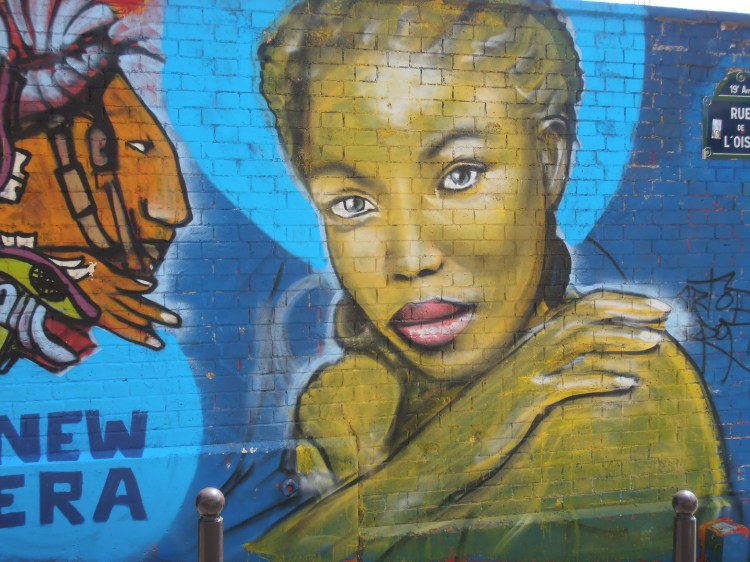
Photo by Jeanne Menjoulet on Flickr

The fetishisation of black women’s bodies is attributed to colonial times when black women were presented as hypersexualised, promiscuous wantons. As explained by Nefertari Bilal, when European colonisers travelled to Africa they met women who, to cope with the hotter climate, wore revealing clothes. Their exposed bodies contradicted the colonisers’ “Eurocentric standard of beauty” and perpetuated the belief that African women were sexually immoral Jezebels. The Jezebel stereotype was used to justify and rationalise the sexual assault of African slaves by their owners as it inferred that black women constantly desired sex and therefore, could not be rape victims. This was perpetuated even by abolitionists such as James Redpath who argued that black women appreciated the “criminal advances of Saxons.”

One woman who suffered in particular from the hyper-sexualisation of black women was Saartjie ‘Sara’ Baartman. Baartman was a Khoikhoi woman sold as a slave when Dutch colonisers invaded her land. Suffering from steatopygia (a genetic condition involving large accumulation of fat on the buttocks and thighs) Baartman was taken to Europe to be exhibited as a freak show attraction. Exhibited in Piccadilly Circus, and later across Paris, as the “wild or savage female” she was displayed in a cage and forced to perform supposedly ‘native’ dances half-naked while people poked her with a stick. Her “notable buttocks and spotty giraffe skin” were a source of fascination for the Europeans and became a symbol of her “uncontrollable sexuality.” She was even studied by naturalist George Cuvier who established her as a “link between animals and humans” and used her to confirm that Africans were an “oversexed” race.

Kim Kardashian’s highly controversial cover of Paper magazine back in 2014 caused outrage as her pose was considered a “not so subtle reincarnation” of Baartman. She was seen to be “endorsing the exploitation and fetishism of the black female body” while ignorantly reinforcing the Jezebel stereotype. This sexualisation of black women is also rampant in music videos. Black women are paraded around as sex symbols, draping themselves over expensive cars or male rappers. Nicki Minaj’s 2014 music video for Anaconda, is a perfect example of this. The video, which revolves around the theme of large bums, was lauded for “asserting her (Minaj’s) power, not as a sexual object but a sexual subject.” However, while some women may want to “reclaim and revise” the image of Jezebel to demonstrate emancipation from colonist interpretations, it is difficult to draw the line between the sex objects and the sexually liberated. Differentiating between women who “freely exploit their sexuality” and “repackaged Jezebels” is a difficult task.

Explained succinctly by Faatimah Solomon, the “fetishisation of black women’s bodies in their music videos translates into their hypersexualisation in the real-world.” In other words, depicting scantily-clad black women twerking for men’s pleasure creates dangerous stereotypes of ordinary black women. Dr Carolyn M. West, an expert on the psychology of women, argues that this Jezebel stereotype is inflicted upon black women even when they are not engaging in sexual behaviour. This perpetuates the idea that a black woman’s body is of more value than any other characteristic; her intelligence, education and professional successes are inconsequential as she is defined primarily by her sexuality.

This is evident in the criticism faced by professional tennis player Serena Williams. Williams has been ranked the No.1 tennis player eight times in her fifteen-year career and, with 39 Grand Slam titles, holds the most titles of any active tennis player. However, her achievements are often overshadowed in the media by criticisms of her body. These range from critiques that she is “too strong” to the assumption that her successes are accredited to the fact that she is “built like a man”:

Source: Twitter

Dr David J Leonard, Professor in the Department of Critical Culture, Gender and Race Studies at Washington State University compiled a list of Tweets and YouTube comments following Williams Wimbledon victory in 2012. These were focused on her sexuality and her resemblance to gorillas, rather than her fifth Wimbledon title.

In another incident, President of the Russian Tennis Federation and member of the International Olympic Committee, Shamil Tarpischev referred to Venus and Serena Williams as the “Williams brothers” on a Russian TV show. Fellow tennis player Caroline Wozniack also stuffed her shorts and bra with padding in reference to Williams during an exhibition match against Maria Sharapova. Described by Yahoo News as “hilarious” and an “uncanny” resemblance to Williams, the incident was discarded as “light-hearted joshing” that should be brushed off by Williams. However, these instances reflect the prejudice faced by Williams not only by strangers on the Internet but by her peers. She is exoticised and sexualised while her physical appearance is the subject of mockery, much like Baartman. These incidents sadly depict how Williams’ achievements continue to remain secondary to her physical appearance.

This issue is compounded by the fact that a women’s sexuality and physical appearance is often the “only popular narrative available for black women.” There is a lack of “positive or realistic images to counter” these interpretations depriving young black women of much-needed role models in popular culture. However, there has been some diversification in the black characters depicted in mainstream media. Take for example the character of Jessica Pearson in legal drama Suits. A high-powered corporate lawyer and Harvard law graduate, Pearson overcame numerous challenges on her path to success and represents the difficulties faced by ambitious black women in environments predominately consisting of white men. These are the types of conversations we need to see more of in films, TV shows and music videos. There needs to be a greater focus on black women’s professional aspirations and academic achievements. This exploitation of their sexuality and the exoctisation of their bodies, which is prevalent in contemporary society, represents a serious and troubling lack of change over four centuries. Furthermore, it is every individual’s responsibility, regardless of gender or race, to be agents for this change.

#womensrights #racism #media #blackwomen #colonialism

The Exploitation and Fetishism of the Black Female Body: How Popular Media Continues Centuries of Racism

Photo by Jeanne Menjoulet on Flickr

The fetishisation of black women’s bodies is attributed to colonial times when black women were presented as hypersexualised, promiscuous wantons. As explained by Nefertari Bilal, when European colonisers travelled to Africa they met women who, to cope with the hotter climate, wore revealing clothes. Their exposed bodies contradicted the colonisers’ “Eurocentric standard of beauty” and perpetuated the belief that African women were sexually immoral Jezebels. The Jezebel stereotype was used to justify and rationalise the sexual assault of African slaves by their owners as it inferred that black women constantly desired sex and therefore, could not be rape victims. This was perpetuated even by abolitionists such as James Redpath who argued that black women appreciated the “criminal advances of Saxons.”

One woman who suffered in particular from the hyper-sexualisation of black women was Saartjie ‘Sara’ Baartman. Baartman was a Khoikhoi woman sold as a slave when Dutch colonisers invaded her land. Suffering from steatopygia (a genetic condition involving large accumulation of fat on the buttocks and thighs) Baartman was taken to Europe to be exhibited as a freak show attraction. Exhibited in Piccadilly Circus, and later across Paris, as the “wild or savage female” she was displayed in a cage and forced to perform supposedly ‘native’ dances half-naked while people poked her with a stick. Her “notable buttocks and spotty giraffe skin” were a source of fascination for the Europeans and became a symbol of her “uncontrollable sexuality.” She was even studied by naturalist George Cuvier who established her as a “link between animals and humans” and used her to confirm that Africans were an “oversexed” race.

Kim Kardashian’s highly controversial cover of Paper magazine back in 2014 caused outrage as her pose was considered a “not so subtle reincarnation” of Baartman. She was seen to be “endorsing the exploitation and fetishism of the black female body” while ignorantly reinforcing the Jezebel stereotype. This sexualisation of black women is also rampant in music videos. Black women are paraded around as sex symbols, draping themselves over expensive cars or male rappers. Nicki Minaj’s 2014 music video for Anaconda, is a perfect example of this. The video, which revolves around the theme of large bums, was lauded for “asserting her (Minaj’s) power, not as a sexual object but a sexual subject.” However, while some women may want to “reclaim and revise” the image of Jezebel to demonstrate emancipation from colonist interpretations, it is difficult to draw the line between the sex objects and the sexually liberated. Differentiating between women who “freely exploit their sexuality” and “repackaged Jezebels” is a difficult task.

Explained succinctly by Faatimah Solomon, the “fetishisation of black women’s bodies in their music videos translates into their hypersexualisation in the real-world.” In other words, depicting scantily-clad black women twerking for men’s pleasure creates dangerous stereotypes of ordinary black women. Dr Carolyn M. West, an expert on the psychology of women, argues that this Jezebel stereotype is inflicted upon black women even when they are not engaging in sexual behaviour. This perpetuates the idea that a black woman’s body is of more value than any other characteristic; her intelligence, education and professional successes are inconsequential as she is defined primarily by her sexuality.

This is evident in the criticism faced by professional tennis player Serena Williams. Williams has been ranked the No.1 tennis player eight times in her fifteen-year career and, with 39 Grand Slam titles, holds the most titles of any active tennis player. However, her achievements are often overshadowed in the media by criticisms of her body. These range from critiques that she is “too strong” to the assumption that her successes are accredited to the fact that she is “built like a man”:

Source: Twitter

Dr David J Leonard, Professor in the Department of Critical Culture, Gender and Race Studies at Washington State University compiled a list of Tweets and YouTube comments following Williams Wimbledon victory in 2012. These were focused on her sexuality and her resemblance to gorillas, rather than her fifth Wimbledon title.

In another incident, President of the Russian Tennis Federation and member of the International Olympic Committee, Shamil Tarpischev referred to Venus and Serena Williams as the “Williams brothers” on a Russian TV show. Fellow tennis player Caroline Wozniack also stuffed her shorts and bra with padding in reference to Williams during an exhibition match against Maria Sharapova. Described by Yahoo News as “hilarious” and an “uncanny” resemblance to Williams, the incident was discarded as “light-hearted joshing” that should be brushed off by Williams. However, these instances reflect the prejudice faced by Williams not only by strangers on the Internet but by her peers. She is exoticised and sexualised while her physical appearance is the subject of mockery, much like Baartman. These incidents sadly depict how Williams’ achievements continue to remain secondary to her physical appearance.

This issue is compounded by the fact that a women’s sexuality and physical appearance is often the “only popular narrative available for black women.” There is a lack of “positive or realistic images to counter” these interpretations depriving young black women of much-needed role models in popular culture. However, there has been some diversification in the black characters depicted in mainstream media. Take for example the character of Jessica Pearson in legal drama Suits. A high-powered corporate lawyer and Harvard law graduate, Pearson overcame numerous challenges on her path to success and represents the difficulties faced by ambitious black women in environments predominately consisting of white men. These are the types of conversations we need to see more of in films, TV shows and music videos. There needs to be a greater focus on black women’s professional aspirations and academic achievements. This exploitation of their sexuality and the exoctisation of their bodies, which is prevalent in contemporary society, represents a serious and troubling lack of change over four centuries. Furthermore, it is every individual’s responsibility, regardless of gender or race, to be agents for this change.

Opinion: A Guide to Boycotting Human Rights Violations

Protests against Nike after a factory collapse in Bangladesh. Image courtesy of Reuters via Business Insider.

Consumer boycotting is one of the most obvious, and perhaps easiest, forms of protest. My introduction to boycotting came early, via my mother, who refuses to buy Nestlé or Nike products and proudly proclaims to have never stepped foot in a Primark. Her grounds for boycotting originate in the Nestlé baby milk scandal and reports of child labour at Nike factories. These companies are not alone, the statement of boycotting is used to protest everything from films due to allegations against cast members, to the country of Israel over the treatment of Palestinians. While the idea and motives behind a boycott are clear, the desired outcomes are not always so easy to make out. When companies like Nestlé and Nike continues to boast multi-billion-pound annual revenue, it has to beg the question: do boycotts work?

What is a boycott?

Boycotting is defined as the conscious withdrawal from commercial or social relations with a country, organization, or person as punishment or protest. Although seemingly varied, boycotts usually fall into two categories; grassroots and professional. The former tends to draw in like-minded consumers, and substantially reducing sales, but the impact often remains short term. Professional boycotts, on the other hand, are methods of powerful actors such as states and multinational corporations implementing economic sanctions, often by a state, which tend to be more effective but are generally more difficult to enact due to the scale of the matter.

The case of Nestlé

The Nestlé boycott following the 1974 report “The Baby Killer” by Mike Miller commissioned by War on Want, is a great example of how the outcome of a boycott is dictated by the methods used in the protest. The report outlined the investigation into the promotion and sale of powdered baby milk in developing countries. Nestlé sales representatives dressed as nurses encouraged the replacement of breast-feeding with Nestlé products in communities who did not have the proper training in using the substitute. As a result of these tactics, infections and malnutrition in children caused several deaths and lead to an international boycott of the brand. Even the United Nations World Health Assembly recommended an “international code of conduct to govern the promotion and sale of breast milk substitutes.” Some activists concluded their boycott when Nestlé claimed to have refined their policy in 1982 through the help of stakeholders including UNICEF. However, others continue to boycott the brand, highlighting the disparities in boycott goals. Where some aim to change policy, others attempt to punishing companies for historic wrong doings.

What makes it effective?

Whether boycotts like the Nestlé example make any impact at all is often not down to the financial pressure they cause but the damage they do to brand reputation. According to Brandon King, IPR associate “The number one predictor of what makes a boycott effective is how much media attention it creates, not how many people sign onto a petition or how many consumers it mobilizes,”, largely because those who boycott a company may not be the target consumers, exemplified by PETA’s boycott of KFC. The Nike Boycott in the 1990’s is an excellent example of a boycott made effective through its damage to a brands reputation. A report in 1991 by Jeff Ballinger exposed the low wages and poor working conditions of workers in the factories Nike subcontracted to make its products, and led to protests at the Barcelona 1992 Olympics, provoking mainstream media attention that carried throughout the 1990’s. This resulted in Nike raising the minimum age of their workers, better monitoring of subcontractors, adoption of clean air strategies in factories, as well as continuing commitment to audits and increasing transparency of policy.

The Nike example goes to show that if you want something, you need to ask for it. Effective campaigns have a clear set of “asks” of the company, provide clear lures to incentivise compliance with demands and threaten punishments if they resist. Ideally the company should be presented with two options; “In one, the brand loses value because it is connected with a problem… In the other, the brand gains value when it is perceived as a leader. Combined with a smart, do-able ask, a brand might be inclined to sign on without the need for a public boycott.”

So should you boycott? My answer is obviously yes. Boycotting is demonstrable way to pressure companies to change business practices that you deem immoral, using the producer consumer dependency to your advantage. It gives you and me a role in nudging the world in the right direction. However for an enduring change it is clear that boycotts can only be one element of a campaign. That is the beauty of boycotts; they cannot be done by one loud voice, because they are the result of the many.

Caught in the Crosshairs

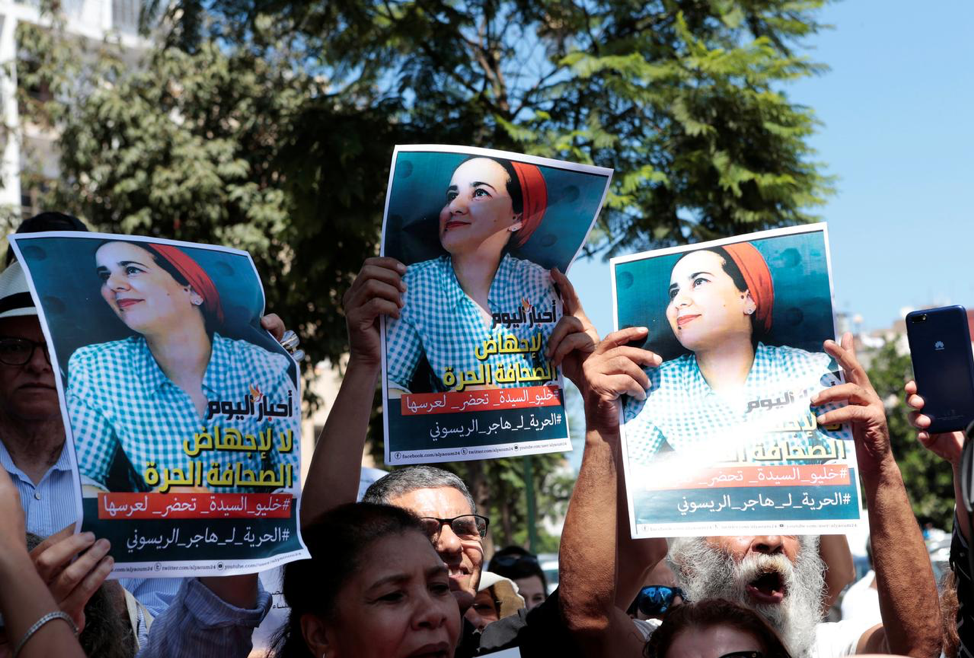
On August 31st, while exiting the office of a Rabati based Gynecologist, Moroccan journalist Hajar Raissouni and her Sudanese fiancé were arrested on the grounds that she had just received an illegal abortion. The pair were subsequently detained at a police station in Morocco’s capital city of Rabat before being brought before a prosecutor on September 2nd. Despite repeatedly denying any such procedure, the 28-year-old journalist was officially charged with “consenting to have an abortion”, as well as pre-marital sex on September 30th. Raissouni was not the only person to face legal punishment. Her fiancé was also charged with having sex out of wedlock, while the staff of the clinic all faced varying punishments for assisting and performing the procedure.

Hajar Raissouni is a journalist for the independent Arabic-language Moroccan daily Akhbar al-Youm. Akhbar al-Youm is one of the few remaining newspapers left in Morocco that is openly critical of the Moroccan government. According to Human Rights Watch, since its first publication in 2009, Akhbar al-Youm has had repeated run-ins with authorities and has faced restrictions on several occasions. This has led many, in the case of Hajar Raissouni, to accuse Moroccan authorities of creating false charges in order to silence the out-spoken journalist.

Women and Men gathered in protest holding Hajar’s photo

Morocco is one of many countries around the world in which abortion is illegal and remains a highly sensitive subject. The country’s penal code makes abortions illegal with few exceptions other than life threatening pregnancies. Additionally, Article 490 of the penal code punishes sex outside of wedlock. Morocco has often been criticized both by its citizens and international groups for maintaining outdated laws surrounding topics of sex and reproductive health. A Muslim nation, Morocco follows the Malaki school of Islamic law which is known for being conservative and makes the topic of legalization controversial. Interestingly enough, other schools of Islamic law, namely the Hanafi and Shafi schools, allow abortions up until the 120th day of pregnancy. Nonetheless, in an effort to relax stipulations against abortion following an investigation by the Moroccan Association for the Fight against Clandestine Abortion (AMLAC), the government updated Article 453 of the penal code to allow abortion for cases of incest, rape, and birth defects.

Moroccan women seeking abortions for reasons outside of medical exemptions are forced to undergo the procedure at clinics that often employ untrained staff. In addition to this, under-the-table abortions in Morocco can cost a woman up to 3,000 Moroccan dirhams, which translates to roughly 300 USD. With many making below 400 USD per month this is a steep cost to incur. While abortions may officially remain illegal, this has not stopped nearly 220,000 Moroccan women from undergoing the procedure per year. A research study conducted by Rabat and Salé estimates that at least 50 illegal abortions are performed every day. Another doctor from a hospital in Rabat’s Les Oranges neighborhood suggests that there are between 600-800 abortions carried out in Morocco each day.

The country’s strict laws around pre-marital sex in combination with the strict abortion protocols has left many women to become single mothers at the mercy of social ostracization. It is estimated that there are about 27,000 single mothers in the kingdom who were abandoned by their partners. Children born outside of wedlock can be denied an identity card, placing limitations on their access to a good future. Additionally, adoption is not a common or widely accepted practice, and often times these children end up in orphanages or forced into poverty.

Morocco’s stance on women’s reproductive health, more specifically abortion, is not unique for the region. Most countries across the Middle East and North Africa (MENA) hold similar if not identical views on the topic. All countries in the MENA region permit the procedure if the mother’s life is in danger, while some allow it if the fetus puts the mother’s mental health at risk, there are fetal impairments, or the pregnancy is a result of rape. Only Tunisia and Turkey allow women to have an abortion on demand during the first trimester. Nonetheless, this does not mean these laws are always put into practice or followed. Cuts to government health expenditures coupled with the resurgence of religiously-oriented political parties target family planning and women’s health services first. In Turkey, it has become increasingly difficult to find public hospitals that will agree to perform abortions, while other hospitals simply refuse.

As mentioned before, Hajar Raissouni’s case has led many to believe her arrest over an alleged abortion is really a cover to silence her work. Human rights groups and Moroccan nationals have expressed their suspicions surrounding the sequence of events which led to her arrest and the evidence presented at her prosecution. Hajar’s uncle, who is the editor-and-chief of the controversial newspaper, has said that his niece has been wrongly convicted and rather she is a political prisoner. The young journalist even wrote a letter from prison which was recently published by Akhbar al-Youm which detailed her questioning during detention. Rather than discussing her alleged abortion, the undercover police who arrested Hajar interrogated her about the newspaper and the high-profile members of her family (her uncles Souliman and Ahmed). Ahmed was the former leader of Morocco’s largest Islamic group- the Party for Unity and Reform. In the letter, Hajar Raissouni says the chargers are fabricated and that she is being targeted for her work with the newspaper where she has repeatedly covered unrest in northern Morocco’s Rif region. A part of the country that has fought famously for many years for independence, sighting cultural and ideological differences from the rest of Morocco on the basis of its Amazigh (Berber) identity.

Rabatis on Mohammed V Avenue in Rabat holding Amazigh flags

The conflation of women’s bodily autonomy and reproductive health with politics is an age-old issue, unique neither to the past, nor the present. Abortion has also recently been used as a tool to curtail political opposition in Turkey. Most recently, Istanbul’s provincial directorate of security demanded names of all the women who had abortions between January 2017 and May 2019 as part of “Terror Investigations.” It was claimed that the information was necessary as part of an ongoing investigation into membership of armed terrorist organizations, bribery, and insulting the president and state elders. Luckily, Turkish Law surrounding information related to health and sexual life protected these women’s identities and prevented the information from being released.

Following Hajar Rassouni’s arrest, there was immediate local and international outcry about the journalist’s situation. Amnesty International Middle East called for her immediate release and for Moroccan authorities to repeal the laws. Throughout late September and early October, Moroccans, specifically young Moroccan women, flocked to facebook to share articles about the journalist’s situations in addition to their sympathies and personal experiences. On October 2nd, a sit-in was held in front of the Moroccan Parliament in Rabat by an association called ‘Collective Assiouar’ to demonstrate against government imposed censorship and the kingdom’s penal codes which curtail the rights of women. A letter of solidarity was also signed by many Moroccan women and individuals of the Moroccan diaspora which was published in the French Daily Le Monde and proclaimed: “We, Moroccan citizens, declare that we are outlaws. We are violating laws that are unfair, obsolete, no longer necessary. We had sex outside marriage. We have undergone, performed, or been accomplices in an abortion.”

As a country that is still reconciling its postcolonial, Muslim, and North African identity, Morocco is caught in the crosshairs of the fight between liberal and conservative ideologies. Although Morocco’s stance on topics related to sexual and reproductive health as well as women’s health is not unique for the region- let alone the world-it seems Morocco is especially full of paradoxes surrounding sex and sexuality. One where Plan B is readily available in pharmacies around the capital city, especially when a foreigner or ex-pat is in search of it, but also one where a Moroccan couple cannot rent a hotel room without presenting a marriage certificate and where gay, trans, and gender-queer individuals are still persecuted and imprisoned. More generally, and possibly more disturbing, is the way in which women’s bodily autonomy and sexuality is used as a weapon to silence dissent and force conformity. While some say patience is key to seeing these changes in Morocco and the Middle East more broadly. It was just last year when new laws were implemented to protect women from domestic violence. However, for Morocco’s women and youth, time is a precious commodity.

Are there Jews being Marginalised in Israel Today?

‘Demonstration of Ethiopian residents in Tel-Aviv’ via Wikimedia.

The main component of Zionism as an ideology is for all Jews to live safely and equally in their ancestral homeland. So, is the current status of Ethiopian Jews in Israel going against Zionism’s main ideological framework, or has the citizen’s rights situation improved?

Ethiopian Jews, also known as Beta Israel, have been settled in the state of Israel for over three decades. Despite a growing population of 150,000 Ethiopian Jews in Israel (with just under a third being born in the state), the community appears to be regularly discriminated against by governmental organisations and has spent the majority of the three decades in the periphery.

In July 2019, Ethiopian Jews rioted in the streets of Haifa and Tel Aviv following the death of Solomon Tekah by an armed police officer. These grievances have become all too regular since the settlement of Ethiopians in the 1980s. Reasons for such outrage include civilian rights factors such as the treatment of the community by the government, as well as police brutality and political and economic discrimination.

Economic discrimination against Ethiopian Jews suggests that the group are marginalised. Previous analysis of 2008–9 government data by the Myers-JDC-Brookdale Institute showed that poverty levels among Ethiopian Israelis were 41%, compared to 15% among the general Jewish population. In 2016, another report showed that “Ethiopian households earned less than the average Israeli household (net NIS 751,15 with compared, net month per NIS 254,11).” Some argue that this situation is the direct result of systematic discriminatory government policies. For example, programmes headed by the Immigrant Absorption and The Ministry of Aliyah have regularly demoted the Ethiopian community to poorer neighbourhoods and treat Ethiopians as immigrants. This is despite the fact that 70% of the community are not ‘new immigrants’, referring to the normal definition of the term by the State of Israel. According to Fidel, the Association for Education and Social Integration of Ethiopian Jews in Israel, “the term reflects the continued segregation of the Ethiopian minority, despite the fact that the majority have been resident in the country for more than 30 years.”

Discrimination is seen in other walks of life too. In education, according to the Jewish Virtual Library, standardized tests show that there are serious gaps between Ethiopian Israelis and the general population, with a rate of matriculation only at 53%. Furthermore, the Taub Centre for Social Policy Studies in Israel did research that highlighted that only 55% of Ethiopian Israelis are credible candidates for matriculation whereas 75% of all other Jewish Israelis are deemed credible. In politics, only seven Ethiopian Israelis have served in the Knesset (Israeli parliament) since 1996, when Adisu Masalla was the first Ethiopian Jew elected for the Labour Party.

All of these issues combine to suggest that there is a citizens rights issue in Israel regarding inequality and discrimination against the Ethiopian Jewish community.

However, within the last decade improvements have been made to the economic, educational and political status of Ethiopian Jews, specifically through governmental legislation and programmes. Since 2000, the employment rate for Ethiopian men has increased from 62% to 80% as well as 37% to 74% for women. For the first time in history, employment figures among Ethiopian Israelis are not disproportionately different, with 81% of Jewish men being employed and 80% being the figure for women. As well as this, Ethiopian Jews employed in janitorial services has dropped to 5% for the first time since the first Ethiopian Jews immigrated to Israel.

Improvements have also been seen in education, with 90% of the youngest generation graduating from high school, thus beginning to match figures seen by the majority of the Jewish population at 93%. As mentioned previously, the rate of matriculation is only at 53%, yet this is a huge increase compared to the first generation of Ethiopian Israelis with matriculation levels for them figuring at 16%. Finally, in politics, a 2005 amendment to the 1959 Public Service Law ordered that Ethiopian Israelis should be adequately represented at all levels of public office. This has been seen in recent times with the first male Ethiopian judge, Bialin Elazar, being appointed to Jerusalem Magistrate’s Court in November 2018. Moreover, in 2013, Prina Tamano Shata was the first female Ethiopian Jew to be voted into the Knesset.

To conclude, despite improvements regarding equality and anti-discriminatory legislation being implemented, figures highlight that there are remaining citizen rights issues for Ethiopian Jews. As we move into the next decade, the question remains whether discrimination against Ethiopian Jews will continue, or will the trend of improving equality remain?

Egypt: A Hidden Uprising

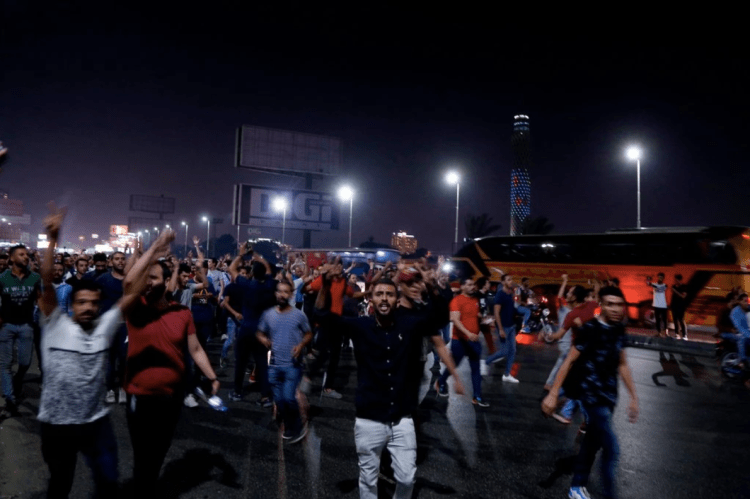
Protesters in Cairo last week called for the removal of President el-Sisi. Getty images.

Currently in their second week of protests, the scattered gatherings in Egypt call for President Abdel Fattah el-Sisi to step down. Though the protests this week were smaller in size and number compared to last week, the demonstrations continue to challenge the authoritarian government.

In a country where the government has imprisoned thousands of political opponents and controls the media, even the smallest of protests represents a shocking challenge to absolute authority.

The protests followed the UN summit, and President el-Sisi seemed unwilling to take chances with Egypt’s recent reputation for peace. The Egyptian government has been swift and decisive in smothering the demonstrations. Tear gas was used to break up rallies. In pursuit of stunting the organization of uprisings, more than 2,000 Egyptians have been arrested in the last two weeks, preventing protest leaders and organizers from continuing to lead. A number of those jailed are still waiting to be released.

The protests spanned several regions, including Warraq in Cairo, the city of Giza and the southern cities of Qus and Qena. The gathering in Giza was reportedly shut down before it reached Giza Square. Tahrir Square in Cairo, the central location for protests leading to the displacement of former President Hosni Mubarak, was closed off by police, preventing the protests from spreading to historically preserved locations.

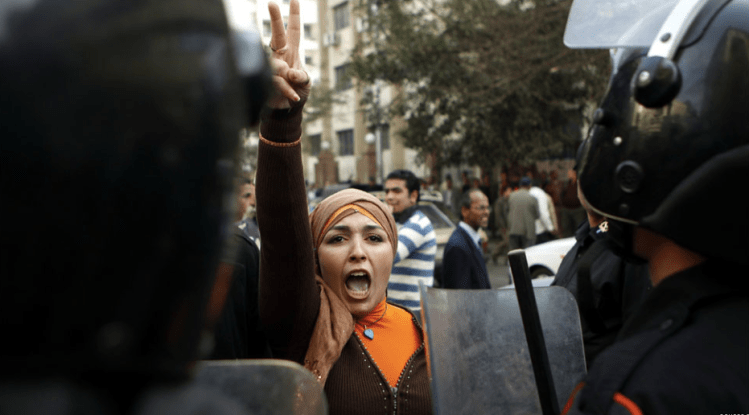
Protesters take to the streets to oppose Mubarak in 2011. Flickr.

Protesters stopped buses and cars at intersections and shut down major streets. Residents joined after leaving mosques for midday prayers, filling the streets with posters, shouting, and marching.

Live Facebook videos were one of the only forms of documentation of the events aside from eye-witness accounts. The crowds reportedly chanted: “No matter how, we’ll bring Sisi down.”

Following the surprising protests last week, the government anticipated and planned for continued protests. They placed numerous police and plain-clothes officers in hot spots to disperse any signs of uprising. Pop-up checkpoints were randomly planted. This caused the protests to adjust by finding new areas, and subsequently losing a portion of participants.

Police guard Ramses Square in Cairo to prevent further protests from gathering. Mohamed Abd El Ghany/ Reuters.

Additionally, President el-Sisi orchestrated a pro-government rally to occur at the same time as the protests, using incentives like a day off work for state employees, and free food to encourage attendance. The counter-protest of more than 1,000 people took place near former president Anwar Sadat’s tomb. At night, the pro-Sisi counter protest became a concert with a stage and crowds chanting: “Long Live Egypt.”

Egyptian media, controlled by the government, condemned the protesters, calling them “forces of evil.” Authorities blocked both external (BBC) and domestic independent forms of media, including Twitter.

Though el-Sisi has been credited with stabilizing a tumultuous country, his policies have left a third of the population in poverty, according to the government’s official statistics. Those protesting were mostly young men with little to lose, creating an uncertain future for the movement.

Despite the unprecedented support for rare protests in Egypt against President el-Sisi, there has been virtually no coverage of the events in Western media.

UN High Commissioner for Human Rights Michelle Bachelet said of the imprisoned protesters: “they have the rights to express their opinions, including on social media. They should never be detained, let alone charged with serious offenses, simply for exercising those rights.”

Opinion: We need to end the cult of Greta Thunberg

Greta Thunberg at the 2019 meeting of the World Economic Forum in Davos, January 25, 2019 Copyright by World Economic Forum / Manuel Lopez via flickr

Last Monday, the 16-year-old Swedish student-turned-climate-activist Greta Thunberg delivered a passionate and pointed speech to the attendees of U.N.’s Climate Action Summit in New York City. She called for action on climate change and expressed her anger with the assembled world leaders, “You are failing us. But the young people are starting to understand your betrayal.” Thunberg’s speech can be seen as her coronation as the preeminent environmental activist of her generation. But is Thunberg the right leader in the fight against climate change?

The story of Greta Thunberg is admirable in every sense of the word. From standing outside the Swedish Parliament alone with a cardboard sign to leading a global march against climate change in over 170 countries, her prowess as an activist is undeniable. The crux of her argument can be found in her igniting speech on Monday; she said, “We are in the beginning of a mass extinction. And all you can talk about is money and fairytales of eternal economic growth. How dare you!”

Additionally, she called for an immediate change in global emissions as well as a rejection of the notion that “business as usual” will lead to anything but destruction and fear. She finished her speech by alluding to the global campaign she has run, saying, “The world is waking up. And change is coming, whether you like it or not.”

The change Thunberg is talking about is a fundamental shift in the way we live our lives in the developed world. It would entail nothing short of a revolution in how we meet our energy needs, how we organise our economies, as well as require reconfiguration of our current political systems that serve the status quo.

That is a tremendously powerful idea. But make no mistake, Thunberg’s calls for immediate action would also entail immediate consequences in the form of mass unemployment in the energy and transportation sector, and above all, it would cause a great deal of social and political unrest. Taken to the logical extent of her argument, if the only way to curb these changes is through a governmental change of society rather than through the process of deliberative democratic government, the government must also change. There is neither time nor space for nuance or deliberation.

Her “all or nothing” approach to the climate crisis may very well convince and activate a base that already sees climate change as a pressing issue, but her militaristic rhetoric may cause further division and ultimately strengthen the belief that the political left’s overemphasis on climate change serves as a detriment to the political system.

The fundamental question about Greta Thunberg is whether she is a symbol of climate activism or an agent in developing solutions to climate change. As a symbol of the climate movement, Thunberg’s rhetoric and aim is unproblematic, but if her goal is to influence and change the status quo, then she has become an agent of change. Her speech at the UN represents her ascension into the role of an agent, and her arguments and aims should therefore meet the same scrutiny as any other head of state, CEO, or NGO. But, critiques of Thunberg have been either lacking or fundamentally cruel, misguided, and infantilising. U.S. President Donald Trump mocked Thunberg after her speech saying that “she seems like a very happy young girl looking forward to a bright and wonderful future. So nice to see!”

So is Thunberg good for the debate on climate change? She has motivated students across the world to partake in her school strikes for climate, even here at the University of St Andrews. Her speeches serve as valuable arenas for educating the public on the reality that is climate change. But however filled with facts her speeches are, they lack policy suggestions on how to implement the reforms needed to actually meet her goals. Of course, it is not expected of a student to reinvent an economic structure that underpins modern life, but her followers in the media pigeonholing any critique of her argument as misogyny or the action of climate deniers is a dangerous notion.

Ultimately, the shunning of debate on the role of Thunberg is a sign that her movement has reached a point where there is an acceptance for authoritarian language on the issue of climate change. To be clear, it is not Thunberg herself that is at fault for causing this situation, but rather the obsession with collectivism on the issue of climate change. When criticism goes unheard, there can be a slippery slope from leading boldly to blindly.

Climate change is undoubtedly a tremendous challenge to mankind in the 21st century and beyond, but cultishly embracing an “all or nothing” attitude on how to solve it will only further entrench viewpoints that so desperately need to be merged in order to reach a sustainable solution. Therefore, there needs to be a more inclusive debate on who should lead and how the necessary changes should be implemented. Only then can a figure like Thunberg rightfully reign on the throne of climate activism.

Hopes Hung by Hunger: Politics and Crisis in Argentina

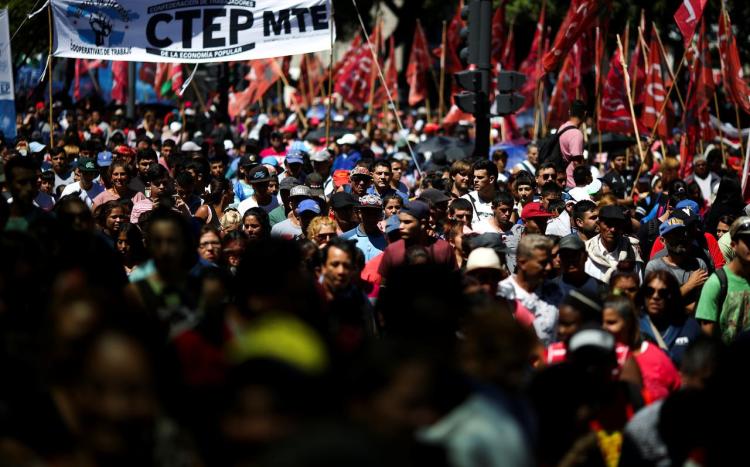
Protestors gather on the streets of Buenos Aires via REUTERS/Agustin Marcarian

Widely regarded as ‘the granary of the world’, Argentina is within the world’s top ten producers for wheat, peanuts, corn, soy, lemons, apples, and pears, amongst others. The country produces enough food for some 440 million people: more than ten times its population figure. How, then, is it possible for several million people in the country to be unable to feed themselves? The answer lies largely in the Argentinian populist-socialist ideology of Peronism, a socio-economic philosophy that the country cannot seem to live with or without.

Juan Domingo Perón’s philosophy of centering government policies around ‘political sovereignty, economic independence and social justice’ have permeated Argentinian politics since his first term in office started in 1946. Though Peronism has been interpreted and practised in a variety of ways throughout the years, it is irrevocably the most prominent left-wing ideology, if not overall the most prominent ideology, to exist in Argentinian politics. However, its popularity on a social level is inversely proportional to its economic success, rendering Argentina a country plagued by crippling debt and inflation, as well as the country with the largest quantity of bail-outs from the International Monetary Fund (IMF), including the $57 billion dollar bail-out that the country applied for only last year (the largest bail-out programme ever launched in the history of the IMF).

The current Argentinian president, Mauricio Macri, may be the first non-Peronist president to finish his term in 70 years. Nevertheless, it is incredibly unlikely that he will win his bid for re-election in October as his time in office has been marked by economic turmoil and crisis which has evolved into strong social unrest in the form of mass protest in the last months. Why are the people protesting? Because they are hungry.

“The reality of the regime’s achievements, however, fall drastically short of all that was promised in 2015 and have resulted in a mounting hunger crisis in the country.”

Macri’s election in 2015 represented a turn away from the financially unsustainable social policies of the Kirchner-Fernandez regimes and towards a free-market and prosperous economy, in theory. The reality of the regime’s achievements, however, fall drastically short of all that was promised in 2015 and have resulted in a mounting hunger crisis in the country. Following the economic crisis of 2018, some 3 million people fell under the line of poverty in the country and one in five people were left unemployed as inflation soared upwards of 50% and the value of the currency crumbled. This has left an estimated 6.7% of the country’s population unable to afford their basic nutritional needs and is the primary reason for the recent protests outside the House of Government (‘La Casa Rosada’) in Buenos Aires.

Pressured by a brutal loss against his Peronist counterpart in the first round of election that took place in August, President Macri and his government found themselves hastily attempting to win back the popular vote by passing increasingly left-leaning policies such as capital controls and extending the Emergency Food Law until 2022. The Emergency Food Law has been in place since the economic crisis of 2002 and was due to expire this year. Initially, the proposal for extension was met with resistance from Macri’s government because it requires them to spend 50% more funds on public provision of food and nutrition but under the pressure of growing protests that have paralysed many major streets of the country’s capital and the likely defeat of Macri’s government against the Peronist coalition in late October, the congress was able to pass the law unanimously in mid-September.

An estimated 2.5–5 million people eat only once a day in Argentina. An estimated 14 million people feel uncertain that they will be able to consistently afford food for themselves or their family. More than 30% of the adult population and more than 50% of the child population live under the poverty line. It is clear that the Macri government’s departure from Peronism has not helped the country move forward and prosper economically, but it is also the burden of the heavily subsidised Peronist policies of previous regimes that have sunk Argentina so deeply into a state of crisis.

Considering the likely victory of Alberto Fernandez, the Peronist left-wing candidate running against President Macri in October, what does this mean for the future of Argentina both economically and socially? It is difficult to forecast a positive outcome in both of these areas. Given the popularity of Peronism in Argentina, it is likely that public opinion of the government will be higher under Mr Fernandez than it has been under Macri.

Economically there is no guarantee that Argentina will be able to lift itself out of this crisis without needing more help from the IMF, defaulting, or implementing subsidies for infrastructure and social programmes that will only propel inflation and diminish investor confidence. Nevertheless, this balance seems to have been the most socially successful one for Argentina since Mr Perón’s first regime, so perhaps giving the people what they want is more important than the financial stability that we, on the outside, are ever so concerned about.

5 Things You Might Not Have Known About Cuba

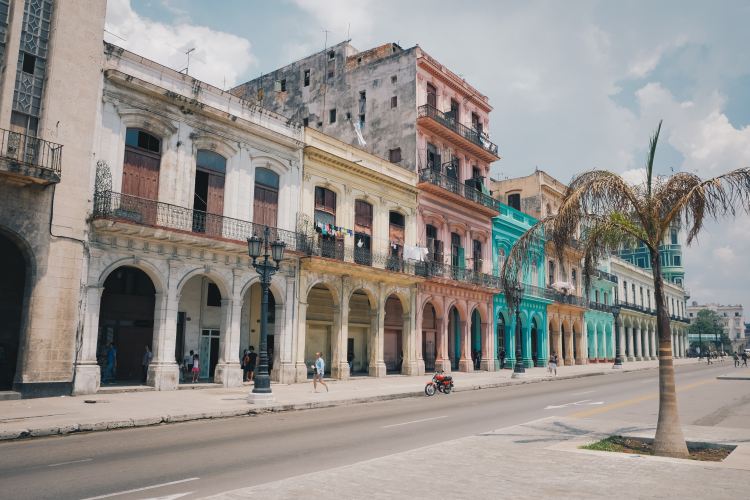
Photo by Emanuel Haas on Unsplash

1. Cuba has two currencies.

These are the CUP (Cuban Peso) and CUC the (Cuban Convertible Peso). Most wages are paid in CUP, while most consumer goods are priced in CUC. Because the CUC is pegged to the US dollar and the CUP is not, this system greatly diminishes the purchasing power of everyday Cubans and highlights inequalities between those who can access CUC and those who cannot.

This arrangement goes back to Fidel Castro’s decision to legalize the use of the dollar in 1993, but only in certain stores that sold luxury items for tourists and wealthy Cubans living abroad. In 2004 the USD was replaced by the CUC – but they’re essentially the same. Now almost all everyday household items are priced in CUC.

2. This year Cubans got 3G for the first time and it has expanded citizens capacity for social action.

Last December, Cubans gained (albeit expensive and slow) access to 3G on their phones. This change has led to an increase in civic engagement on island. In April there was a march to end animal abuse and just one month later a march for LGBT rights. Both were coordinated almost entirely through social media.

The government allowed the animal rights groups to demonstrate, most likely seeing it as an apolitical and non-threatening issue. However, these demonstrations should not be taken for granted. In advocating for ‘non-threatening’ issues, Cuban’s are still developing the mechanisms, knowledge and organization structures of dissidence which could be used later to organize around more traditionally politicized issues.

The government did cancel the LGBT march and of those who showed up anyway, at least 3 activists were arrested and others claimed to have suffered violence at the hands of plainclothes security officers.

Twitter activism has also become a significant dynamic since the 3G plans became more widespread.

These news ways for Cuban citizens to organize and engage in activism enabled by expanded access to the internet is an important dynamic to watch moving forward.

3. Cubans are also part of the northern triangle immigration crisis at the US border.

Many Cubans have made their attempts to move north to the US border, especially dangerous is crossing the River Darien in Panama near the Colombians border. On a visit to the area, an AP reporter recorded over 1000 Haitian and Cuba refugees in the area.

If they make it to the border they no longer have the protections of the Cold War era Wet Feet Dry Feet policy allowing Cubans to become residents after a year in the US, as this was repealed in 2017.

Like all migrants heading north, they are targets of extorsion, sexual assault, violence, human trafficking and are exposed to dangerous environmental circumstances. With the US militarizing the southern border and exacerbating the humanitarian crisis, even arrival in the US means separation from loved ones, detention and deportation.

4. The Cuban government practices short term detention of activists to reduce their effectiveness without drawing attention.

These detentions usually last only a few hours and are not long enough for anyone to really notice or advocate on their behalf. They often occur outside of regular business hours so that the detained person cannot contact a lawyer. They are carried out to reduce the effectiveness of an activist, causing them to miss meetings, demonstrations or flights leaving the country.

5. Cuban doctors are currently deployed all over the world and their salaries make up most of government earnings.

Over 30 000 Cuban Doctors are stationed around the world in over 67 countries practicing medicine contracted out by the Cuban state. Countries will pay the Cuban government directly for their services, making doctors one of Cuba’s most lucrative exports as well as a soft power tool.

The doctors themselves only get a small cut of the money they make and are subjected to sometimes adverse circumstances. In April two Cuban doctors were kidnapped by militant group Al-Shabab while working in Kenya, and still haven’t been returned home.

Because of lingering Cold War logics, the reality of life in Cuba is often obscured, sensationalized or romanticized to serve political perspectives and agendas. It’s important that we, as members of the international community, interrogate the way those narratives and interests shape how we think of Cuba. If you’re interested in learning more, check out these online independent news platforms run by Cuban journalists!

On Cuba News

Diario de Cuba

Revista El Estornudo

El Toque

The Forgotten Lesson of ‘No Place to Hide’

Photo by Daniel von Appen on Unsplash

In the 2014 book No Place to Hide by Glenn Greenwald, the esteemed free-lance journalist recounts his interviews in Hong Kong with the National Security Agency (NSA) whistle-blower Edward Snowden. Based on the data Snowden shared with Greenwald and his colleagues, they exposed the architecture of the post-9/11 US surveillance state. More importantly, they brought attention to the issue of mass surveillance and how the steadfast demolition of individual privacy has quietly become a hallmark of statehood in the digital age. Henry Porter in the Guardian wrote in 2014 that the book was about “…how we let the spies probe our lives with such inadequate controls, and how on earth we fell for the propaganda that this massive apparatus was there to protect, not control, us.”

Greenwald’s first couple of chapters focus on the Stormbrew program in which the U. S. Government has permitted the intelligence agencies to create “corporate partnerships” with large telecom and internet service companies. Although none of the companies are named in Snowden documents, the partnering PRISM program explicitly lists companies such as Apple, Google, Yahoo, Microsoft, and many more, where they have direct access to servers. This not only allows the U. S. and UK Governments to track the data of domestic citizens, but also due to their global customer base they have access to the metadata of a large part of the world’s population. Building on his discussion on NSA programs, Greenwald arrives at the crux of his argument, that “privacy is a core condition of being a free person”. His book is a challenge to every citizen of a democratic state to rid themselves of the norm that “I have nothing to hide”, because it is inherently shunning concerns for individual liberty as a form of deviance.

Five years after the release of Greenwald’s book, it has become clear that the message has fallen on deaf ears. In his 2007 presidential campaign, former President Barack Obama stated that the Bush administration “puts forward a false choice between the liberties we cherish and the security we provide”. Yet Obama failed to address the core issue at hand in the book and in Snowden’s fundamental message. His administration not only aggressively targeted Snowden personally, but it also more importantly expanded many of the programs of the Bush era. When Donald Trump was elected president in 2016, Greenwald wrote in the Washington Post that “by putting a prettier liberal face on these policies, and transforming them from a symbol of GOP radicalism into one of bipartisan security consensus, the president entrenched them as permanent fixtures of the American presidency”.

Greenwald’s work centres on the mass surveillance of the domestic population of American and British citizens, but the most important story within mass surveillance today takes place in China, not the United States. If there was to be any doubt of the power of mass surveillance in the hands of unchecked authority, look no further than China under rule of Xi Jinping. In the past five years, the world’s digital footprint has increased dramatically in both intensity and scope. In the most populous country in the world, Xi Jinping and the Communist Party are using that footprint to govern the lives of their population with a contracting iron fist. In China, dissent and individuality are the enemy of progress and the extent of the Communist Party’s effort to quench it is seemingly boundless. An example of such Orwellian rule can be observed in the city of Kashgar in Xinjiang province where the ethnic minority population of Uighurs are being controlled through facial recognition, cameras, GPS tracking, audio, metadata, and other mechanisms of suppression.

China is changing, and so is the international impact of their domestic surveillance. During the Beijing Olympics in 2008, their awesome surveillance technology was on display for the world to see and it did not go unnoticed. In April, The New York Times showed how the Chinese are selling this equipment as “the future of governance” and have already installed system in Ecuador called ECU-911. This system was largely made by two Chinese companies: the state-controlled C.E.I.E.C. and Huawei.

However, the Ecuadorian system is not the first or the last version of the “exported surveillance state”. According to Freedom House via the New York Times, “18 countries — including Zimbabwe, Uzbekistan, Pakistan, Kenya, the United Arab Emirates and Germany — are using Chinese-made intelligent monitoring systems, and 36 have received training in topics like ‘public opinion guidance’.” What this “new normal” of statehood entails is yet to be known, but Greenwald’s message of mass surveillance as a universal temptation for any unscrupulous power has proven itself alarmingly accurate.